
CME impact forecast early January 20 with G4 – Severe or higher storm risk and aurora as low as California
A G4 – Severe or greater geomagnetic storm is forecast for early January 20, 2026, as a full-halo coronal mass ejection from the January 18 X1.9 solar flare approaches Earth. If G4 conditions materialize, auroral activity is expected to expand significantly equatorward, with visibility possible as far south as Alabama and northern California.

Image credit: ESA, CC BY-SA 3.0 IGO
Modeling and analysis indicate that the CME produced by the long-duration X1.9/3b flare from Active Region 4341 on January 18 is likely to reach Earth early on January 20. The eruption generated a full-halo CME observed in coronagraph imagery shortly after the flare peak, indicating an Earth-directed trajectory.
Space weather forecasts now indicate a high likelihood of severe geomagnetic storming after CME arrival. NOAA’s Space Weather Prediction Center has issued a geomagnetic storm watch predicting G4 – Severe conditions, superseding all prior watches. Weaker storming at G1 – Minor levels is expected to persist into January 21 as CME effects gradually wane and coronal-hole influences resume.
At G4 intensity, geomagnetically induced currents may cause widespread voltage control problems in power transmission systems, with some protective systems potentially tripping out key assets. Satellite systems may experience surface charging, increased drag on low Earth orbit spacecraft, and tracking or orientation difficulties. Satellite navigation systems, including GPS, may be degraded or unavailable for several hours.
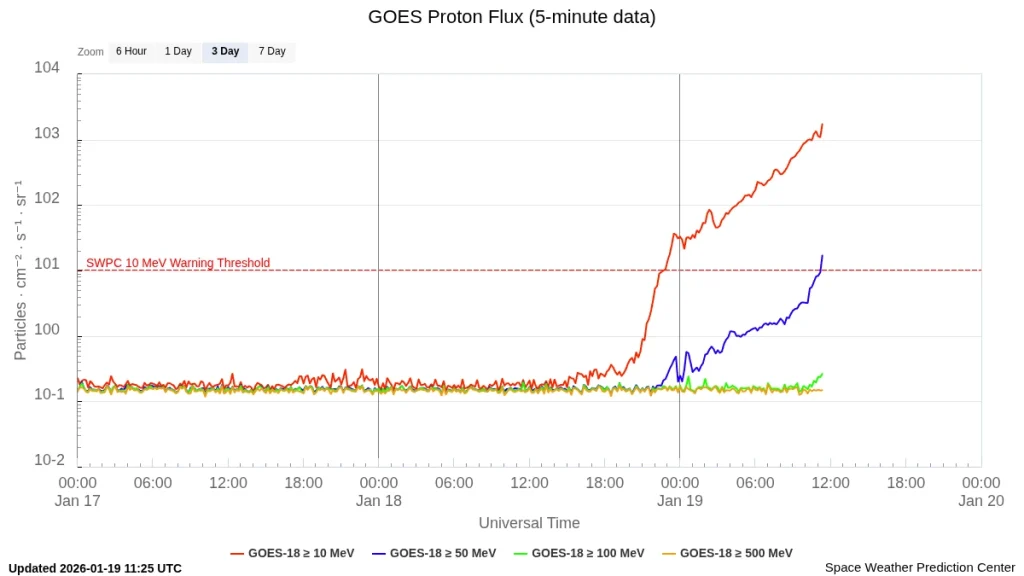
High-frequency radio propagation is expected to become sporadic or completely blacked out at polar latitudes. Aviation operations on polar routes may be affected due to communication disruptions and increased radiation exposure linked to the ongoing S3 – Strong solar radiation storm.
Auroral activity is expected to expand significantly equatorward during peak storming. If G4 conditions materialize, aurora may be visible well beyond typical high-latitude regions, potentially reaching as far south as Alabama and northern California under favorable viewing conditions.
The geomagnetic response will depend strongly on the magnetic structure of the CME upon arrival, particularly the orientation and duration of southward interplanetary magnetic field components. Space weather conditions remain dynamic, and forecasts may be adjusted as upstream solar wind observations become available closer to impact.
Updates
19:34 UTC, January 19
The solar radiation storm increased to the very rare S4 – Severe level at 18:10 UTC on January 19 after ≥10 MeV proton flux exceeded 10 000 pfu, significantly increasing radiation exposure risk for polar aviation, satellite systems, and causing widespread blackout of polar HF radio communications.
An interplanetary shock associated with the CME was detected at the Sun–Earth L1 point at 19:03 UTC, marking the onset of geomagnetic response. G4 – Severe or greater geomagnetic storming is expected.

I'm a dedicated researcher, journalist, and editor at The Watchers. With over 20 years of experience in the media industry, I specialize in hard science news, focusing on extreme weather, seismic and volcanic activity, space weather, and astronomy, including near-Earth objects and planetary defense strategies. You can reach me at teo /at/ watchers.news.

Commenting rules and guidelines
We value the thoughts and opinions of our readers and welcome healthy discussions on our website. In order to maintain a respectful and positive community, we ask that all commenters follow these rules.