
Very rare S4 – Severe solar radiation storm in progress, G4 – Severe geomagnetic storm forecast
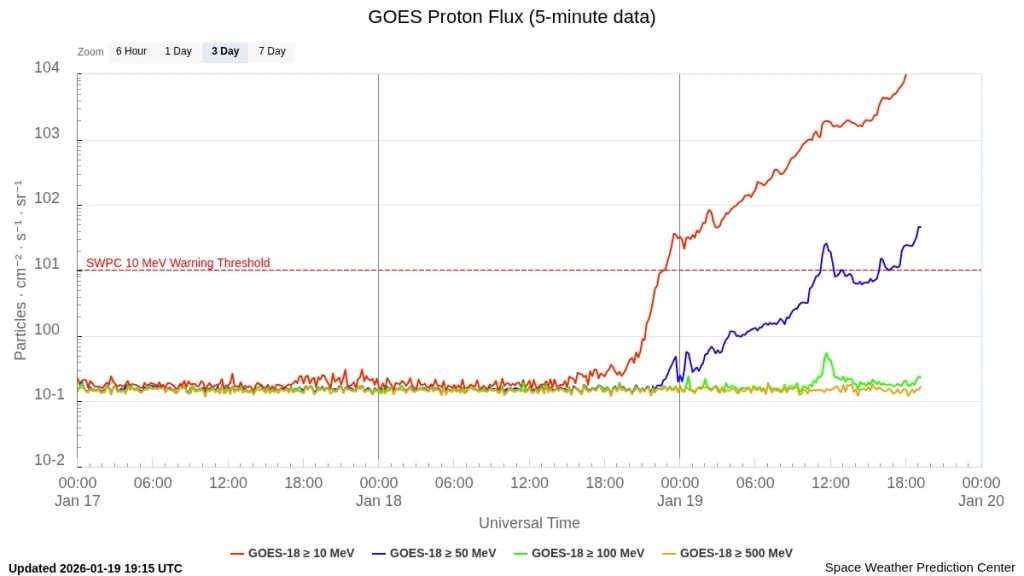
A G4 – Severe solar radiation storm is in progress after ≥10 MeV proton flux exceeded 10 000 pfu at 18:10 UTC on January 19, 2026, following the X1.9 solar flare on January 18. As the associated full-halo coronal mass ejection approaches Earth, forecasters warn that a G4 – Severe geomagnetic storm is likely early on January 20.

Full halo coronal mass ejection (CME) produced by long-duration X1.9 solar flare on January 18, 2026. Credit: NASA SDO, NASA/ESA LASCO, Helioviewer, The Watchers
The solar radiation storm intensified rapidly through January 19, reaching S4 – Severe levels at 18:10 UTC as high-energy proton flux crossed the 10 000 pfu threshold.
The event is associated with a long-duration X1.9/3b solar flare that peaked at 18:09 UTC on January 18. The eruption produced Type II and Type IV radio emissions, a 3 200 sfu F10.7 radio burst with a Castelli-U signature, and a full-halo coronal mass ejection observed shortly after the flare peak, indicating an Earth-directed event capable of sustained particle acceleration.
Proton flux levels began rising late on January 18, initially reaching S1 – Minor storm levels before escalating through S2 – Moderate and S3 – Strong thresholds earlier on January 19. Continued particle injection and efficient shock acceleration drove the event into S4 territory by early evening, confirming a prolonged and energetic solar energetic particle event rather than a short-lived impulsive spike.
Solar radiation storms reaching S4 – Severe intensity are very rare. Such events typically occur only a small number of times per 11-year solar cycle, while in weaker cycles they may be entirely absent. Most proton events peak at S1 or S2 levels, with only a limited subset progressing through S3 and into S4, generally in association with the most energetic solar eruptions and fast, Earth-directed CMEs.
At S4 intensity, significant radiation exposure is possible for passengers and crew on high-latitude, high-altitude flights, and mitigation measures may be required on polar routes. Astronauts conducting extravehicular activities are exposed to unavoidable radiation hazards under these conditions, and EVA operations are typically restricted.
Satellite systems face increased risk, including memory device upsets, increased noise in imaging systems, and disruptions to star trackers that can affect spacecraft orientation and control. Prolonged exposure to high-energy particles may also result in temporary degradation of solar panel efficiency. Widespread blackout of polar high-frequency radio communications is likely during peak radiation storm conditions.


An interplanetary shock associated with the CME was detected by upstream solar wind monitors at the Sun–Earth L1 point at 19:03 UTC on January 19, prompting a geomagnetic sudden impulse warning valid from 19:20 to 20:00 UTC as Earth’s magnetosphere is expected to be compressed.
This marks the initial impact phase of the CME, with forecasts indicating that the main body will arrive early on January 20, likely driving a rapid intensification of geomagnetic activity. A geomagnetic storm watch remains in effect, with G3–G4 storming considered likely and severe G4 conditions forecast depending on the magnetic structure of the CME upon arrival.
At G4 intensity, geomagnetically induced currents may cause widespread voltage control problems in power transmission systems, particularly at high latitudes. Satellite navigation systems may become degraded or unavailable for hours, spacecraft may experience increased drag and orientation issues, and high-frequency radio communications could become sporadic or blacked out across polar regions.
Auroral activity is expected to expand significantly equatorward, with displays potentially visible well into mid-latitudes under favorable conditions.
The combination of an ongoing S4 solar radiation storm and a forecast G4 geomagnetic storm represents a high-impact space weather scenario.

Teo Blašković founded The Watchers in 2011 and edited it until 2026, covering seismic and volcanic activity, extreme weather, space weather and near-Earth objects. Articles on this page are his archive.
Published in the last 24 hours
- Northern lights are possible at high latitudes on November 17 and 18 as NOAA forecasts minor (G1) geomagnetic storms from coronal hole wind
- In February 2022, SpaceX launched 49 Starlink satellites into a solar storm so mild that forecasters rated it minor, and within days 38 of them had fallen back and burned up, because the storm had swollen the thin air they were flying through Epicenter
- On a Friday night in October 1992, a fireball over the eastern US was filmed by fans at high school football games before it punched through the trunk of a teenager’s $400 Chevy Malibu in Peekskill, New York, and she sold the wrecked car for $10,000 Epicenter
- Green Lake, Hawaii's largest freshwater lake, was gone by the afternoon of June 2, 2018, after lava from Kilauea filled its basin. The water was about 20 feet deep, not the 200 feet often claimed. Epicenter
