
Woman killed, homes damaged as heavy rainfall and landslides strike New South Wales, Australia
Heavy rain and severe thunderstorms swept across New South Wales and southeast Queensland between Saturday and Monday, January 17 and 19, 2026, forcing evacuations around Sydney’s Narrabeen Lagoon and causing one death at Macquarie Pass. The storm system brought flash flooding, landslides, and dozens of rescues as the NSW State Emergency Service continued operations across inundated coastal suburbs.
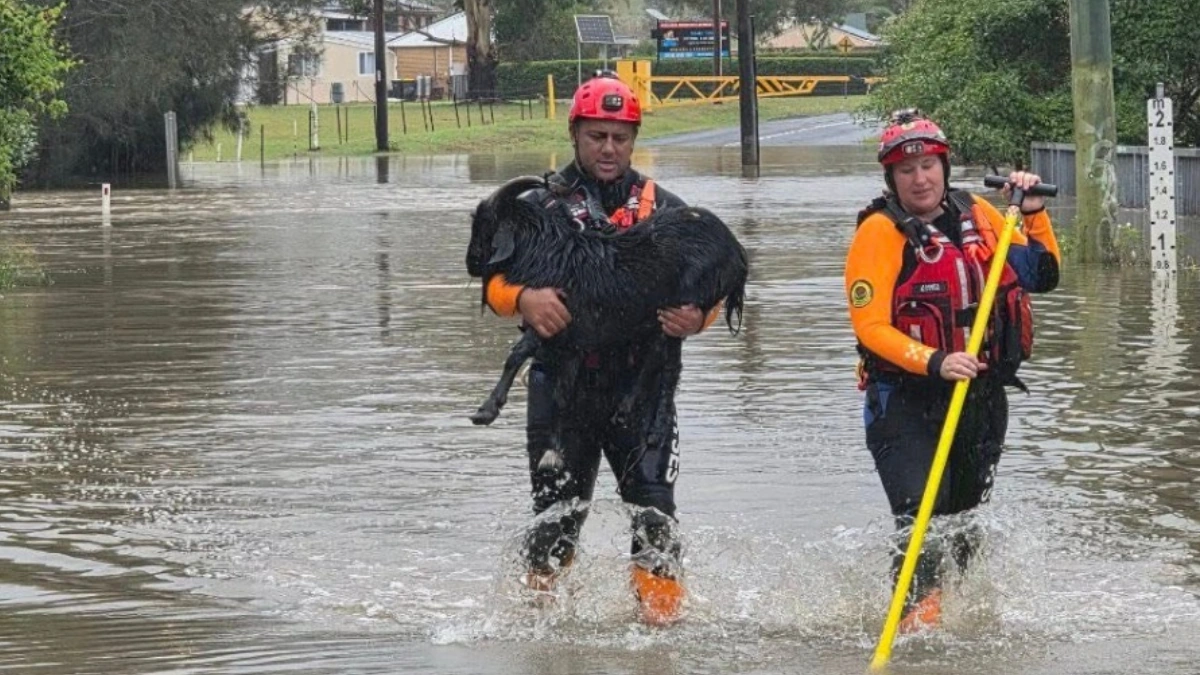
Image credit: NSW SES
Severe thunderstorms moved along Australia’s east coast between Saturday and Monday, bringing heavy rains, flash flooding, and damaging winds to large parts of New South Wales (NSW) and parts of southeast Queensland.
The heaviest rainfall struck Sydney’s northern beaches, where Narrabeen Lagoon overflowed late Saturday, prompting an emergency evacuation order.
Residents and visitors were instructed to move to higher ground as floodwaters rose rapidly through low-lying streets and properties. The NSW State Emergency Service (SES) conducted at least 25 flood rescues and advised that floodwaters would take several days to recede.

In the Illawarra region, a woman died on Saturday when a large tree branch fell onto her vehicle while she was driving at Macquarie Pass, south of Wollongong. NSW Police confirmed she was the driver and that the force’s Crash Investigation Unit is preparing a report for the coroner.
Meanwhile, a man remains missing after falling from a cliff into the sea off the South Coast near Mystery Bay Beach.
A landslide damaged at least three homes, leaving debris scattered across hillside properties at Great Mackerel Beach. One person reportedly sustained minor injuries.
The Bureau of Meteorology (BOM) reported that thunderstorms brought around 60 mm (2.4 inches) of rain in parts of southeast Queensland, while coastal New South Wales experienced locally intense downpours of over 100 mm (4 inches). Forecasters warned that unstable atmospheric conditions could sustain further storms during the week, prolonging flood recovery in several areas.

BOM’s Dean Narramore said the coastal trough that caused the storms stalled over the Central Coast, leading to repeated downfalls.
“That’s why we just had storm after storm going over the same area, dropping 30 to 50mm (1 to 2 inches) each time,” he said.
“After four or five of those, some places racked up to 200mm (8 inches), which has led to quite a bit of flooding.”
Acting Assistant Commissioner Sonya Oyston said conditions were easing in Sydney, but a major clean-up remained.
“Our volunteers and emergency service partners have been out in force today assisting with fallen trees, damaged roofs and skylights, downed powerlines, and helping residents who have had water come into their homes through ceilings, under doorways and from blocked drains,” Ms Oyston said.

At least 1 000 SES volunteers were on the ground on Sunday responding to weekend call-outs, with the busiest units in the south coast, Illawarra, Sydney, and Hunter regions.
By early Sunday afternoon, crews had responded to more than 2 300 incidents, mostly in Sydney and the surrounding area.
Parts of Queensland also experienced significant rainfall, with Port Douglas recording 109 mm (4.2 inches) and the southeast receiving more than 60 mm (2.3 inches). More than 2 500 customers in southeast Queensland were without power on Sunday afternoon.
References:
1 Clean-up begins as deadly, damaging storms move on – The Leader – January 18, 2026
2 Man missing after he ‘tripped’ and fell off Far South Coast cliff – Narooma News – January 19, 2026

Rishav Kothari is Editor-in-Chief of The Watchers, where he runs the newsroom and covers earthquakes, volcanoes, severe weather and space weather.
Published in the last 24 hours
- In September 1859, a solar storm lit up the night sky so brightly that gold miners in the Rocky Mountains woke up after midnight and started cooking breakfast, convinced the aurora glowing over their camp was the sunrise Epicenter
- A patch of warm Pacific water that could become the strongest El Niño in more than 70 years sits thousands of miles from any American town, yet it is already the main reason NOAA expects a wetter winter across the South and a milder one across the North
- A 19-year-old Nebraska teacher reportedly tied her pupils together with twine and led them to safety through a blizzard in January 1888 Epicenter
- NASA built the Opportunity rover to last 90 days on Mars, and Martian winds helped keep it alive for nearly 15 years by blowing dust off its solar panels, until a planet-wide dust storm in 2018 blocked sunlight and silenced the rover Epicenter
