
Long-duration X1.9 solar flare erupts from Region 4341, Earth-directed CME produced
A long-duration X1.9 solar flare erupted from Active Region 4341 at 18:09 UTC on January 18, 2026. The event began at 17:27 and ended at 18:51 UTC. Coronagraph imagery indicates that a full halo coronal mass ejection (CME) was produced during the eruption. Given the location of the source region on the solar disk, the CME is considered likely to be at least partially Earth-directed, pending further analysis of its speed and magnetic structure.
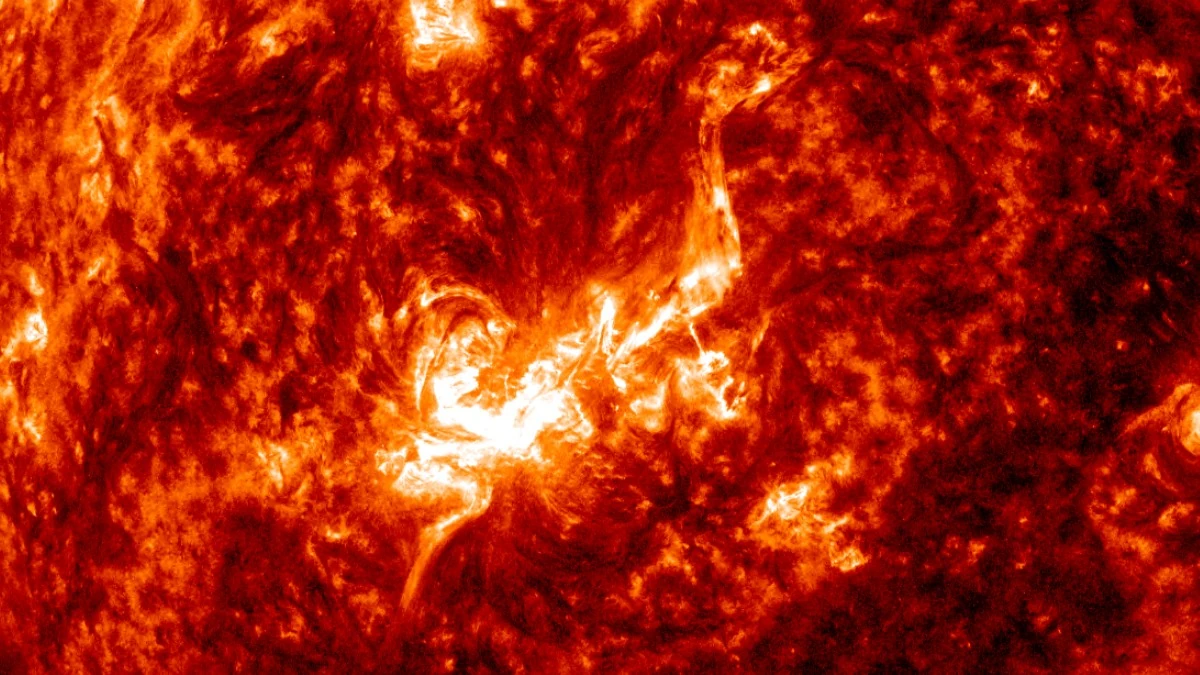
X1.9 solar flare on January 18, 2026. Credit: NASA/SDO AIA 304, The Watchers
A Type II Radio Emission with an estimated velocity of 693 km/s was associated with the event, suggesting a coronal mass ejection (CME) was produced. A Type IV Radio Emission was registered at 18:13 UTC, indicating a strong CME was produced.
Additionally, a 10cm Radio Burst lasting 122 minutes and with a peak flux of 3200 sfu was registered from 17:39 to 19:44 UTC. A 10cm radio burst indicates that the electromagnetic burst associated with a solar flare at the 10cm wavelength was double or greater than the initial 10cm radio background.
This can indicate significant radio noise associated with a solar flare. This noise is generally short-lived but can cause interference for sensitive receivers, including radar, GPS, and satellite communications.
Radio frequencies were forecast to be most degraded over the Pacific Ocean and parts of the Americas.
Region 4341 is in a location that favors Earth-directed CMEs. While a detailed analysis of this event is still in progress, it appears we have a strong CME on the way. Given the long duration of this event, the energy released might produce a strong geomagnetic storm around January 20/21.
The region has a ‘beta-gamma’ magnetic configuration and is capable of producing more strong to major eruptions on the Sun, making Earth-directed solar flares a real possibility through the coming week.


Updates
11:55 UTC, January 19
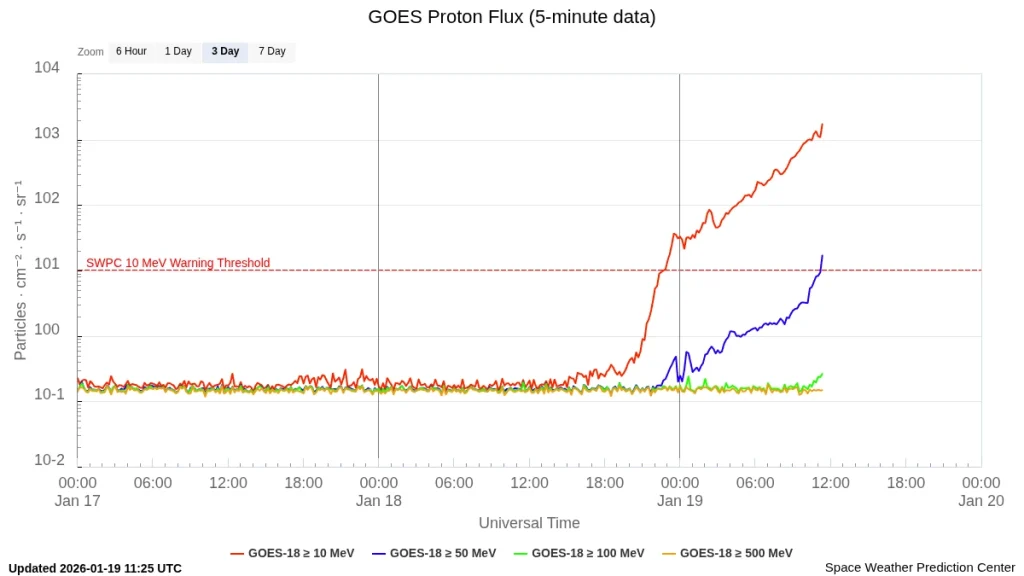
The solar radiation storm intensified further on January 19, reaching S3 – Strong levels after ≥10 MeV proton flux exceeded 1 000 pfu at 10:20 UTC. This marks a significant escalation from earlier S1–S2 conditions following the X1.9 flare on January 18.
Solar radiation storms reaching S3 – Strong levels are relatively uncommon, typically occurring only a few times during an 11-year solar cycle.
At this intensity, increased radiation exposure is possible for high-latitude, high-altitude flights, while satellites may experience single-event upsets, imaging noise, minor efficiency losses in solar panels, and degraded or episodically blacked-out polar HF radio propagation.
15:40 UTC, January 19
Forecasts indicate that the full-halo coronal mass ejection produced by the January 18 X1.9 flare is expected to arrive at Earth early on January 20, with geomagnetic conditions likely to intensify rapidly afterward.
A G4 – Severe or greater geomagnetic storm is now predicted, with potential impacts including power grid disturbances at high latitudes, degraded or unavailable satellite navigation, spacecraft charging and increased drag, widespread HF radio disruptions, and auroral activity expanding well into mid-latitudes, potentially as far south as Alabama and northern California.
19:34 UTC, January 19
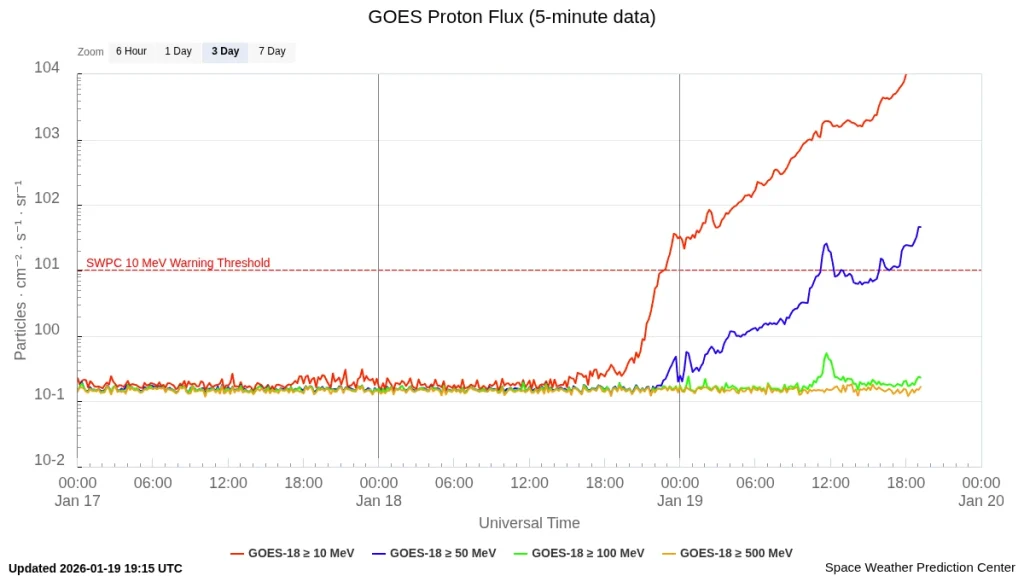
The solar radiation storm increased to the very rare S4 – Severe level at 18:10 UTC on January 19 after ≥10 MeV proton flux exceeded 10 000 pfu, significantly increasing radiation exposure risk for polar aviation, satellite systems, and causing widespread blackout of polar HF radio communications.
An interplanetary shock associated with the CME was detected at the Sun–Earth L1 point at 19:03 UTC, marking the onset of geomagnetic response. G4 – Severe or greater geomagnetic storming is expected.

I'm a dedicated researcher, journalist, and editor at The Watchers. With over 20 years of experience in the media industry, I specialize in hard science news, focusing on extreme weather, seismic and volcanic activity, space weather, and astronomy, including near-Earth objects and planetary defense strategies. You can reach me at teo /at/ watchers.news.

Looks like more earthquakes and floods are going to be happening, be prepared my friends.