
X1.0 solar flare erupts from geoeffective Region 4455
An X1.0 solar flare erupted from Active Region 4455 at 11:28 UTC on June 3, 2026, producing R3 – Strong radio blackout conditions on the sunlit side of Earth. This is the third major flare from the same region today, following M9.3 at 01:36 UTC and M7.7 at 07:00 UTC.
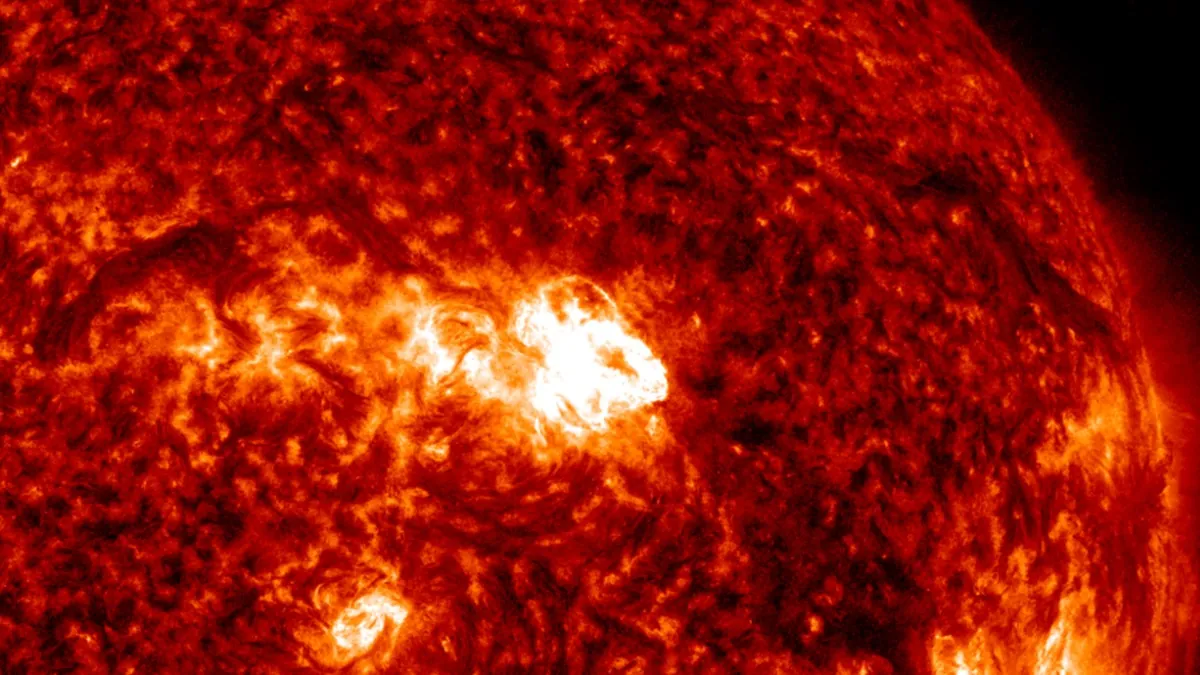
X1.0 solar flare on June 3, 2026. Credit: NASA SDO/AIA 304
A third significant solar flare today erupted from geoeffective Active Region 4455 at 11:28 UTC on June 3, reaching X1.0 and producing an R3 – Strong radio blackout, according to NOAA’s Space Weather Prediction Center (SWPC). The event started at 11:19 UTC and ended at 11:35 UTC.
R3 radio blackouts can affect high-frequency radio communication across large portions of the sunlit side of Earth, with the strongest effects near the sub-solar point. SWPC described the potential impact from this event as a wide-area HF communication blackout lasting about one hour.
The X1.0 flare followed two earlier major eruptions from the same region — an M9.3 flare at 01:36 UTC, and M7.7 at 07:00 UTC. The M9.3 flare was accompanied by a Type IV radio sweep and a 10.7 cm radio burst peaking at 360 sfu. A faint coronal mass ejection became visible in LASCO C2 imagery at about 02:13 UTC.
SWPC forecasters said GOES/SUVI imagery suggested a partial to full halo structure from that eruption. STEREO triangulation indicated an Earth-directed component, but modeling is still underway.
The M7.7 flare produced a stronger 10.7 cm radio burst, peaking at 540 sfu. It was also associated with a Type II radio burst, with an estimated shock velocity of 313 km/s (194 miles/s).
The associated CME appeared in LASCO C2 imagery at about 07:48 UTC. SWPC said most of that eruption may have been deflected northward by a nearby coronal hole, although STEREO triangulation also indicated an Earth-directed component.
The X1.0 flare produced a 10.7 cm radio burst peaking at 250 sfu, lower than the radio bursts observed during the two earlier M-class events. “If a CME is associated with this flare, it should become visible in coronagraph imagery in a few hours,” SWPC forecasters said at 12:30 UTC today.
Region 4455 is a magnetically complex sunspot region, with an anti-Hale configuration, continued flux emergence, mixed polarities, and substantial shear. This magnetic complexity is important because strong flares are produced when stored magnetic energy in active regions is released through magnetic reconnection.
While Earth-directed components had been identified from the M9.3 and M7.7 eruptions, the arrival timing and possible geomagnetic effects are still being modeled.
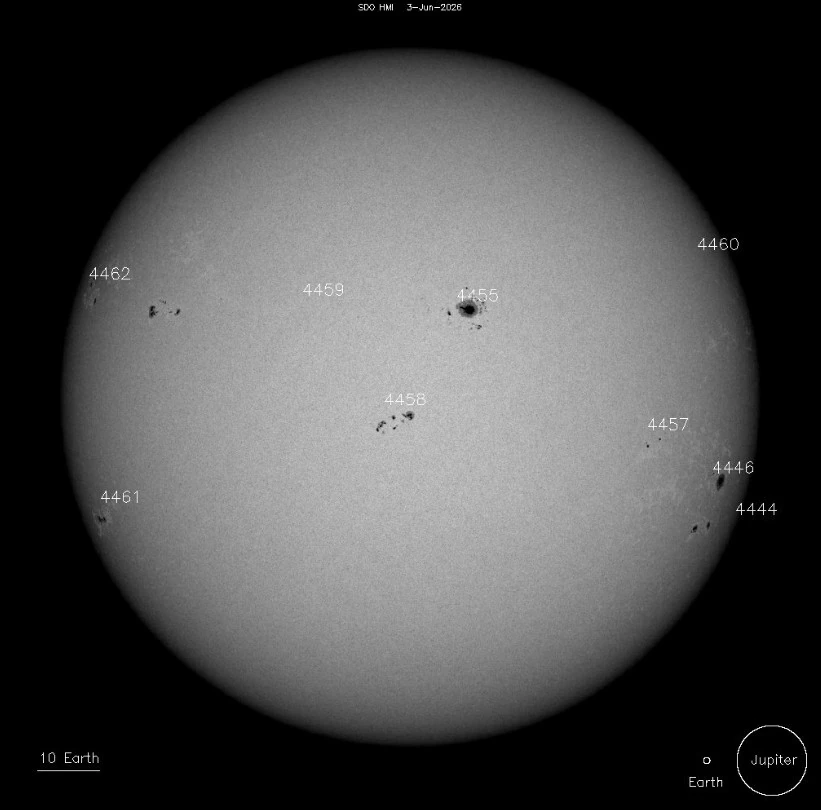
Solar activity is expected to remain at moderate levels through June 5, with M-class flaring likely and a slight chance for additional X-class flaring. The main source regions for additional strong flares are Regions 4455, 4458, 4461, and 4462.
Proton flux remained at background levels over the past 24 hours and is expected to stay there through June 5. The high-level M-class flares were not located in a highly geoeffective position for solar radiation storm events.
References:
1 Forecast Discussion – NOAA/SWPC – June 3, 2026

I'm a dedicated researcher, journalist, and editor at The Watchers. With over 20 years of experience in the media industry, I specialize in hard science news, focusing on extreme weather, seismic and volcanic activity, space weather, and astronomy, including near-Earth objects and planetary defense strategies. You can reach me at teo /at/ watchers.news.

Commenting rules and guidelines
We value the thoughts and opinions of our readers and welcome healthy discussions on our website. In order to maintain a respectful and positive community, we ask that all commenters follow these rules.