
Rare S3 – Strong solar radiation storm in progress after X1.9 flare on January 18
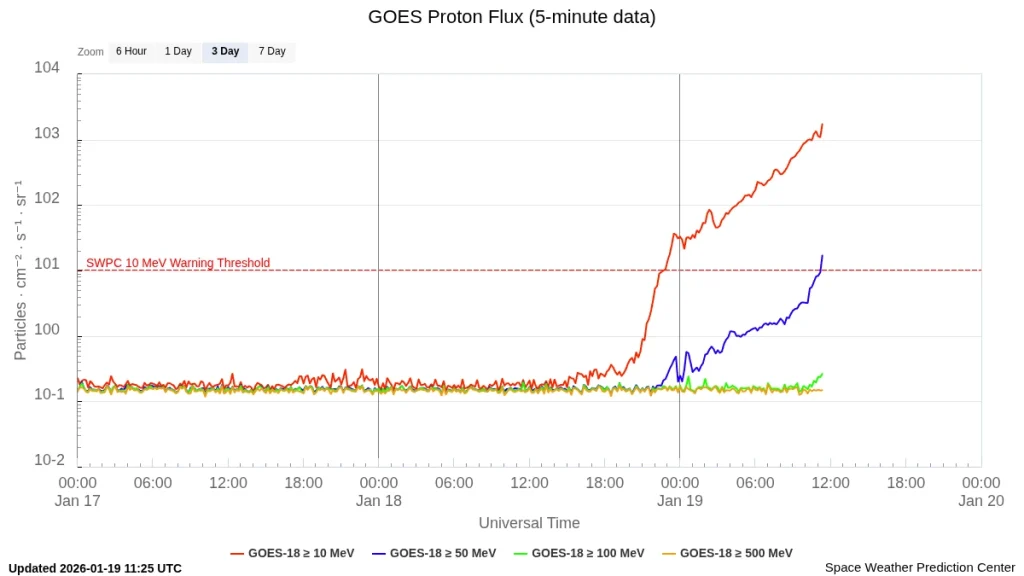
A strong solar radiation storm (S3) is in progress after ≥10 MeV proton flux exceeded 1 000 pfu at 10:20 UTC on January 19, 2026. The event follows an X1.9 solar flare and full-halo coronal mass ejection that erupted on January 18. S3 – Strong solar radiation storms are relatively rare, occurring just a few times in one 11-year solar cycle.

Full halo coronal mass ejection (CME) produced by long-duration X1.9 solar flare on January 18, 2026. Credit: NASA SDO, NASA/ESA LASCO, Helioviewer, The Watchers
Solar radiation storm produced by a long-duration X1.9 solar flare from Active Region 4341 on January 18 reached S3 – Strong levels at 10:20 UTC on January 19 after the ≥10 MeV proton flux exceeded 1 000 pfu.
The flare peaked at 18:09 UTC on January 18 and was accompanied by Type II and Type IV radio emissions, a 3 200 sfu F10.7 radio burst with a Castelli-U signature, and a full-halo coronal mass ejection first observed in coronagraph imagery at approximately 18:30 UTC. The CME is expected to impact Earth on January 20.
Proton flux levels initially crossed the S1 – Minor threshold at 22:55 UTC on January 18, exceeded S2 – Moderate levels early on January 19, and continued rising steadily through the morning hours. At 10:20 UTC, ≥10 MeV protons surpassed 1 000 pfu, triggering an S3 alert issued at 10:29 UTC.
GOES-18 proton data show sustained increases across multiple energy channels, indicating an ongoing and well-developed solar energetic particle event. Elevated ≥50 MeV proton flux has also been observed, confirming the high-energy nature of the storm.
At S3 intensity, increased radiation exposure is possible for passengers and crew on high-latitude, high-altitude flights, while astronauts conducting extravehicular activities are exposed to significantly elevated radiation levels. Satellite systems may experience single-event upsets, noise in imaging sensors, and minor reductions in solar panel efficiency. Polar high-frequency radio propagation may become degraded or experience intermittent blackouts.
Solar radiation storms of S3 – Strong intensity are relatively rare space weather events. Based on long-term NOAA statistics, only a limited number of such storms usually occur during a full 11-year solar cycle, as they require efficient particle acceleration by strong solar eruptions and CME-driven shocks.
The radiation storm continues as the CME propagates through interplanetary space. Additional impacts are possible if enhanced solar wind conditions and southward magnetic field components accompany the CME’s arrival at Earth later on January 19 or January 20.
Further updates will follow as particle flux trends and CME-driven space weather conditions evolve.
Updates
15:40 UTC, January 19
Forecasts indicate that the full-halo coronal mass ejection produced by the January 18 X1.9 flare is expected to arrive at Earth early on January 20, with geomagnetic conditions likely to intensify rapidly afterward.
A G4 – Severe or greater geomagnetic storm is now predicted, with potential impacts including power grid disturbances at high latitudes, degraded or unavailable satellite navigation, spacecraft charging and increased drag, widespread HF radio disruptions, and auroral activity expanding well into mid-latitudes, potentially as far south as Alabama and northern California.
19:34 UTC, January 19
The solar radiation storm increased to the very rare S4 – Severe level at 18:10 UTC on January 19 after ≥10 MeV proton flux exceeded 10 000 pfu, significantly increasing radiation exposure risk for polar aviation, satellite systems, and causing widespread blackout of polar HF radio communications.
An interplanetary shock associated with the CME was detected at the Sun–Earth L1 point at 19:03 UTC, marking the onset of geomagnetic response. G4 – Severe or greater geomagnetic storming is expected.

I'm a dedicated researcher, journalist, and editor at The Watchers. With over 20 years of experience in the media industry, I specialize in hard science news, focusing on extreme weather, seismic and volcanic activity, space weather, and astronomy, including near-Earth objects and planetary defense strategies. You can reach me at teo /at/ watchers.news.

Commenting rules and guidelines
We value the thoughts and opinions of our readers and welcome healthy discussions on our website. In order to maintain a respectful and positive community, we ask that all commenters follow these rules.