
Wave pattern in jet stream drives rare snow event across the Florida Panhandle
Rare snow fell across parts of Florida’s Panhandle early on January 18, 2026, marking the second consecutive winter with measurable snowfall in the state. 2.3 mm (0.09 inches) of snow was recorded at Pensacola International Airport on the morning of January 18.
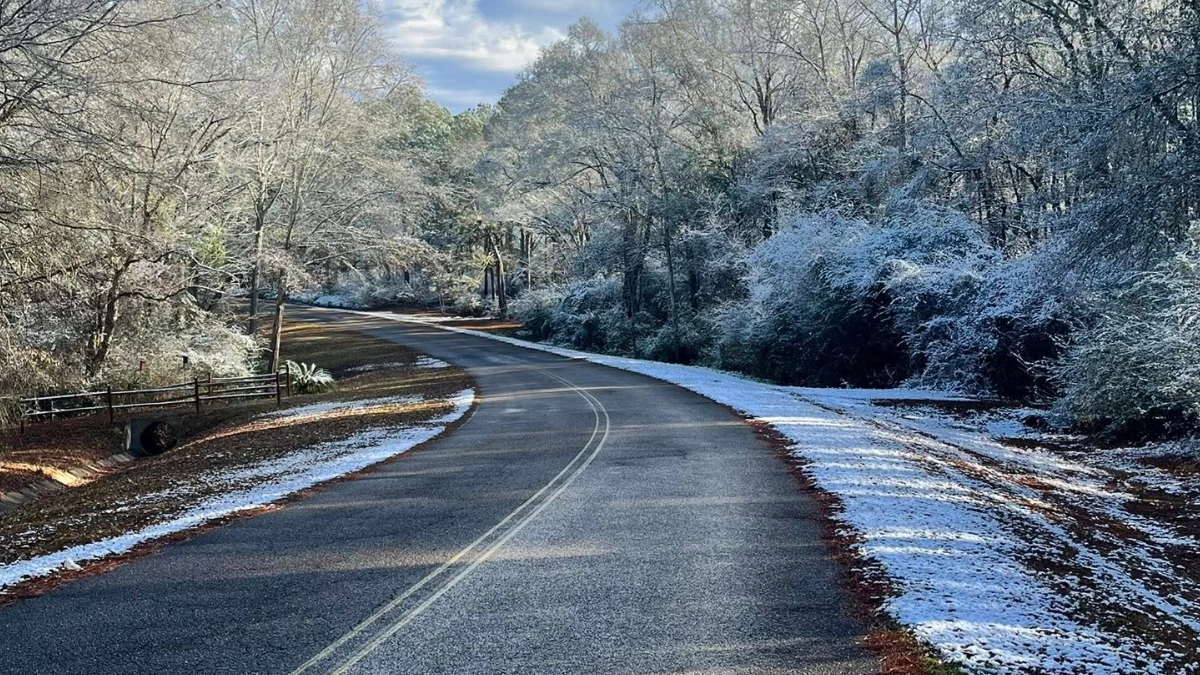
Snowfall at Jackson State Park Alabama on January 18, 2026. Credit: Jackson State Park
Snowfall in Florida is rare due to the state’s humid subtropical and tropical climate, which keeps winter temperatures mostly above freezing.
The light accumulation observed on January 18 mostly affected the Panhandle region, including Pensacola, Walton, Holmes, and Jackson counties. The snow was short-lived, dusting rooftops and grassy areas before dissipating as surface temperatures rose above 0°C (32°F).
Around 2.3 mm (0.09 inches) of snow was measured at Pensacola International Airport during a six-hour period ending at 05:53 local time (LT).
Light flurries were also reported in nearby areas along the Alabama–Florida border. The snowfall resulted from a narrow band of moisture interacting with a deep intrusion of Arctic air moving south behind a strong cold front.
Snow in Pensacola Florida! Jan 18, 2026@NWSMobile @spann @NWSSPC @WKRG @AlanSealls @WEARAllenStrum @NWS @weatherchannel @rzweather pic.twitter.com/InPHP6dFyP
— Deborah Dawkins (@DJDawkins7) January 18, 2026
Consecutive years of measurable snowfall are rare in Florida, with about 52 such events reported since 1900. There are only around 9 such streaks during that period, with the longest streak tied between 1951-55 and 2014-18.
This year’s snowfall followed the record-breaking 2025 Gulf Coast blizzard, which deposited up to 226 mm (8.9 inches) of snow in Pensacola and up to 254 mm (10 inches) in nearby Milton. That storm broke records set in February 1895, when Pensacola measured 76 mm (3 inches).
Other major snow events include the Great Blizzard of 1899, which brought flurries as far south as Fort Myers; the January 1977 event, when snow briefly fell in Miami for the first time on record; and the December 1989 snowfall that covered Jacksonville and Tallahassee.

The snowfall this year was caused by the interaction of strong Arctic air and an active subtropical jet stream extending into the northern Gulf of Mexico.
The jet stream has taken a wave-like shape with the bulge covering the western half of the U.S. while the dip covers the eastern half. This configuration sucked in the Arctic air from Canada through the Midwest into the eastern U.S.
This configuration was also responsible for creating snow squalls in Ohio and Pennsylvania, and blizzard conditions across the Midwest, and brought heavy snow to the Northeast over the last few days.
Read more:
References:
1 Rare Snowfall Dusts Florida Panhandle – Weather.com – January 18, 2026
2 Rare snow falling in Florida as winter storm targets the South with more to come for Georgia, Carolinas – Fox Weather – January 16, 2026

Rishav Kothari is Editor-in-Chief of The Watchers, where he runs the newsroom and covers earthquakes, volcanoes, severe weather and space weather.
Published in the last 24 hours
- High Risk of excessive rainfall covers Florida’s Space Coast as St. Johns River near Cocoa reaches 5.67 m
- Male toads abandoned a pond in Italy five days before a deadly 2009 earthquake, while a scientist was counting them Epicenter
- An asteroid was spotted 19 hours before it exploded over Sudan in 2008, and students picked its pieces off the desert Epicenter
- A wave up to 3 m (10 feet) high rose out of Lake Michigan on a sunny June morning in 1954 and swept fishermen off Chicago’s piers, and when a second came 10 days later, warnings had cleared the shore Epicenter
