
Japan deploys Self-Defense Forces in Aomori for first time in 21 years as record snowfall kills 30
At least 30 people have died across Japan since January 20, 2026, due to record-breaking snow affecting much of the country, with Aomori seeing the heaviest accumulation in 40 years on February 1. The self-defense forces were deployed in Aomori City for the first time in 21 years due to the serious threat to life amid heavy snow.
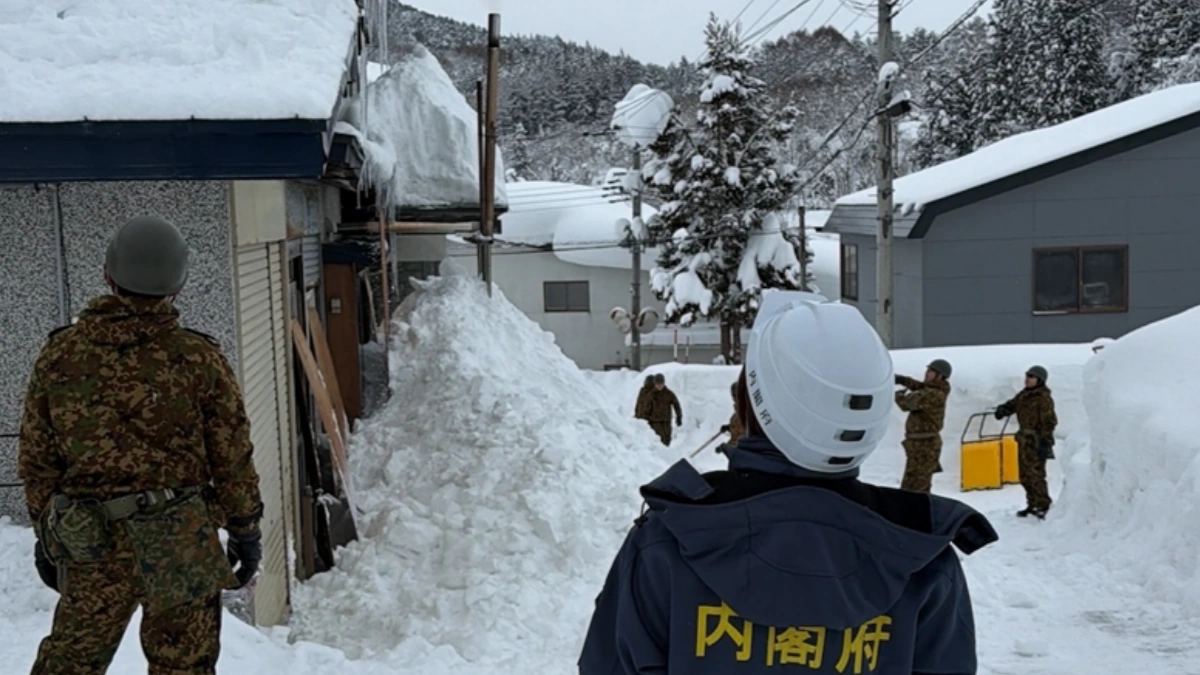
Heavy snow accumulations in Aomori, Japan, on February 3, 2026. Credit: CAO_Bousai
Heavy snowfall across northern and western Japan since last month has produced severe accumulations and widespread disruption.
The Fire and Disaster Management Agency (FDMA) confirmed 30 fatalities and 324 injuries from January 20 to February 3, 2026. Most deaths occurred during snow-clearing work, including falls from roofs and accidents involving snow-removal machinery.
Niigata Prefecture reported the most fatalities, with 12 deaths, followed by Akita with six and Aomori with three. Officials warned that elderly residents are at particular risk during manual clearing and continue to urge the use of safety harnesses and teamwork when removing snow from roofs.
According to the Daisen Police Station, a man was found collapsed on the first-floor roof of a house in Daisen City of Akita Prefecture at approximately 4:30 p.m. on January 31.
Firefighters who arrived at the scene later found a woman buried in the snow. Both were reported dead at the scene.
The victims were a 79-year-old man and his 78-year-old wife, who lived in the house. Their son, who lives separately, visited the home after being unable to contact them and dialed the police after finding his father collapsed on the roof.
Meanwhile, two men were swept into a waterway while clearing snow in a residential area near JR Tokamachi Station in Niigata Prefecture on February 1. According to police, the 74-year-old and 67-year-old men were clearing snow from a vacant house when the accident occurred.
Police and firefighters conducted a search, and the two men were found in a river flowing near the scene.
At least one house was destroyed, while three others were partially destroyed, and eight more were damaged in different parts of northern Japan due to the snow accumulations.
Snow accumulations peaked in Aomori City on February 1, reaching 183 cm (72 inches), over 2.5 times the seasonal average. This broke the 40-year-old record of 181 cm (71.2 inches) set in 1986. It was also the fourth-highest snowfall total on record for the city.
Snow accumulation in the city of Joetsu reached 146 cm (57.5 inches), about 2.4 times the seasonal average. Kazuno, in Akita Prefecture, recorded 142 cm (55.9 inches), approximately three times the average, while Sapporo measured 106 cm (41.7 inches), about 1.6 times the seasonal average, NHK reported.
The heavy snow prompted the deployment of the self-defense forces for the first time in 21 years, following a request from Aomori City. Governor of Aomori Prefecture Miyashita Soichiro formally asked the commander of the Japan Ground Self-Defense Force 9th Division in communication dated February 1 to dispatch troops for disaster relief operations in the city..
“In Aomori Prefecture, the ‘Disaster Relief Act’ has been applied to 21 cities, towns, and villages, and the Self-Defense Forces, having received a disaster dispatch request, are carrying out on-site activities,” said the Cabinet Office for Disaster Management.
Along the Sea of Japan coast, Niigata and the Hokuriku region reported snow depths of over 2 m (6.6 feet) in some towns. In Hokkaido, Sapporo recorded more than 100 cm (40 inches) of accumulation, well above the monthly average. At many stations, January-to-early-February totals were more than twice the long-term mean.
The snowfall was brought by repeated intrusions of cold Arctic air over the Sea of Japan, producing intense sea-effect bands and localized bursts of accumulation. More snow is forecast through the coming days, with additional totals of up to 60–70 cm (23.6–27.6 inches) expected in parts of Niigata, Yamagata, and Fukui prefectures.
Transportation across northern Japan remained heavily disrupted, with sections of the East Japan Railway Company network temporarily suspended and major highways closed due to snowdrifts and low visibility.
Authorities continue to warn of avalanche risk and structural failures from overloaded roofs amid fluctuating temperatures.
Read more:

I am an Assistant Editor and Severe Weather & Science Journalist at The Watchers, specializing in real-time severe weather coverage, geophysical event reporting, and research-driven scientific analysis. You can reach me at rishav(at)watchers(.)news.

Commenting rules and guidelines
We value the thoughts and opinions of our readers and welcome healthy discussions on our website. In order to maintain a respectful and positive community, we ask that all commenters follow these rules.