
X1.5 solar flare erupts from Region 4366, fifth X-class since February 1
An X1.5 solar flare erupted from AR 4366 at 14:08 UTC on February 3, 2026, the fifth X-class event recorded since February 1. The flare caused an R3-level radio blackout over daylight regions of Earth, affecting HF communication across the Atlantic and parts of Europe and Africa.
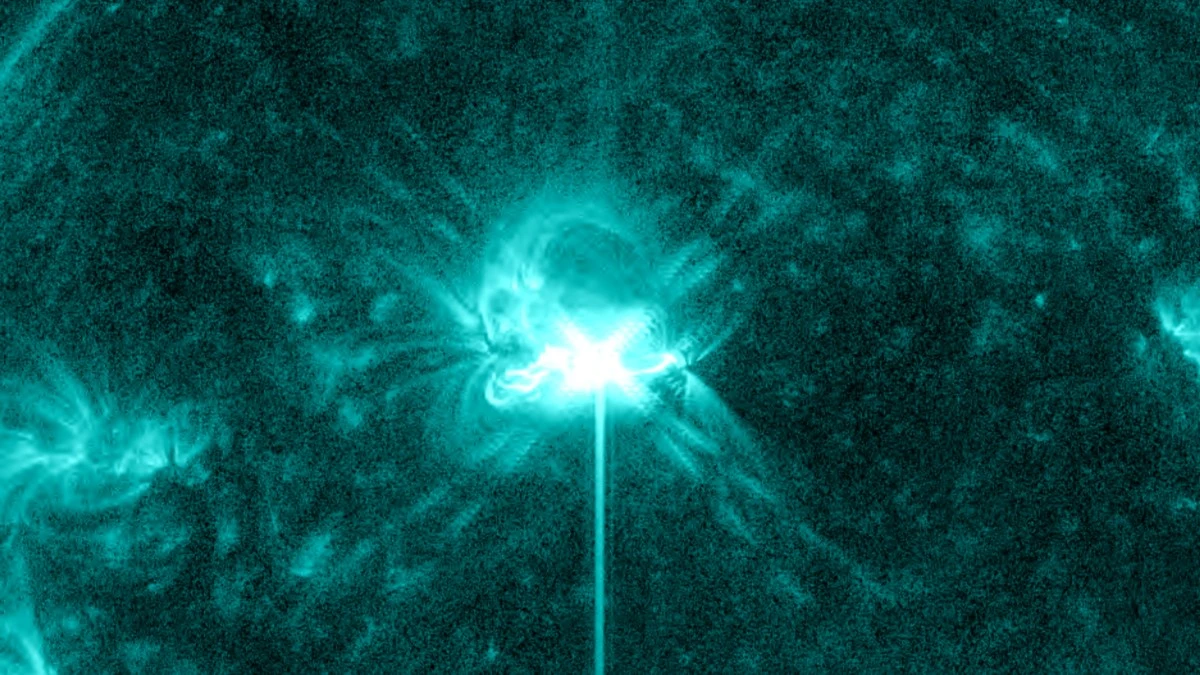
X1.5 solar flare on February 3, 2026. Credit: NASA SDO/AIA 131, The Watchers
An X1.5 solar flare erupted from active region AR 4366, positioned at N14E14, beginning at 13:58 UTC, peaking at 14:08 UTC, and ending at 14:18 UTC on February 3.
There were no confirmed radio signatures detected that would suggest a coronal mass ejection (CME) was produced. Radio frequencies were forecast to be most degraded over the Atlantic Ocean and South America.
This was the fifth X-class solar flare since February 1, continuing a series of major eruptions from the same region. AR 4366 produced X1.0 and X8.1 events on February 1, X2.8 and X1.6 on February 2, and the current X1.5 on February 3. Five high-energy events in less than 60 hours make AR 4366 one of the most active regions of Solar Cycle 25 so far.

Optical and EUV imagery from SDO show AR 4366 as a large, complex ‘beta-gamma-delta’ sunspot group spanning about 730 millionths of the solar disk with 45 visible spots. The region maintains intense magnetic shear and mixed polarities, favoring continued major flare activity as it approaches the central meridian.


A coronal mass ejection (CME) from the X8.1 flare at 23:57 UTC on February 1 is already en route to Earth. SWPC models and independent forecasts indicate its outer edge will glance Earth late on February 5, causing G1 – Minor geomagnetic storm conditions and possible auroral activity poleward of 60° geomagnetic latitude.
Under G1 conditions, minor power-grid fluctuations and auroral visibility in northern U.S. states such as Michigan and Maine are possible.


No significant solar-energetic-particle enhancement has been observed so far; proton flux remains below alert thresholds as of 15:20 UTC.
AR 4366 continues to rotate toward the center of the solar disk, maintaining a favourable position for potential Earth-directed activity in the days ahead.

Teo Blašković founded The Watchers in 2011 and edited it until 2026, covering seismic and volcanic activity, extreme weather, space weather and near-Earth objects. Articles on this page are his archive.
Published in the last 24 hours
- Male toads abandoned a pond in Italy five days before a deadly 2009 earthquake, while a scientist was counting them Epicenter
- An asteroid was spotted 19 hours before it exploded over Sudan in 2008, and students picked its pieces off the desert Epicenter
- A wave up to 3 m (10 feet) high rose out of Lake Michigan on a sunny June morning in 1954 and swept fishermen off Chicago’s piers, and when a second came 10 days later, warnings had cleared the shore Epicenter
- Just 12 inches of rushing water can carry away most cars, and more than half of US flood drownings happen to people who drive into flood water Epicenter
