
Haze from Indonesia’s fires was like smoking 23 cigarettes a day at its worst in one Malaysian district, an MP told parliament
Transboundary smoke from fires across Kalimantan reached Malaysia during the September 2026 haze episode, while Serian in Sarawak crossed Malaysia’s emergency Air Pollutant Index threshold on September 4. Bandar Kuching MP Dr Kelvin Yii later told parliament that exposure at the worst point was roughly equivalent in health-risk terms to smoking 23 cigarettes in a day, citing Berkeley Earth’s PM2.5 comparison.
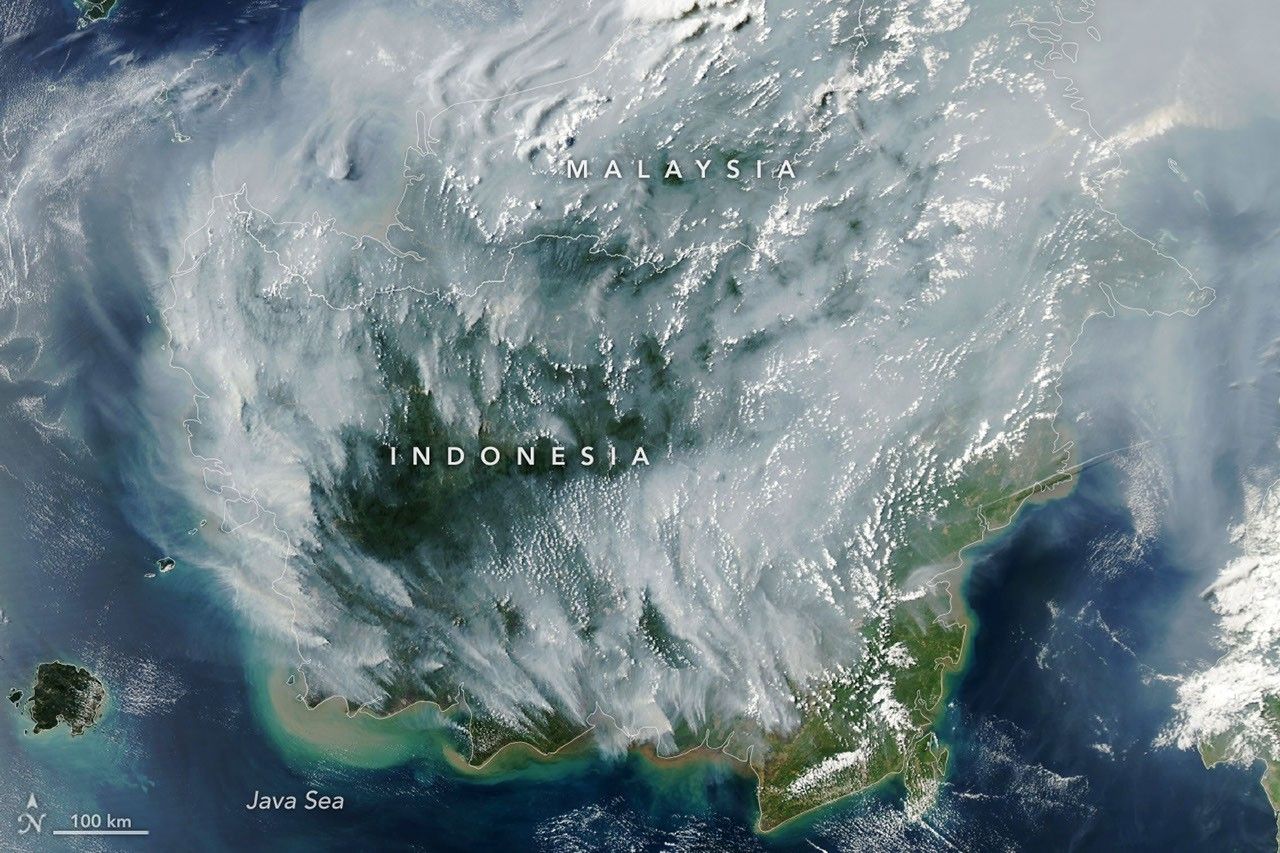
Thick smoke covered large parts of Borneo when NASA’s Aqua satellite passed over the island on September 1, 2026, three days before Serian crossed Malaysia’s emergency API threshold. Credit: NASA Earth Observatory / Lauren Dauphin, using MODIS data from NASA EOSDIS LANCE and GIBS/Worldview.
Serian’s air quality deteriorated rapidly on September 4. Malaysia’s National Disaster Management Agency (NADMA), citing the Department of Environment’s Air Pollutant Index Management System (APIMS), reported an API of 495 at 07:00 local time and 510 at 09:00. The reading rose to 517 at 11:00, while Radio Televisyen Malaysia reported an APIMS reading of 521 at 14:00.
Malaysia issued an emergency proclamation for the entire Serian Division later on September 4. The federal proclamation, P.U. (A) 317/2026, formally established the emergency area after air pollution reached levels considered hazardous to public health and safety.


At 14:00 on September 4, RTM reported Kuching at API 311, Samarahan at 284 and Sri Aman at 235. Serian remained above 500 later in the afternoon, with a reading of 514 reported at 16:00.
The Sarawak State Education Department announced that 647 primary and secondary schools would close from September 7 to 11, with teaching shifted to home-based learning. The closures comprised 563 primary schools and 84 secondary schools across 12 district education offices.

The regional smoke source was independently documented by the ASEAN Specialised Meteorological Centre (ASMC). Its September review found persistent scattered to widespread hotspots across most of Kalimantan and central and southern Sumatra, with moderate to dense smoke from large parts of Kalimantan drifting into Malaysia, Singapore and the Philippines.
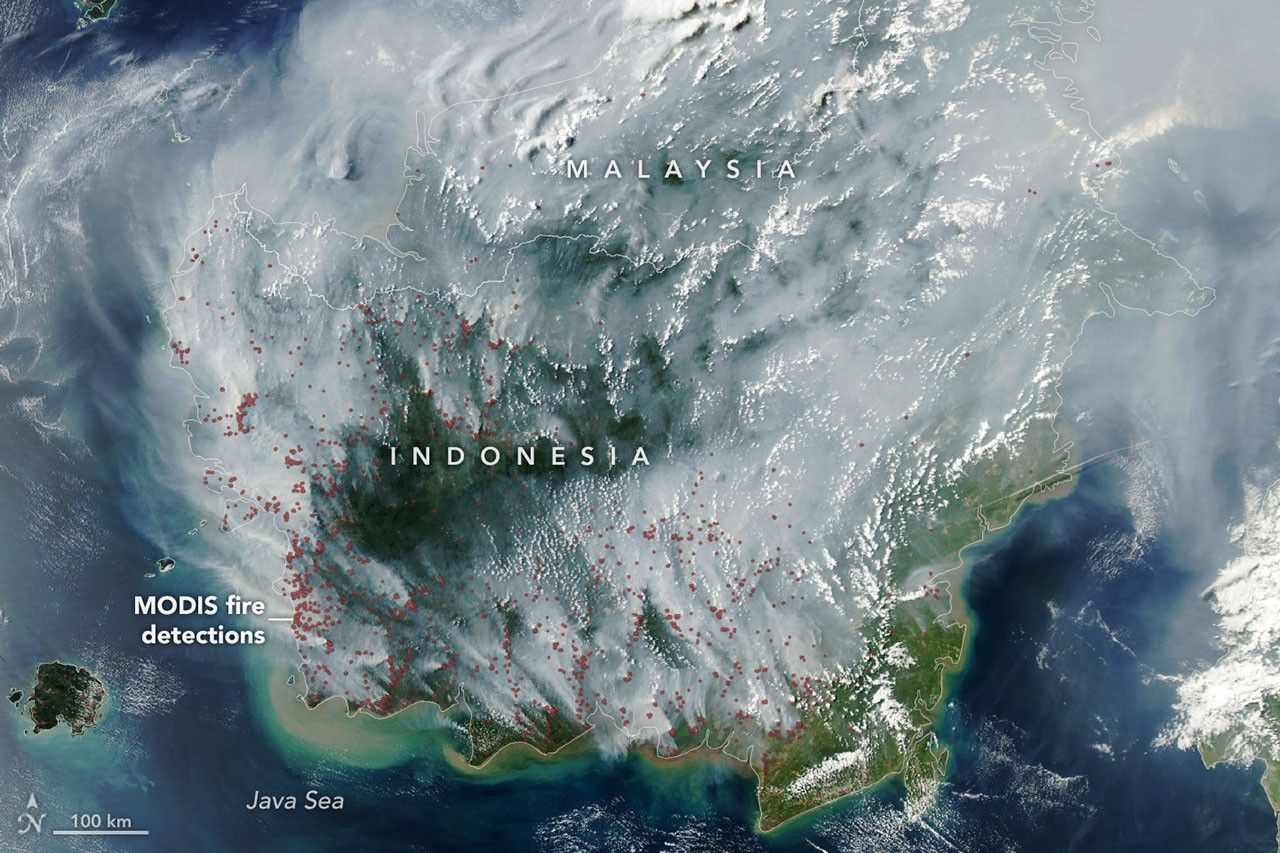
ASMC reported that both Sumatra and Kalimantan recorded their highest September hotspot counts in five years. Indonesia’s Ministry of Forestry was also reporting hundreds of high-confidence hotspots across West and Central Kalimantan as fire activity intensified around the turn of August and September.
Yii returned to the episode on October 13 during a debate on haze in the Dewan Rakyat’s Special Chambers. He used the Serian emergency and Kuching’s September 1 API of 357 to argue for a Malaysian Transboundary Haze Pollution Act and targeted trade measures against products linked to companies proven to be involved in burning.
CodeBlue reported Yii saying: “On September 4, every resident of Serian, from newborn babies to the elderly, was breathing air equivalent to smoking approximately 23 cigarettes a day.” He placed Kuching’s API of 357 at approximately 14 cigarettes a day under the same comparison.

The cigarette comparison comes from a 2015 analysis by Berkeley Earth co-founders Richard A. Muller and Elizabeth A. Muller. Their rule of thumb treats continuous exposure for one day to a PM2.5 concentration of 22 µg/m³ as carrying roughly the same health impact as smoking one cigarette per day.
The conversion was derived from mortality statistics rather than by matching the physical mass or chemical composition of cigarette smoke with outdoor particulate pollution. Berkeley Earth said the purpose was to give people an intuitive way to understand the health effects of air pollution. Its own example equates 550 µg/m³ of PM2.5 over a day with approximately 25 cigarettes.

Malaysia’s API and PM2.5 concentration are different quantities. The Department of Environment calculates separate pollutant sub-indices and uses the highest sub-index as the API. PM2.5 is commonly important during haze, but an API value does not by itself establish the underlying PM2.5 concentration unless PM2.5 was the pollutant controlling the index.
For PM2.5 specifically, Malaysia’s official sub-index table maps API 401–500 to a 24-hour PM2.5 concentration of 350.5–500.4 µg/m³. At the upper end of that range, 500.4 divided by Berkeley Earth’s 22 µg/m³ rule gives about 22.7 cigarette-equivalents, which rounds to 23.
That calculation helps explain how the 23-cigarette figure can arise around the API-500 emergency threshold if PM2.5 is the dominant pollutant. It does not establish that Serian’s reported API 521 corresponded to 521 µg/m³ of PM2.5, and the historical APIMS record identifying the pollutant controlling Serian’s index at the exact 521 observation has not been independently recovered.
The 23-cigarette figure is therefore an approximate health-risk comparison, not a measured cigarette-smoke dose. It does not mean Serian residents inhaled the same quantity or chemical mixture as someone who smoked 23 cigarettes, and Berkeley Earth’s methodology does not establish identical toxicity between haze particles and tobacco smoke.
The framing also predates Yii’s 2026 parliamentary intervention. Greenpeace Malaysia used an API-500 comparison of about 23 cigarettes a day in a 2023 haze campaign, also drawing on Berkeley Earth’s rule of thumb.
September falls within the southern ASEAN region’s traditional dry season, when fire and haze activity is seasonally favored. ASMC nevertheless reported unusually high fire activity in September 2026, with Sumatra and Kalimantan recording their highest September hotspot counts in five years.
Malaysia lifted the Serian emergency declaration on September 7 after air quality improved below the hazardous range. The improvement was not uninterrupted: Serian returned to the hazardous category the following morning, with an API of 302 reported on September 8.

References:
1 Review of Regional Haze Situation for September 2026 – ASEAN Specialised Meteorological Centre
2 Serian API hits emergency level of 510 at 9am on Sept 4 – National Disaster Management Agency (NADMA) – September 4, 2026
3 Serian, Kuching catat IPU bahaya, Samarahan, Sri Aman sangat tidak sihat – Radio Televisyen Malaysia – September 4, 2026
4 Proklamasi Darurat (Bahagian Serian, Sarawak), P.U. (A) 317/2026 – Attorney General’s Chambers of Malaysia – September 4, 2026
5 Haze: 647 schools in Sarawak to close temporarily – Bernama – September 4, 2026
6 Bandar Kuching MP Moots Haze Tariffs On Indonesia – CodeBlue – October 13, 2026
7 Air Pollution and Cigarette Equivalence – Berkeley Earth – December 17, 2015
8 PM2.5 Sub-Index Calculation – Department of Environment Malaysia
9 King consents to lift emergency declaration in Serian – Bernama – September 7, 2026
10 Are we all smoking or is it just haze? – Greenpeace Malaysia – September 22, 2023

I’m a science journalist and researcher at The Watchers, contributing to the Epicenter edition, where I cover peer-reviewed scientific research and emerging discoveries across Earth and space sciences. With a background in astronomy and a passion for environmental science, I’ve worked in shark and coral conservation in Fiji, conducting reef and shark-behavior research, contributing to mangrove restoration, and earning PADI Open Water and Coral Reef Certifications. I bring a blend of scientific rigor and storytelling to illuminate the discoveries shaping our planet and beyond.
Published in the last 24 hours
- In 2022, Hurricane Ian made a direct hit on Babcock Ranch, a Florida town of about 5,000 people built beside 700,000 solar panels with every power line buried; gusts topped 150 mph, and not a single resident lost power Epicenter
- Marine iguanas in the Galápagos got shorter by as much as 6.8 cm (2.7 inches), or a fifth of their length, when El Niño left them short of the seaweed they can digest, and the biggest ones shrank the most and lived the longest Epicenter
- An 83-year-old lodge owner named Harry R. Truman refused to leave his home on Spirit Lake below Mount St. Helens in the spring of 1980, insisting the mountain would not get him, and the May 18 eruption buried him along with his 16 cats Epicenter
- A new model of Antarctica’s Thwaites Glacier that lets seawater seep beneath its grounded ice projects up to about 30 millimeters of sea-level rise by 2100 from that glacier alone, roughly twice the earlier average projection, in a scenario its authors call a lower bound Epicenter
