
In April 2014, golden-winged warblers in the mountains of Tennessee, songbirds weighing about as much as four dimes, fled their breeding grounds a day or two before a tornado outbreak and flew hundreds of miles south, while the scientists tracking them sheltered in a Waffle House
Five male golden-winged warblers carrying light-level geolocators left established breeding territories in Tennessee’s North Cumberland Mountains on April 26–27, 2014, one to two days before a tornadic storm system reached the area, and flew roughly 700 km (435 miles) south toward the Gulf Coast. The birds returned after the storm passed; the field team later described waiting out its worst day at a Waffle House in Caryville, Tennessee.
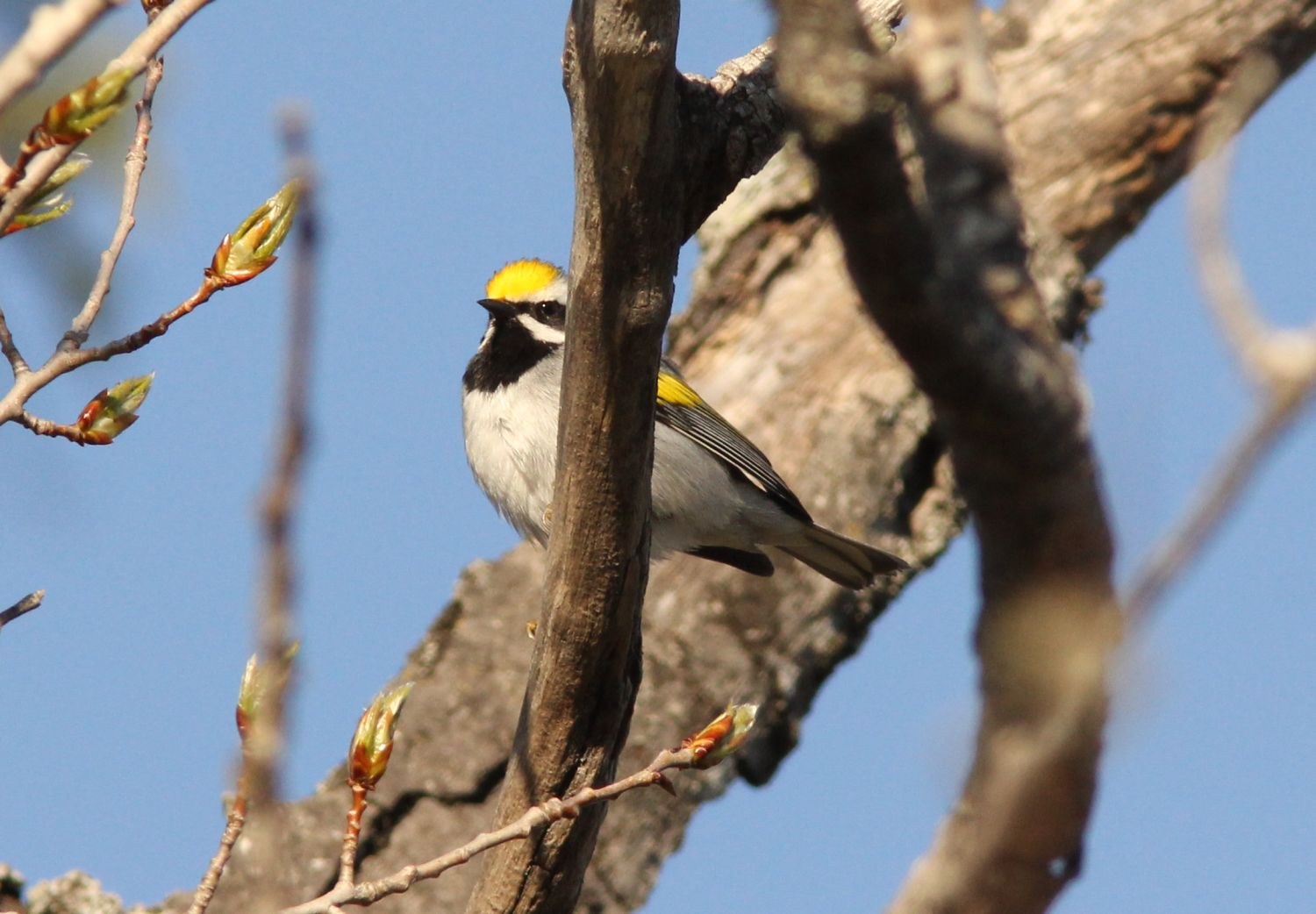
Golden-winged Warbler (male), Kate's Grade, Marquette Co., MI, 19 May 2015 (17915241585). Credit: Caleb Putnam (CC BY-SA 2.0), via Wikimedia Commons.
The discovery came from a tracking experiment designed to answer a different question. In May 2013, researchers attached miniature light-level geolocators to 20 adult male golden-winged warblers breeding on three mountaintop reclaimed strip mines in the North Cumberland Mountains Wildlife Management Area of northeastern Tennessee. The devices weighed 0.45–0.51 g, including their harnesses, about 5% of the birds’ body mass.
Ten of the tagged males returned to the study area in 2014. One had lost its geolocator, one had its device removed before the storm, two could not be recaptured, and another disappeared after being seen before the storm. The storm-avoidance analysis therefore rests on the five birds whose geolocators recorded the period of interest and were subsequently recovered.

Streby et al. (2015) had set out to study ordinary seasonal migration, but the recovered tracks captured a different type of movement. Golden-winged warblers are obligate migrants, meaning their principal migrations occur on a regular seasonal schedule. Birds were already known to delay, redirect or reverse flights during migration when weather became unfavorable, but large facultative migrations after an obligate migrant had settled on its breeding grounds had not previously been documented in this way.
The five males had only recently completed their normal spring journey. The paper reports that the tagged warblers reached their breeding territories between April 13 and April 27 after a roughly 5 000 km (3 100 mile) migration from eastern Colombia. They had been back on territory for between one and 13 days when the additional movement began.
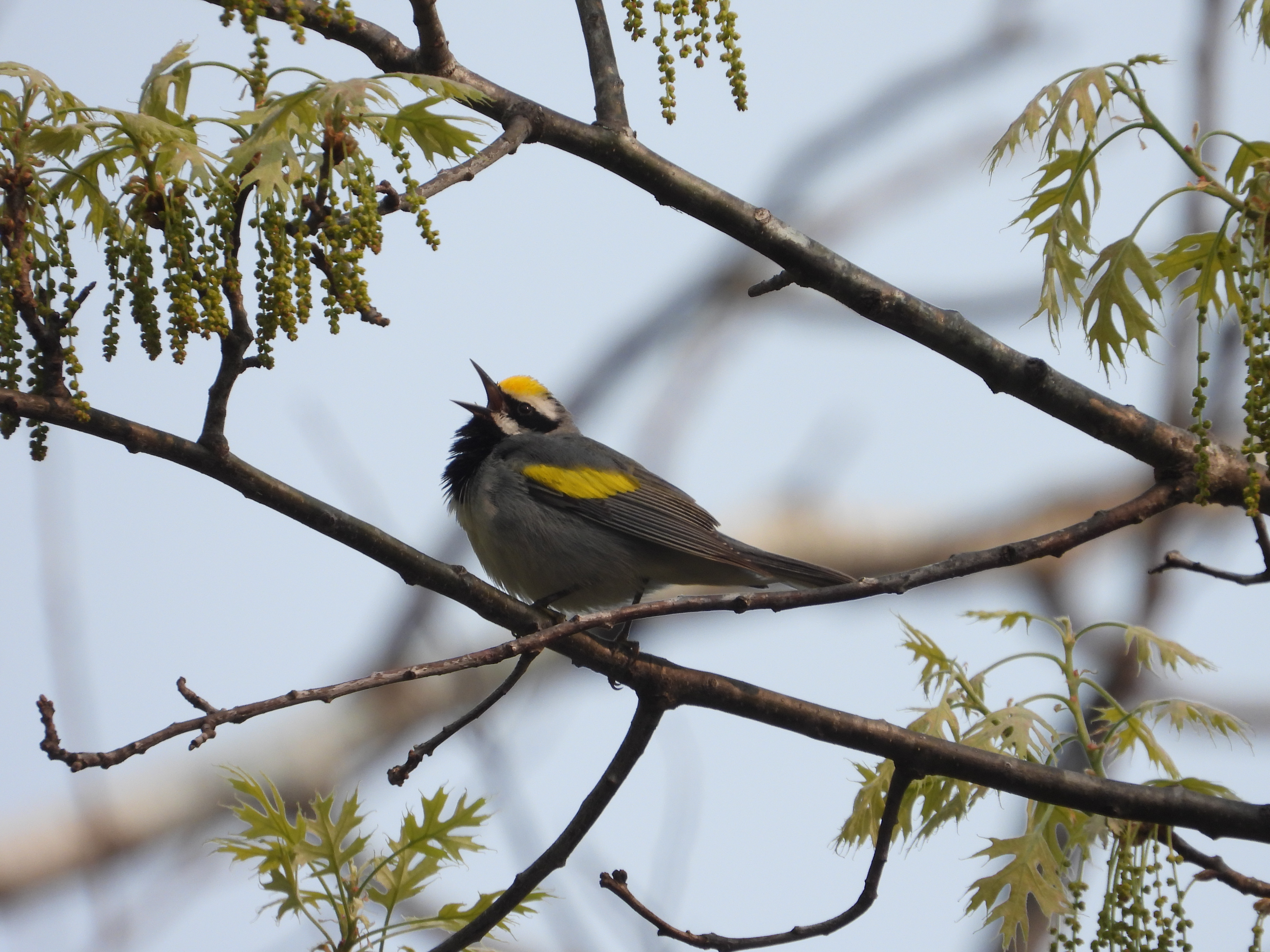
The tracked birds began leaving on April 26–27, one to two days before the severe storm system reached the Tennessee study area. Each followed a different route toward the Gulf of Mexico, approximately 700 km (435 miles) from the breeding grounds. Four remained around the Florida Panhandle during the storm period, while one continued south along western Florida and reached western Cuba.
All five returned to the Tennessee study sites on May 1–2 and resumed defending their territories. The complete movement exceeded 1 500 km (932 miles) over about five days. Their routes were not identical, which led the researchers to conclude that the movements were independently initiated rather than a flock moving together.
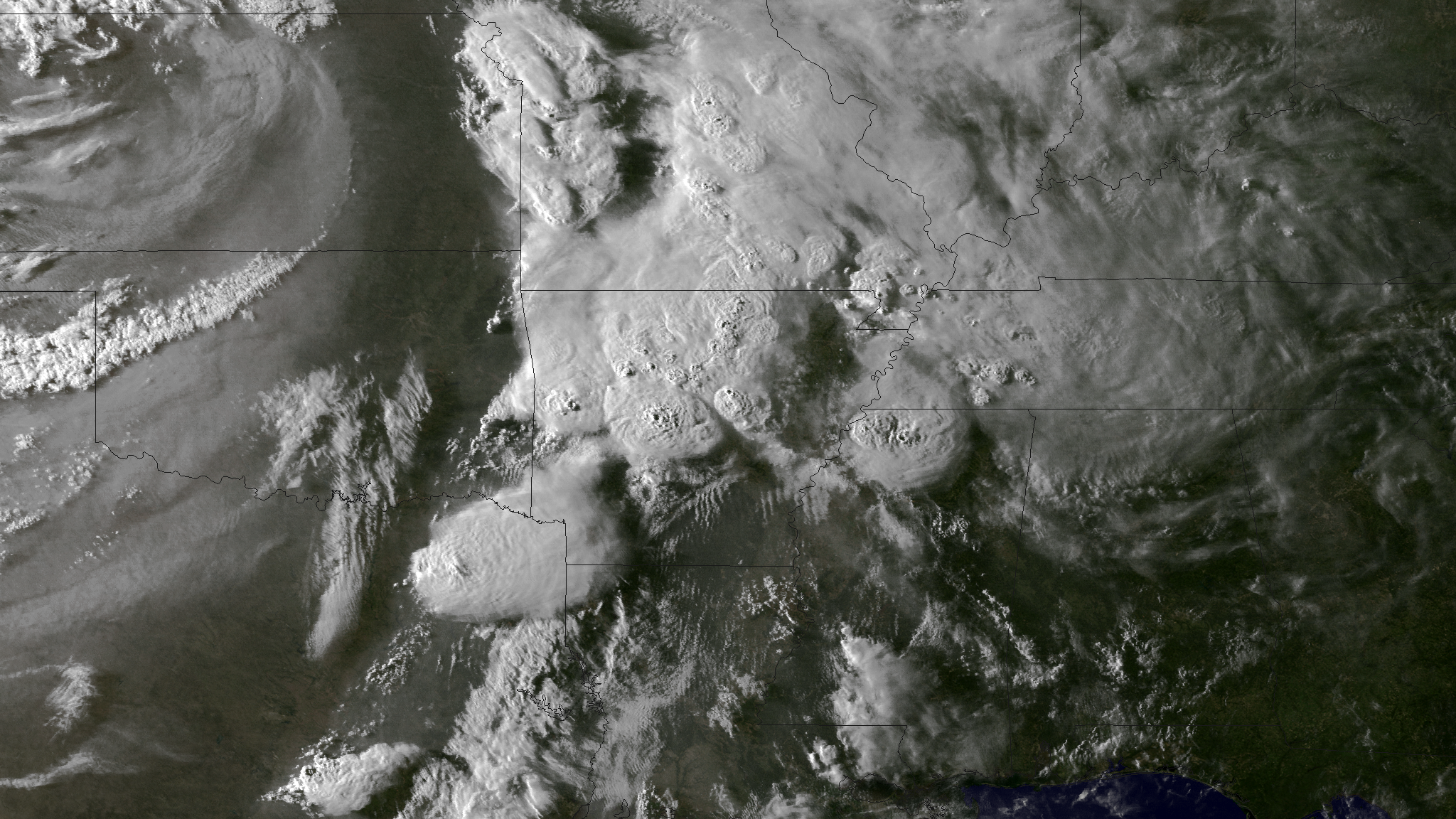
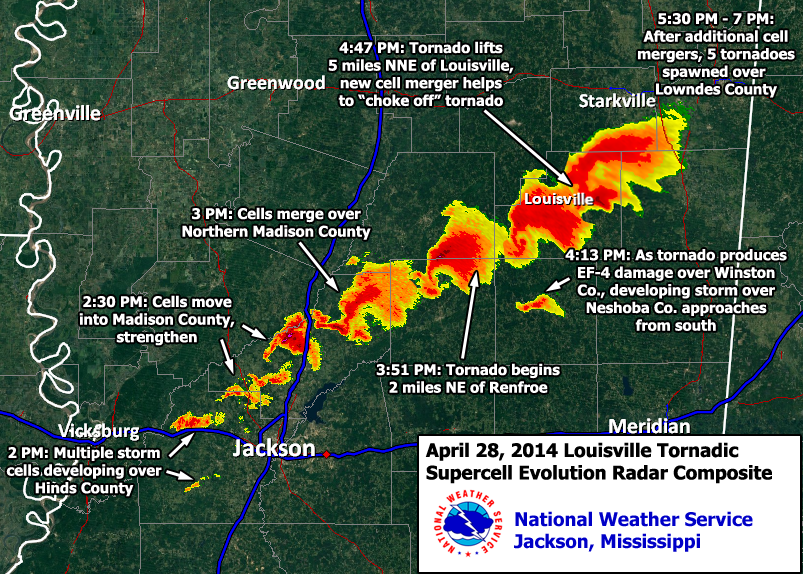
The timing created the central scientific problem. When the warblers evacuated, the tornadic storm system was still 400–900 km (250–560 miles) west of the breeding area and moving toward it. The paper reports no evidence that the local variables normally associated with approaching severe weather — atmospheric pressure, temperature, wind speed and direction, cloud cover and precipitation — provided the cue for the movement.
Conditions immediately before departure were also not unique compared with conditions recorded before and after the evacuation. Atmospheric soundings near Nashville, about 230 km (143 miles) west of the study area, had not yet developed the severe-weather characteristics that later accompanied the approaching system.

The authors therefore considered signals capable of traveling much farther than ordinary local weather changes. Their leading explanation was infrasound, acoustic energy below 20 Hz and therefore below the normal lower limit of human hearing. Tornadic storm systems can generate low-frequency sound that travels over very long distances through the atmosphere, and previous research had shown that birds can detect infrasonic frequencies.
The study did not demonstrate that infrasound caused the birds to leave. The warblers carried light sensors, not microphones or physiological instruments, and the researchers did not experimentally expose them to storm-generated sound. The authors explicitly acknowledged that an unidentified visual, olfactory or other cue could not be ruled out and described infrasound as the most parsimonious explanation available from the evidence.
The geolocators introduced a separate measurement limitation. They estimated position from light levels and the timing of sunrise and sunset rather than obtaining GPS coordinates. Cloud, vegetation and other shading can shift the calculated location of a bird, so the researchers checked whether the apparent evacuation could have been produced by abnormal light records instead of actual movement.
The transitions recorded by the tags remained smooth through the event. The paper reports that the largest shading error measured during the week before or after the evacuation displaced an estimated breeding location by 290 km (180 miles), while estimated positions during the evacuation lay 360–1 460 km (224–907 miles) from the study area. The authors concluded that ordinary geolocation error could not explain movements of that scale.

Ground surveys supplied another check on the tracking result, but they also showed that the response was not universal among birds in the study area. None of the five geolocator-marked males was detected during surveys on April 30. Seven other male golden-winged warblers were observed that day, about 30% of the number expected from territory occupancy in previous years and observations after the storm.
That distinction matters because the study involved five usable tracks from one population during one storm sequence. The observations establish what those five males did. They do not establish that every golden-winged warbler, every population or every bird species responds to distant severe weather in the same way.

The field team’s experience with the storm developed on a different timeline. The scientific paper says the researchers conducted their own evacuation and waited out the storm in Caryville, Tennessee. UC Berkeley’s account quotes Streby saying that the team had to evacuate to a hotel.
In a BBC News interview published on December 19, 2014, Streby provided the detail behind the Waffle House account, saying the researchers evacuated to the Waffle House in Caryville for the one day when the storm was at its worst. The birds had already started their southward movements before that episode. The human and avian evacuations therefore belonged to the same storm sequence but were not simultaneous departures.

The movements also revealed how much additional flight these small migrants could perform after their seasonal journey. Three of the five tracked males began a more-than-1 500 km round-trip evacuation only one to two days after completing the roughly 5 000 km spring migration reported in the study. The authors interpreted that observation as evidence that at least some long-distance migrants retain substantial flight capacity after reaching their breeding grounds.

The study left several questions unresolved. The tracked sample consisted of males, and the researchers specifically raised the question of whether birds would make the same decision later in the breeding season when adults were more heavily invested in nests or fledglings, whether females would respond in the same way, and what energetic or reproductive costs such an evacuation might impose.
Answering the sensory question requires evidence the 2014 experiment was not designed to collect. Future work would need to connect long-range storm signals with direct measurements of what birds detect and with independently tracked departures. The Tennessee geolocators established the movement itself; they did not establish which sensory pathway told the five birds that severe weather was approaching.
References:
1 Streby, H. M., Kramer, G. R., Peterson, S. M., Lehman, J. A., Buehler, D. A., & Andersen, D. E. (2015). Tornadic storm avoidance behavior in breeding songbirds. Current Biology, 25(1), 98–102. DOI: 10.1016/j.cub.2014.10.079
2 Tornadic storm avoidance behavior in breeding songbirds – U.S. Geological Survey – 2015
3 Sensing Distant Tornadoes, Birds Flew the Coop. What Tipped Them Off? – Research UC Berkeley – December 18, 2014
4 Birds ‘heard tornadoes coming’ and fled one day ahead – BBC News – December 19, 2014
5 Tornado Damage in Mayflower, Arkansas – NASA Earth Observatory – May 6, 2014

I’m a science journalist and researcher at The Watchers, contributing to the Epicenter edition, where I cover peer-reviewed scientific research and emerging discoveries across Earth and space sciences. With a background in astronomy and a passion for environmental science, I’ve worked in shark and coral conservation in Fiji, conducting reef and shark-behavior research, contributing to mangrove restoration, and earning PADI Open Water and Coral Reef Certifications. I bring a blend of scientific rigor and storytelling to illuminate the discoveries shaping our planet and beyond.
Published in the last 24 hours
- A South Dakota man put the widest and heaviest hailstone on US record in his freezer, and a power cut melted part of it before NOAA measured it at 8 inches across and nearly 2 pounds in 2010 Epicenter
- After record Nordic heatwave, Swedish researchers to recreate indoor heat to study older adults Epicenter
- San Juan River cuts through 300-million-year-old rocks while retaining its winding course in Utah Epicenter
- Haze from Indonesia’s fires was like smoking 23 cigarettes a day at its worst in one Malaysian district, an MP told parliament Epicenter
