
After record Nordic heatwave, Swedish researchers to recreate indoor heat to study older adults
Following a record 21-day heatwave across sub-Arctic Fennoscandia in July 2025, researchers at Umeå University are preparing to recreate indoor summer heat to investigate how older adults respond physically and psychologically inside homes designed for cold winters. The 2026–2030 project will combine controlled heat exposure, physiological measurements and brain-activity monitoring to evaluate adaptations such as shading and ventilation, with the aim of identifying measures that protect well-being without assuming that the same solutions work for every household.

Image credit: Richard Vanlerberghe/Unsplash
For decades, homes in northern Sweden have been built primarily to withstand long, cold winters. Insulation, energy-efficient windows and building envelopes that limit heat loss help maintain warmth when outdoor temperatures are low. During a summer heatwave, however, the same homes can be difficult to keep cool. The research question now being pursued at Umeå University is how that indoor environment affects older residents and whether relatively accessible building adaptations can reduce heat-related discomfort and psychological strain.
The challenge is not simply to establish that extreme heat can affect health. Researchers already have evidence linking temperature exposure with physical and mental-health outcomes, but less is known about how older people respond to specific indoor conditions and which interventions produce measurable improvements. Umeå University’s new project will examine the interaction between the building, the occupant and the measures available to reduce heat exposure, rather than treating outdoor weather conditions as a complete measure of the environment people experience at home.

The 2025 heatwave provides a recent example of the conditions motivating the research. According to the Copernicus Climate Change Service and the World Meteorological Organization, sub-Arctic Fennoscandia experienced its most severe heatwave on record in July 2025. The event lasted 21 days, from July 12 to August 1, with temperatures reaching or exceeding 30°C (86°F) in parts of the region close to and within the Arctic Circle. The highest reported temperature was 34.9°C (94.8°F) at Frosta in Norway. The regional severity ranking combines temperature anomaly, duration and the area affected, rather than relying on the highest temperature alone.

Copernicus attributes the prolonged heat to a persistent atmospheric blocking pattern over northern Europe. In this configuration, a high-pressure system remained between areas of lower pressure, allowing unusually warm and sunny conditions to persist. At high northern latitudes, where summer daylight lasts for much of the day, the resulting weather pattern sustained high temperatures over an extended period. The regional heatwave was accompanied by dry conditions, elevated fire danger and unusually warm seawater in parts of the surrounding seas.
A separate study by Feng et al. (2026), involving researchers from Umeå University, examined how residents responded to that 2025 Nordic heatwave. The investigation collected survey data from 201 households representing 450 residents in Umeå, Skellefteå and Luleå. It assessed reported thermal discomfort, perceived risk, psychological effects, household care responsibilities and the adaptations residents used during the event. Unlike the newly announced laboratory project, this was a completed survey-based investigation of an actual heatwave.
The survey found that behavioural changes were considerably more common than purchasing cooling equipment. Among the surveyed households, 94.0% reported adopting daily behavioural measures, while 22.4% reported purchasing new cooling devices. The distinction matters because changing routines and making purchases involve different costs and resources. The study also found that respondents with age-, health-, socioeconomic- or housing-related vulnerabilities continued to report greater heat-related impacts despite more active behavioural adaptation.

Those findings provide relevant background, but they cannot establish that a particular household intervention reduced physiological or psychological harm. The survey relied on reported experiences and behaviours, and its results describe associations among household characteristics, responses and perceived impacts. Its 450 residents were not exclusively older adults. The new Umeå project will address a narrower question by comparing controlled indoor heat conditions and potential adaptations while recording direct physiological measurements and participants’ assessments.
There is also a wider scientific reason to investigate mental well-being alongside physical responses. Ugwu et al. (2026) reviewed 28 quantitative studies of climate exposures and mental or cognitive health among adults older than 60. Their analysis found associations between thermal stress, including heat and cold exposure, and increased depressive symptoms. The authors also identified emerging evidence connecting heat exposure with cognitive impairment, although the underlying studies differed considerably in their methods and outcome measurements.
The review identified a pronounced geographic imbalance in the research literature. Of the 28 included studies, 12 were conducted in East Asia, including 11 in China, while only one eligible study came from Europe. The authors did not conduct a single pooled statistical estimate for all outcomes because of differences among the included studies. Their conclusions support further investigation of thermal exposure and mental health, but they do not establish that every older person responds in the same way or that all exposure conditions have equivalent effects.
The newly announced Umeå investigation is titled Ageing at Home During Heatwaves in Northern Sweden: Protecting Mental Well-being through Evidence-Based Indoor Climate Adaptation. It is led by Weizhuo Lu, professor at the Department of Applied Physics and Electronics and director of the Intelligent Human-Buildings Interaction Lab (IHBI). The programme runs from 2026 to 2030 and brings together building research, psychology and neuroscience to examine how older residents experience heat inside homes.
Umeå University announced the project on November 5, 2026, reporting nearly SEK 9 million in support from Formas, the Swedish research council for sustainable development. Formas lists the project under reference 2026-01293 with an amount of SEK 8 978 276 in its preliminary decision table. The funding authority specifies that only decisions published through its Prisma system guarantee granted funding, a qualification that applies to the amount shown in the publicly available table.
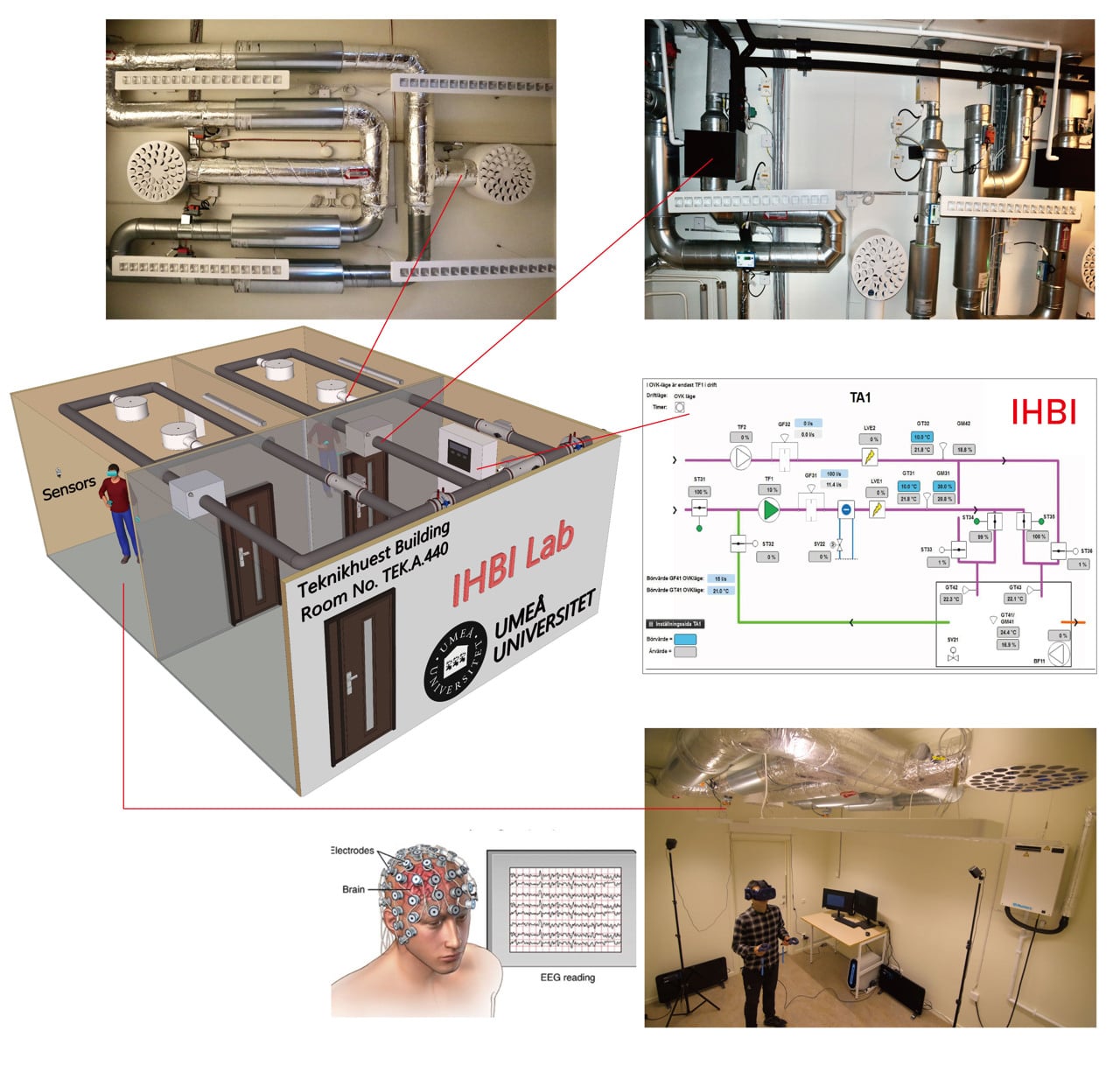
The IHBI laboratory combines a physical climate chamber with immersive virtual environments. The chamber provides a setting in which indoor temperature, humidity and airflow can be controlled, while the virtual system can make the surroundings appear to resemble an ordinary home. This arrangement allows participants to experience physical indoor conditions while interacting with a simulated living environment. The research team can then compare responses across different settings without depending entirely on the timing of naturally occurring heatwaves.
The laboratory is equipped with physiological sensors and technology for recording brain activity through electroencephalography (EEG). EEG measures electrical activity using electrodes placed on the scalp. The researchers plan to combine these records with wearable physiological measurements, behavioural observations and participants’ own reports of comfort, stress, fatigue and mental well-being. These different measurements are complementary: changes in recorded brain activity or physiological signals alone do not establish a person’s psychological state or demonstrate that an adaptation has improved mental health.
Lu’s research description outlines a repeated-measures experimental approach in which participants are compared under thermally neutral conditions, during heat exposure and under adaptation conditions. Studying the same people across different environments can help distinguish responses to changing indoor conditions from differences between individuals. The strength of the resulting conclusions will nevertheless depend on the experimental protocol, participant characteristics, exposure conditions and the consistency of the measurements obtained.

The physical characteristics of northern Swedish housing are central to the project. Buildings designed to retain heat often have insulated walls, efficient windows and ventilation arrangements developed primarily for cold-weather energy performance. Those features do not, by themselves, determine how hot an individual room will become. Solar exposure, shading, ventilation practices and the building’s ability to release accumulated heat can also affect indoor conditions. The researchers intend to examine how variations in housing and occupant circumstances influence responses to summer heat.
Solar shading and ventilation are among the adaptations Umeå University identifies for evaluation. Shading can reduce the amount of solar energy entering a room through windows, while ventilation can exchange indoor and outdoor air when conditions permit. The effectiveness of either measure depends on the circumstances in which it is used. The new project has not yet established which combination provides the greatest benefit to older adults or whether an improvement in thermal comfort produces a corresponding change in measured stress or mental well-being.
The research also considers differences in the resources available to older residents. Mobility limitations, household finances, housing characteristics and social support can influence whether a person can alter their indoor environment or obtain assistance during prolonged heat. A measure that can be installed or operated easily in one home may be difficult to use in another. Umeå University said the resulting guidance will be developed in dialogue with older residents, relatives, senior citizens’ organisations and Umeå Municipality, with the aim of making recommendations accessible to households with differing needs.
The research team includes Weizhuo Lu and Kailun Feng from Umeå University’s Department of Applied Physics and Electronics, alongside Linus Andersson, Johan Eriksson and Gustaf Wadenholt from the Department of Psychology. The university’s November 5 press-release distribution indicated that small-scale internal pilot tests were expected to begin in early December 2026 or January 2027. Those dates describe anticipated research activities, not completed experimental findings.
The principal scientific question remains how reliably responses observed in a controlled laboratory can inform decisions inside real homes. The 2025 heatwave survey documented how residents reported coping with prolonged heat, while the broader systematic review identified mental and cognitive health associations across different climate exposures. The Umeå experiments are intended to test the next part of that problem: whether measurable changes in indoor conditions can reduce heat-related strain among older adults, which measures perform best, and how those effects vary between people and housing circumstances. The project has not yet reported results resolving those questions.
References:
1 Feng, K., Wang, S., Zhang, J., Chen, S., Olofsson, T., & Lu, W. (2026). Thermal perception and heat adaptation of residents toward climate warming in cold regions: Evidence from the 2025 Nordic heatwave. Energy and Buildings, 372, 118261. DOI: 10.1016/j.enbuild.2026.118261
2 Ugwu, L. E., Obuaku-Igwe, C., & Idemudia, E. S. (2026). The impact of climate change on the mental health of the ageing population: A systematic review. Aging & Mental Health, 30(7), 1429–1443. DOI: 10.1080/13607863.2026.2634140
3 Recreating heatwaves in the lab to help older people stay well at home – Umeå University – November 5, 2026
4 European State of the Climate 2025 – Copernicus Climate Change Service/ECMWF and World Meteorological Organization – 2026. DOI: 10.24381/zy93-sb27
5 The impact of climate change on public health in Sweden – risks, vulnerabilities, opportunities, and synergies – Formas – 2026. Preliminary decisions, project 2026-01293.
6 Intelligent Human-Buildings Interaction Lab – Umeå University – Institutional research-group description
7 Weizhuo Lu – Umeå University – Researcher profile and experimental programme description
8 Recreating heatwaves in the lab to help older people stay well at home – Umeå University / TT press-release distribution – November 5, 2026

I’m a science journalist and researcher at The Watchers, contributing to the Epicenter edition, where I cover peer-reviewed scientific research and emerging discoveries across Earth and space sciences. With a background in astronomy and a passion for environmental science, I’ve worked in shark and coral conservation in Fiji, conducting reef and shark-behavior research, contributing to mangrove restoration, and earning PADI Open Water and Coral Reef Certifications. I bring a blend of scientific rigor and storytelling to illuminate the discoveries shaping our planet and beyond.
Published in the last 24 hours
- In April 2014, golden-winged warblers in the mountains of Tennessee, songbirds weighing about as much as four dimes, fled their breeding grounds a day or two before a tornado outbreak and flew hundreds of miles south, while the scientists tracking them sheltered in a Waffle House Epicenter
- San Juan River cuts through 300-million-year-old rocks while retaining its winding course in Utah Epicenter
- Haze from Indonesia’s fires was like smoking 23 cigarettes a day at its worst in one Malaysian district, an MP told parliament Epicenter
- In 2022, Hurricane Ian made a direct hit on Babcock Ranch, a Florida town of about 5,000 people built beside 700,000 solar panels with every power line buried; gusts topped 150 mph, and not a single resident lost power Epicenter
