
An 83-year-old lodge owner named Harry R. Truman refused to leave his home on Spirit Lake below Mount St. Helens in the spring of 1980, insisting the mountain would not get him, and the May 18 eruption buried him along with his 16 cats
Harry R. Truman, the 83-year-old owner of the Mount St. Helens Lodge on Spirit Lake in Washington, refused repeated efforts to persuade him to leave as volcanic unrest intensified in the spring of 1980, telling reporters that “the mountain will never hurt me.” At 08:32 PDT (15:32 UTC) on May 18, a M5.1 earthquake accompanied the collapse of the volcano’s north flank, initiating a massive debris avalanche and lateral blast that destroyed the Spirit Lake lodge area; Truman and his 16 cats were killed, and his remains were never recovered.
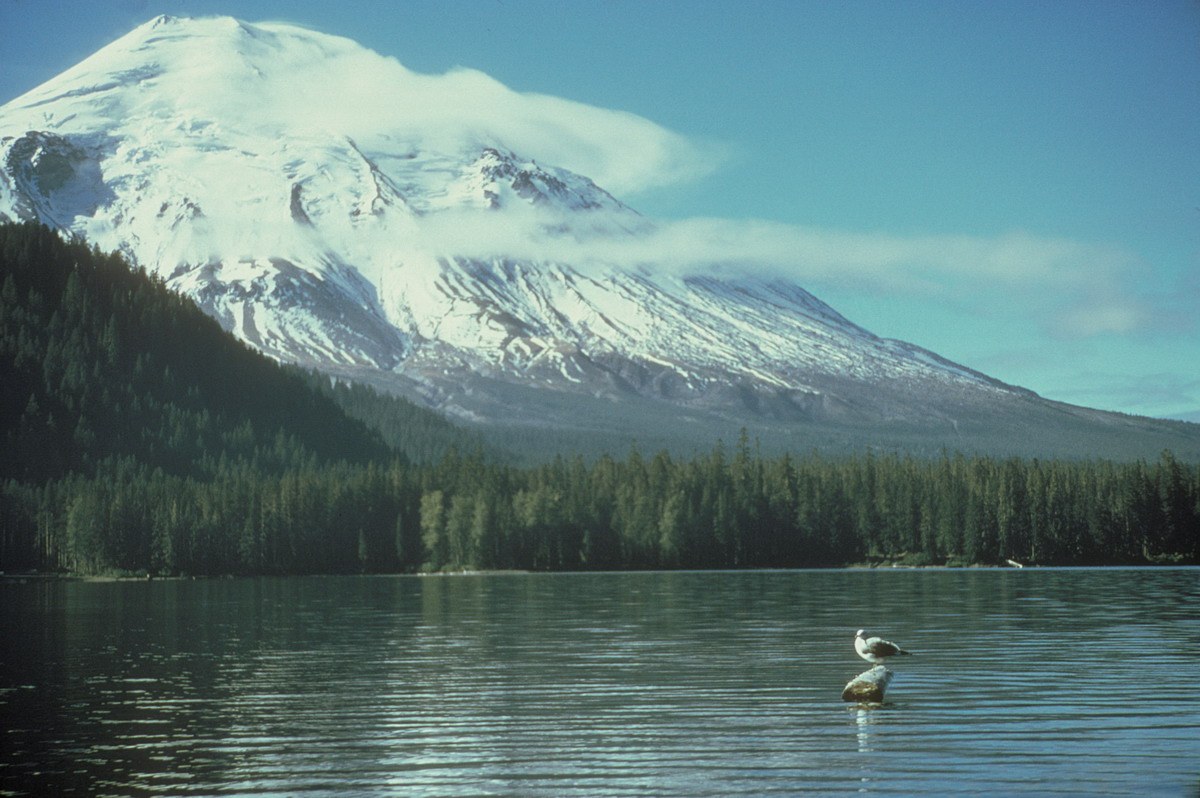
Spirit Lake and Mount St. Helens before the May 18, 1980 eruption. Lodges, cabins and recreational facilities occupied the lakeshore before the eruption radically altered the basin. Credit: U.S. Forest Service, Pacific Northwest Region, public domain.
The sequence that ended at Spirit Lake began on March 20, 1980, when a M4.2 earthquake shook Mount St. Helens after 123 years without an eruption. A week later, on March 27, steam-and-ash explosions opened a crater at the summit, beginning more than seven weeks of unrest that included thousands of earthquakes, repeated explosions and rapid deformation of the volcano’s north flank.
Harry R. Truman had lived at Spirit Lake since the 1920s and operated the Mount St. Helens Lodge for decades. As authorities restricted access around the volcano and repeatedly tried to persuade him to leave, Truman refused. His interviews turned the 83-year-old lodge owner into one of the most recognizable people associated with the developing crisis.

In a March interview later quoted in Steve Olson’s Eruption, Truman said “the mountain will never hurt me.” He believed his long familiarity with Spirit Lake gave him a reliable understanding of the terrain and argued that the surrounding forest would provide protection if part of the mountain came down.

The confidence Truman projected publicly was not complete indifference to the danger. HistoryLink’s reconstruction of his final weeks records that by May he was frightened by the frequent earthquakes and had begun sleeping in the lodge basement because he felt safer there.

The physical changes taking place above Spirit Lake were substantial. Magma was intruding into the volcano and producing a cryptodome, a body of magma that remained trapped inside the edifice rather than erupting freely at the surface. The pressure pushed the north flank outward, producing a bulge that was moving at rates of roughly 1.5 to 2 m (5 to 6.5 feet) per day during parts of the crisis.

By mid-May, the U.S. Geological Survey had recorded roughly 10 000 earthquakes during the unrest, and the north-flank bulge had grown more than 137 m (450 feet) outward relative to its earlier profile. Repeated steam explosions had also altered the summit, although the visible explosions stopped on May 16.

Efforts to get Truman out continued almost until the eruption. HistoryLink records at least five visitors on May 17 who tried to persuade him to leave, including law-enforcement officers and friends. Washington State Patrol chief R. W. Landon later recalled Truman saying that if he went to the lowlands, he would drink himself to death. The final visitors left after 18:00 local time. Truman stayed at the lodge with his cats.
Monitoring data during the early hours of May 18 did not show a sudden short-term change that announced what was about to happen. At 08:32 PDT (15:32 UTC), a M5.1 earthquake occurred beneath Mount St. Helens. Seconds later, the unstable north flank and summit began sliding away in the largest debris avalanche documented in recorded history.

The collapse abruptly removed the confining rock from the pressurized volcanic system. Hot rock, ash, steam and volcanic gas expanded sideways from the exposed interior of the volcano, producing the lateral blast. U.S. Geological Survey measurements place the blast speed at at least 480 km/h (300 mph), while the devastated blast zone covered about 600 km2 (230 mi2).

Spirit Lake lay immediately north of the volcano and directly in the path of the collapse. The debris avalanche entered the lake and displaced a huge volume of water, while the lateral blast crossed the surrounding terrain and stripped or flattened forest across a broad area. Avalanche deposits varied greatly in thickness and reached roughly 152 to 158 m (500 to 520 feet) in parts of the Spirit Lake area.

The measurements near Spirit Lake do not establish an exact burial depth for Truman’s lodge. HistoryLink describes the lodge site as buried beneath hundreds of feet of eruption debris. Truman’s remains were never recovered, and the biography records that authorities did not excavate the site in an attempt to locate them.
The 16 cats associated with Truman’s final months come from Olson’s account of life at the lodge, quoted by HistoryLink. Truman had kept the cats after the death of his wife, Edna “Eddie” Truman, in September 1975. They remained with him at the lodge and were also killed in the eruption.

The eruption killed 57 people. Truman became one of the best-known individual victims, but the physical event that reached Spirit Lake was far larger than the type of avalanche he had described when defending his decision to stay. The failure involved a major portion of the volcanic edifice, followed immediately by rapid depressurization and a laterally directed blast capable of crossing ridges and valleys.

The eruption permanently changed Spirit Lake. NASA Earth Observatory reports that a broader and shallower lake reformed on top of the avalanche deposits with its surface nearly 60 m (200 feet) higher than before May 18. The landslide debris blocked the lake’s natural outlet, creating a long-term flood concern until an engineered drainage tunnel became operational in 1985.

The old shoreline where Truman had lived no longer exists in its pre-eruption form. NASA notes that the lodges, cabins and other lakeside features that once surrounded Spirit Lake lie buried in avalanche debris beneath the modern lake and surrounding deposits.

Truman’s refusal was quickly absorbed into a folk-hero version of the eruption, but the surviving record is less simple. He had been warned repeatedly, experienced the earthquakes directly and privately acknowledged fear, yet continued to believe that decades of familiarity with Spirit Lake gave him enough knowledge to remain. The scale and mechanism of the May 18 collapse were beyond the protective scenario on which that decision depended.
References:
1 Truman, Harry R. (1896–1980) – HistoryLink.org – December 13, 2023
2 Mount St. Helens — From the 1980 Eruption to 2000 – U.S. Geological Survey – 2000
3 1980 Cataclysmic Eruption – U.S. Geological Survey
4 The Lovely Shape of Spirit Lake – NASA Earth Observatory – February 14, 2024

I’m a science journalist and researcher at The Watchers, contributing to the Epicenter edition, where I cover peer-reviewed scientific research and emerging discoveries across Earth and space sciences. With a background in astronomy and a passion for environmental science, I’ve worked in shark and coral conservation in Fiji, conducting reef and shark-behavior research, contributing to mangrove restoration, and earning PADI Open Water and Coral Reef Certifications. I bring a blend of scientific rigor and storytelling to illuminate the discoveries shaping our planet and beyond.
Published in the last 24 hours
- Marine iguanas in the Galápagos got shorter by as much as 6.8 cm (2.7 inches), or a fifth of their length, when El Niño left them short of the seaweed they can digest, and the biggest ones shrank the most and lived the longest Epicenter
- A new model of Antarctica’s Thwaites Glacier that lets seawater seep beneath its grounded ice projects up to about 30 millimeters of sea-level rise by 2100 from that glacier alone, roughly twice the earlier average projection, in a scenario its authors call a lower bound Epicenter
- In 2017, El Niño rains turned part of Peru's Sechura Desert into a lake more than four times the size of Lake Tahoe, and families went out on wooden rafts to fish it Epicenter
- Green Lake, Hawaii's largest freshwater lake, was gone by the afternoon of June 2, 2018, after lava from Kilauea filled its basin. The water was about 20 feet deep, not the 200 feet often claimed. Epicenter
