
In 2022, Hurricane Ian made a direct hit on Babcock Ranch, a Florida town of about 5,000 people built beside 700,000 solar panels with every power line buried; gusts topped 150 mph, and not a single resident lost power
Hurricane Ian struck southwest Florida on September 28, 2022, making landfall near Cayo Costa with sustained winds of 240 km/h (150 mph) before its core moved inland across the region. At Babcock Ranch, where about 5 000 people lived beside a utility-scale solar complex of roughly 700 000 panels, CBS reported that no resident lost power; ASCE later described Category 4 conditions over the site for about eight hours, while developer Syd Kitson reported gusts above 240 km/h (150 mph).
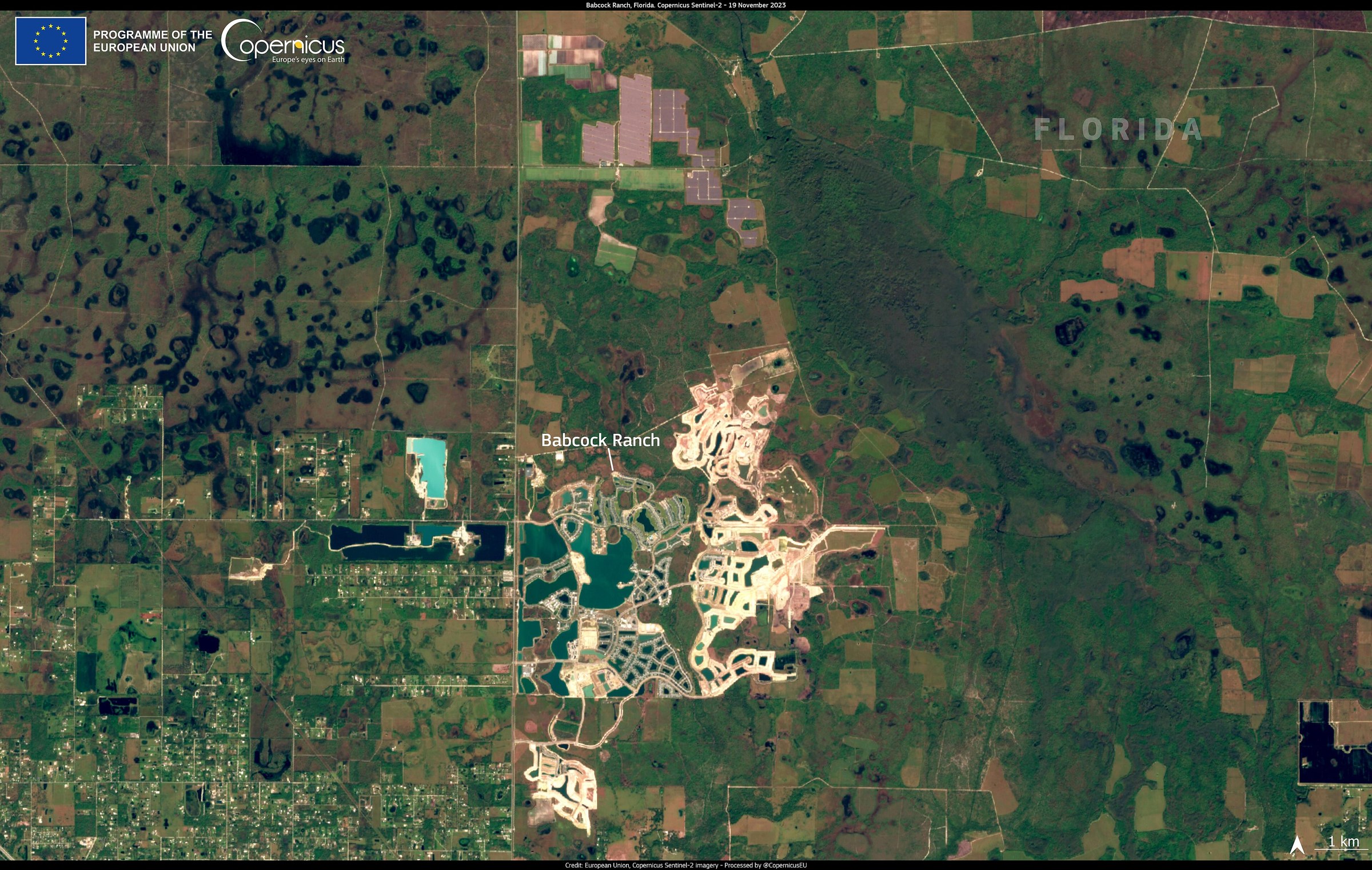
Babcock Ranch, a hurricane-proof town in Florida (Copernicus 2023-12-06). Credit: European Union, Copernicus Sentinel-2 imagery (Attribution), via Wikimedia Commons.
The National Hurricane Center’s revised Tropical Cyclone Report places Ian’s first southwest Florida landfall near Cayo Costa at 15:05 EDT (19:05 UTC) on September 28, 2022, with estimated maximum sustained winds of 240 km/h (150 mph). The center made another mainland landfall near Punta Gorda at 16:35 EDT (20:35 UTC), with sustained winds estimated at about 230 km/h (145 mph).
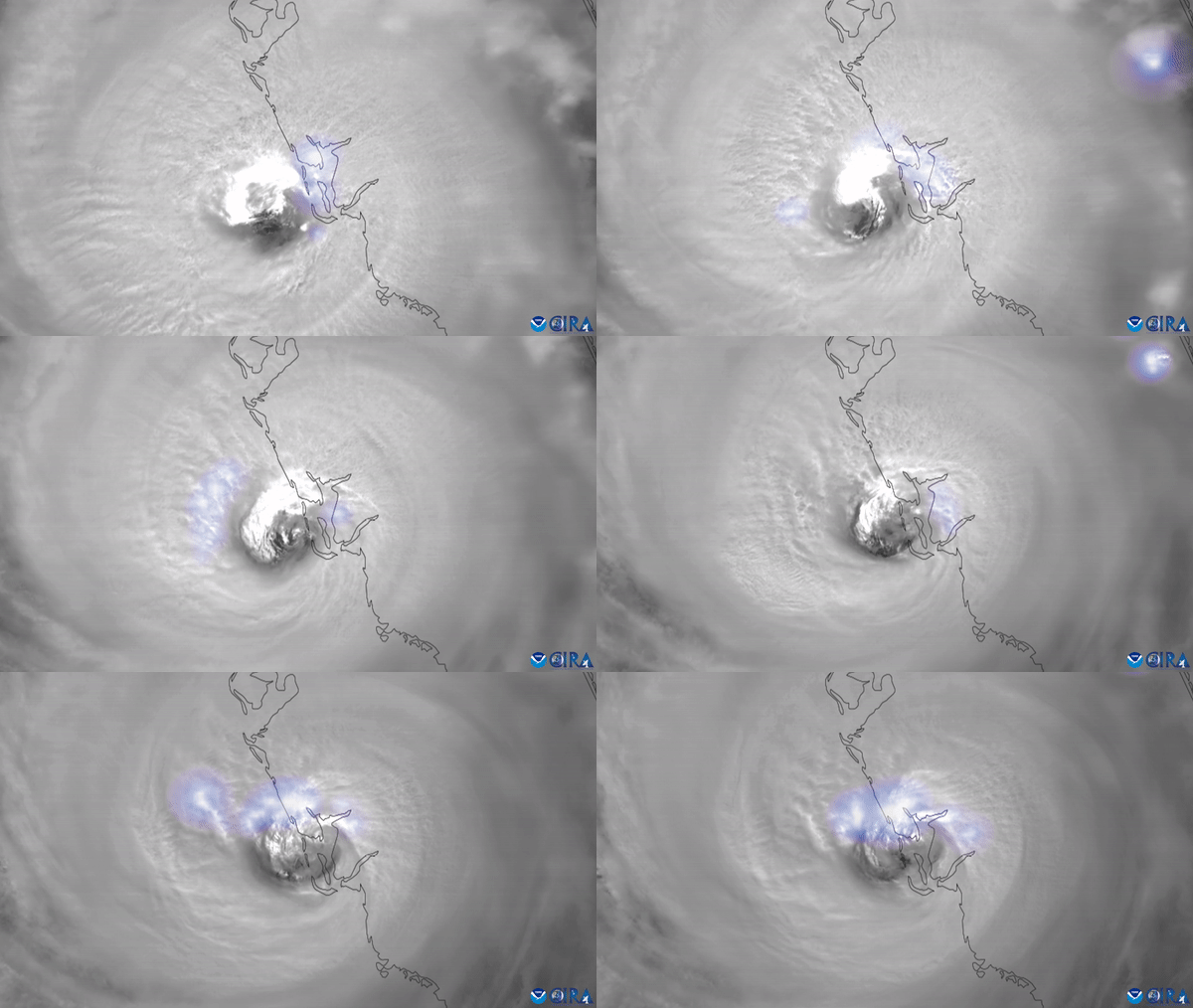
The revised NHC analysis also concludes that Ian briefly reached Category 5 intensity over the Gulf of Mexico earlier that day, with estimated winds of about 260 km/h (160 mph) at 12:00 UTC. Ian weakened before reaching the southwest Florida coast and made landfall at Category 4 intensity.
Babcock Ranch was not Ian’s official coastal landfall point. The planned community lies inland across Charlotte and Lee counties, but the hurricane’s core continued through southwest Florida after coming ashore. ASCE’s engineering review describes Category 4 conditions remaining over the site for about eight hours, while Kitson told 60 Minutes that Babcock Ranch was in the storm’s “bullseye” and experienced roughly eight to ten hours of hurricane conditions.
About 5 000 people lived at Babcock Ranch at the time. CBS reported that none lost electricity during Ian. Kitson said his inspection the following morning found limited damage that included downed trees and shingles removed from some roofs, while ASCE later described mostly minor landscaping damage.

The solar installation provides one of the most visible parts of the story, but published sources use slightly different counts. CBS reported approximately 700 000 panels in 2022. ASCE’s later engineering account gives 687 000 panels across an approximately 352 ha (870-acre) site north of town, with generation capacity of up to 150 MW.
Kitson told CBS that gusts exceeded 240 km/h (150 mph) at Babcock Ranch and that he could not see a panel that had been dislodged. That wind figure is his reported observation rather than an independently verified NHC measurement at the site.
The distinction is important because Ian damaged or disabled weather instruments near its path. NHC’s revised post-storm analysis states that instrument failure left no reliable surface observations from the coastal locations where the eyewall came ashore, limiting direct measurements of the strongest winds in parts of southwest Florida.

The solar array’s survival should not be confused with the community operating as an isolated solar microgrid. Babcock Ranch’s electrical system was developed with Florida Power & Light and remains connected to the wider FPL grid. ASCE reports that the community also receives electricity generated by FPL’s natural-gas plants at times.
Electrical resilience came from several layers of infrastructure. CBS reported that electric and telephone lines in the development were buried. ASCE describes buried electrical lines, concrete utility poles, an electrical substation and other hardened components intended to reduce wind-related failures.
The development also includes ten battery units with a combined capacity of 10 MW. Those batteries support the wider energy system, but neither their presence nor the large solar installation means Babcock Ranch is electrically independent from FPL’s regional network.
Site selection reduced another major hurricane exposure. ASCE reports that the original property lies about 48 km (30 miles) from the Gulf of Mexico and includes parcels around 9 m (30 feet) above sea level. Areas selected for homes and businesses were raised by another 0.9 to 1.8 m (3 to 6 feet), depending on location.
The community’s stormwater system was designed around existing drainage patterns rather than replacing them entirely. Engineers preserved natural flow paths, retained existing wetlands, created additional wetlands and incorporated lakes and control structures that can temporarily hold stormwater.
Road design is part of the same system. Instead of relying only on conventional crowned roads that move water toward storm drains, parts of Babcock Ranch direct runoff toward rain gardens positioned beside or within roadways, allowing water to be detained and treated within the landscape.
Homes and commercial buildings were hardened against wind damage. Structural consultant Jennifer Languell told ASCE that homes use continuous load paths connecting roofs to walls, hurricane straps around roof trusses, reinforced concrete masonry connecting walls to foundations and either operable storm shutters or impact-resistant glass.
Outdoor elements that can become windborne debris were also addressed during design. ASCE reports that trees, playground equipment, benches, trash containers and other objects were braced or anchored where necessary.
Those measures target separate failure mechanisms. Inland and elevated siting reduces exposure to coastal storm surge. Raised construction and stormwater storage reduce flood exposure. Buried electrical distribution removes lines from direct wind loading, while reinforced buildings reduce roof, wall and window failures.
ASCE reported that the community still had electricity, air conditioning, internet access, water and sewer service after Ian and that developed areas had not flooded. A school athletic facility built to serve as an emergency shelter was not required for local residents but received evacuees from surrounding communities.
The local outcome stood against widespread regional infrastructure failure. NHC’s revised 2026 report estimates that approximately 3.28 million electricity customers in Florida lost power at some point because of Ian, with the simultaneous outage count reaching about 2.78 million.
Ian caused much broader destruction beyond electrical outages. NHC attributes at least 156 deaths in the United States to the hurricane, including 66 direct deaths and 90 indirect deaths. Storm surge accounted for 41 direct fatalities, 36 of them in Lee County.
The National Centers for Environmental Information estimated total U.S. damage from Ian at USD 112.9 billion, including USD 109.5 billion in Florida. NHC’s current report ranks Ian as the third-costliest U.S. hurricane and the costliest hurricane in Florida’s history.
Babcock Ranch’s performance does not establish that the community is immune to hurricanes. Its inland position and elevation provided advantages unavailable to exposed coastal settlements, and the town still depends on infrastructure beyond its boundaries.
Ian also exposed weaknesses inside the development. ASCE reported in 2024 that shorelines around some larger lakes experienced more erosion than expected. The community subsequently added hardening measures around those shores and incorporated remotely operated “smart pond” controls intended to increase available stormwater storage before or during major rainfall events.
The electrical system retained another potential single point of failure. In ASCE’s 2024 review, Kitson said the development was working with FPL on a second substation to provide additional redundancy if the existing substation were disabled by a future event.
Ian therefore tested more than a solar field. The result at Babcock Ranch came from the interaction of inland siting, elevation, stormwater engineering, reinforced buildings, buried electrical distribution and a hardened grid connection, while the large solar installation itself also survived the hurricane without the panel losses reported by Kitson.
References:
1 Hurricane Ian Tropical Cyclone Report – National Hurricane Center – March 12, 2026
2 Babcock Ranch: Solar-powered “hurricane-proof” town takes direct hit from Hurricane Ian, never loses electricity – CBS News / 60 Minutes – October 9, 2022
3 How Florida’s Babcock Ranch survived Hurricane Ian – American Society of Civil Engineers – July 1, 2024

I’m a science journalist and researcher at The Watchers, contributing to the Epicenter edition, where I cover peer-reviewed scientific research and emerging discoveries across Earth and space sciences. With a background in astronomy and a passion for environmental science, I’ve worked in shark and coral conservation in Fiji, conducting reef and shark-behavior research, contributing to mangrove restoration, and earning PADI Open Water and Coral Reef Certifications. I bring a blend of scientific rigor and storytelling to illuminate the discoveries shaping our planet and beyond.
Published in the last 24 hours
- Haze from Indonesia’s fires was like smoking 23 cigarettes a day at its worst in one Malaysian district, an MP told parliament Epicenter
- Marine iguanas in the Galápagos got shorter by as much as 6.8 cm (2.7 inches), or a fifth of their length, when El Niño left them short of the seaweed they can digest, and the biggest ones shrank the most and lived the longest Epicenter
- An 83-year-old lodge owner named Harry R. Truman refused to leave his home on Spirit Lake below Mount St. Helens in the spring of 1980, insisting the mountain would not get him, and the May 18 eruption buried him along with his 16 cats Epicenter
- A new model of Antarctica’s Thwaites Glacier that lets seawater seep beneath its grounded ice projects up to about 30 millimeters of sea-level rise by 2100 from that glacier alone, roughly twice the earlier average projection, in a scenario its authors call a lower bound Epicenter
