
LOFAR’s deepest low-frequency radio images reveal hidden structure in distant galaxies
Astronomers have produced the deepest radio images yet at frequencies below 1.28 GHz, bringing faint jets powered by supermassive black holes and other structures in distant galaxies into sharper view. Using the Low Frequency Array (LOFAR), the international team achieved sub-arcsecond detail across a northern-sky field about 25 times the area of the full Moon, allowing astronomers to distinguish radio-emitting structures that previously blended together.
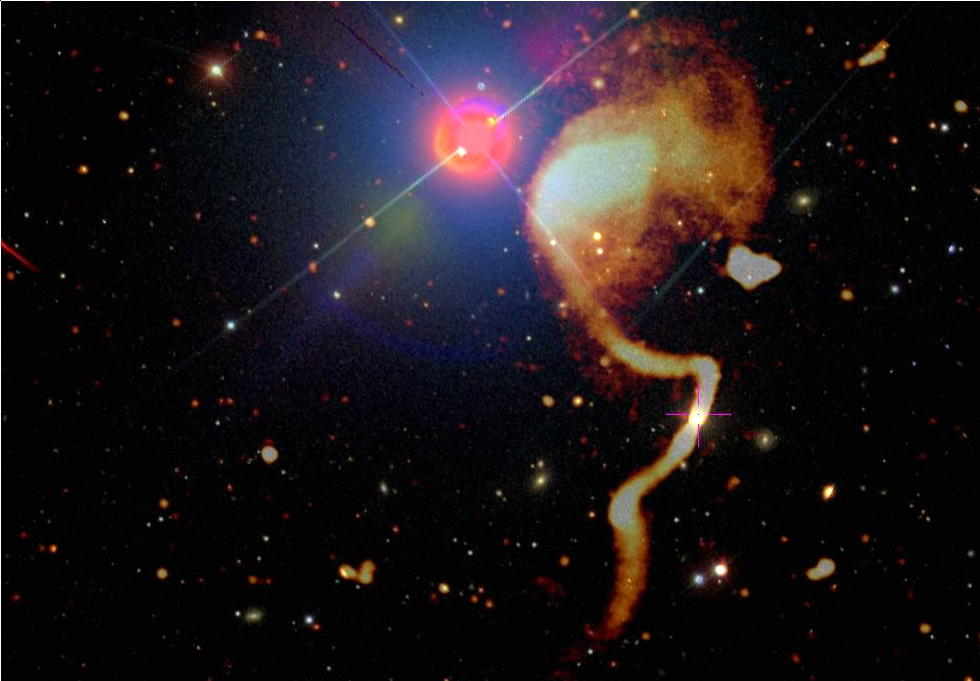
Radio emission from a galaxy in the ELAIS-N1 deep field, overlaid on an optical image. Extended jets and lobes reveal energetic activity associated with a supermassive black hole. Credit: Cyril Tasse and the LOFAR Surveys team (CC BY 3.0)
LOFAR produces deepest low-frequency radio images yet, revealing faint structures in distant galaxies
An international team of astronomers has produced the deepest radio images yet at frequencies below 1.28 GHz, resolving structures in distant galaxies at sub-arcsecond scales while detecting extremely faint emission across a large region of the northern sky. The new Low Frequency Array (LOFAR) observations reveal black-hole-powered jets and radio emission associated with star formation in greater detail, overcoming limitations that previously made it difficult to distinguish these structures in deep radio surveys.
The advance is significant because sensitivity and angular resolution are difficult to combine in low-frequency radio astronomy. Earlier surveys could detect faint emission across large areas, but structures within individual galaxies often remained blended together. The new observations cover a 2.5 × 2.5 deg² region of the ELAIS-N1 field while reaching sub-arcsecond resolution. The researchers also assembled a catalogue of 62 916 unique radio sources, combining detections at several angular resolutions to capture both compact and extended emission.
De Jong et al. (2026) produced the images using 200 hours of LOFAR observations between 115 and 168 MHz. The study, submitted on November 4, 2026, builds on earlier work that established high-resolution imaging of ELAIS-N1 but had not achieved comparable depth across the field. The international team, led by Leiden University, reports that the resulting observations establish a new benchmark for the combination of depth, resolution and survey area at low radio frequencies.

The highest-resolution image reaches a central point-source sensitivity of 5.3 microjanskys per beam (μJy/beam) at 0.33 × 0.39 arcsec resolution. Across the full mosaic, the area-weighted sensitivity is 7.4 μJy/beam at 0.36 × 0.45 arcsec. A microjansky measures a very small radio flux density, while the beam represents the angular area over which the telescope measures the emission. Lower noise allows fainter sources to be detected; a smaller beam reveals finer detail.
Those measurements matter because a faint radio source does not necessarily represent a single physical structure. At lower resolution, the central region of a galaxy, its radio jets and surrounding emission can overlap within the same beam. At sub-arcsecond resolution, astronomers can distinguish some of those components and examine their shapes, positions and brightness distributions separately. The improvement is particularly useful for studying active galactic nuclei (AGN), the energetic central regions of galaxies powered by matter accreting toward supermassive black holes.

Some active galactic nuclei launch jets of high-energy particles that interact with magnetic fields and surrounding gas. Charged particles moving through magnetic fields produce synchrotron radiation, which radio telescopes can detect across enormous distances. The resulting jets and lobes can extend far beyond their host galaxies, providing evidence of how energy released near a supermassive black hole reaches the surrounding environment.
ELAIS-N1 has been a target of LOFAR observations for several years. Earlier radio and optical composites of the same field show how extended jets and lobes appear when radio emission is overlaid on images of the surrounding galaxies. These observations provide useful visual context for the structures now being studied at greater sensitivity and finer resolution.

The radio structures are not always symmetrical. Jets can bend, develop bright knots or inflate large lobes as they move through surrounding material. Their appearance depends on the properties of the outflow, the orientation of the source and the medium through which the particles travel. High-resolution radio observations help astronomers examine those differences without assuming that every extended source has the same physical structure.

Star-forming galaxies constitute another important source population. Massive young stars, supernova remnants and cosmic-ray electrons contribute to their radio emission. Unlike visible light, radio waves can pass through substantial amounts of dust, allowing astronomers to investigate star-forming regions that may be obscured in optical observations. The challenge is to determine how much of a galaxy’s radio emission comes from stellar processes and how much is associated with an active black hole.
The new images improve that separation, particularly where radio jets or compact nuclei would otherwise blend with emission distributed across a galaxy. Radio measurements can also be compared with optical, infrared and X-ray observations to identify host galaxies and estimate properties such as their distances and masses. ELAIS-N1 is especially useful for this work because it has extensive observations at several wavelengths.

Reaching greater depth required much more than a longer exposure. Radio signals recorded across different observing sessions must be calibrated and combined despite changing instrumental conditions and variations in Earth’s ionosphere. The researchers tested the gain from additional observing time by comparing images made from one eight-hour observation with images combining 25 observations, equivalent to the full 200-hour dataset.
The comparisons show how additional observing time reduces image noise and brings out fainter radio structures. At 1.5 arcsec resolution, extended emission becomes easier to trace, while at 0.4 arcsec resolution smaller components appear more clearly against the background. The deepest images contain additional faint point sources and recover more emission associated with radio jets.


The improved images were made possible by LOFAR’s international network of antennas. Instead of using a single large dish, LOFAR combines signals received at stations distributed across Europe. The separation between pairs of stations, known as the baseline, determines the smallest angular structures that the interferometer can resolve. The international baselines used in this work extend to approximately 1 980 km (1 230 miles), providing the resolution required to image distant radio galaxies at sub-arcsecond scales.
Those long baselines also make calibration more difficult. Radio waves passing through Earth’s ionosphere undergo small changes in phase, and the distortions can vary across the observed sky. The team used direction-dependent calibration, applying corrections to different regions of ELAIS-N1 rather than treating the entire field as though all incoming radio signals experienced identical distortions. This approach allowed observations obtained under different conditions to be aligned and combined.

The computational demands were substantial. The Netherlands Research School for Astronomy reports that approximately 400 TB of observational data were processed into an image containing about 8 billion pixels. The calculations were carried out using the Spider high-performance data platform operated by SURF in the Netherlands. Recent improvements in automated calibration and image processing reduced the overall computational cost by more than an order of magnitude compared with the earliest successful LOFAR sub-arcsecond wide-field imaging.
One of the important improvements was sidereal visibility averaging. Radio interferometers record measurements, called visibilities, describing the correlation of signals received by pairs of antennas. After calibration, measurements from different observing sessions with similar baseline coordinates can be averaged together. This substantially reduces the amount of data that must be processed during the final imaging stage while retaining the information needed for the high-resolution images.
The researchers compared their results with other major radio surveys to assess the significance of the achieved depth. The comparison includes observing frequency, sensitivity, survey area and angular resolution. The authors conclude that their images are the deepest radio images below 1.28 GHz to date and among the deepest produced at any frequency. That frequency limit is important: the result does not mean LOFAR has surpassed every radio telescope at every observing wavelength.

Earlier ELAIS-N1 observations provide a useful baseline for the improvement. A 2024 high-definition survey based on 32 observing hours reached a central sensitivity of 14 μJy/beam at approximately 0.3 arcsec resolution. The new 200-hour analysis reaches 5.3 μJy/beam at comparable angular resolution, an improvement of roughly a factor of 2.6. A separate deep LOFAR release using 505 observing hours covered a larger field at 6 arcsec resolution but could not distinguish the same fine structures.
The earlier deep-field surveys also established the value of repeated observations of ELAIS-N1. One 164-hour image revealed more than 80 000 radio sources across a wider area and illustrated the wide range of structures detectable at low radio frequencies. The new investigation concentrates on a smaller field with much finer resolution, building on the earlier surveys rather than replacing them.

Earlier maps at approximately 150 MHz also demonstrated that high sensitivity could reveal faint compact radio sources alongside extended emission from much larger objects. Detecting both populations is important because faint, diffuse radiation can disappear from a high-resolution image when its brightness is distributed across too many small beams. The new work addresses this problem by retaining several versions of the image at different angular resolutions.

The final catalogue combines detections at approximately 0.3, 0.6, 1.2 and 6 arcsec resolution. The sharpest images reveal compact components that may be blended at lower resolution, while the broader beams can retain faint extended structures that fall below the detection threshold at higher resolution. The resulting catalogue contains 62 916 unique radio sources across the 2.5 × 2.5 deg² field.
The distinction between detections and catalogue entries is important. The complete multi-resolution catalogue contains 63 841 rows, but these represent 62 916 unique sources. Some radio galaxies occupy more than one row because they appear as separate components at high resolution but as a single source in broader-beam images. Of the unique sources, 50.5% are detected at more than one resolution and 25.5% are detected at all four resolutions.

The researchers also tested the positional accuracy of the observations using 95 quasars detected by the Gaia space observatory. Quasars are distant, compact sources powered by active galactic nuclei, making them useful reference points when radio and optical measurements need to be aligned. After correcting the positions, the authors obtained offsets of −3 ± 27 milliarcseconds in right ascension and 2 ± 17 milliarcseconds in declination.
One milliarcsecond is one-thousandth of an arcsecond. Such small positional differences matter because a radio detection may be located close to several faint galaxies in optical images. Accurate alignment helps astronomers identify the correct counterpart and connect radio emission with measurements of a galaxy’s distance, mass and other properties.


The dataset was also examined for polarization studies. Radio waves can carry information about magnetic fields through their polarization, but weak polarized signals can be contaminated when a small fraction of total radio intensity leaks into the polarization measurements. The researchers report instrumental leakage from Stokes I, which measures total intensity, into linear polarization as low as 0.12%. This is approximately half the typical leakage in LOFAR Two-metre Sky Survey images at 6 arcsec resolution.
The difference is visible in observations of the radio source 7C 1604+5447. Comparing eight hours of data with the full 200-hour observations shows lower noise and more clearly detectable polarized emission around the source’s hotspots and southern lobe. The result supports the use of the dataset for deeper polarization studies, although detailed analysis of polarization across the wider ELAIS-N1 field remains a separate research task.


The survey has limitations. The researchers selected 200 hours from 505 hours of available ELAIS-N1 observations, excluding data without suitable international-station coverage, observations affected by excessive time smearing, and those with elevated noise or problematic calibration. The final images therefore represent an optimized high-resolution dataset rather than an analysis of every observation previously recorded in the field.
High-resolution imaging also remains less sensitive to some forms of diffuse emission. A source visible at 6 arcsec resolution may disappear from the 0.3 arcsec catalogue because its radiation is distributed across many smaller beams. The researchers identified 1 115 locations requiring further visual inspection where sources detected as single objects at lower resolution break into multiple components at higher resolution. Additional work is also needed to establish the completeness and reliability of detections across the different image resolutions.
The new capabilities are relevant to the next generation of radio surveys. The authors identify deeper and wider imaging with LOFAR2.0, the telescope’s ongoing upgrade, and the Square Kilometre Array era as important extensions of the work. The present study establishes that hundreds of hours of low-frequency observations can be combined at sub-arcsecond resolution across a wide field within a feasible computing effort. Future analysis will determine how completely such surveys can recover faint galaxies, compact black-hole-powered sources and extended radio structures across larger areas of the sky.
References:
1 de Jong, J. M. G. H. J., Morabito, L. K., van Weeren, R. J., Oonk, J. B. R., Ahmadi, A., Best, P. N., Hale, C. L., Kondapally, R., Lusetti, G., Röttgering, H. J. A., Shimwell, T. W., Sweijen, F., Timmerman, R., & van der Wild, M. (2026). Pushing the frontiers of low-frequency radio astronomy: An ultra-deep sub-arcsecond LOFAR image of ELAIS-N1. Astronomy & Astrophysics (accepted manuscript; arXiv:2611.06152). DOI: 10.48550/arXiv.2611.06152
2 de Jong, J. M. G. H. J., van Weeren, R. J., Sweijen, F., Oonk, J. B. R., Shimwell, T. W., Offringa, A. R., Morabito, L. K., Röttgering, H. J. A., Kondapally, R., Escott, E. L., Best, P. N., Bondi, M., Ye, H., & Petley, J. W. (2024). Into the depths: Unveiling ELAIS-N1 with LOFAR’s deepest sub-arcsecond wide-field images. Astronomy & Astrophysics, 689, A80. DOI: 10.1051/0004-6361/202450595
3 Astronomers deliver the sharpest and deepest view yet of the low-frequency radio sky – Netherlands Research School for Astronomy – November 5, 2026
4 Durham astronomer Professor Morabito helps create groundbreaking map of the radio universe – Durham University – November 6, 2026
5 LOFAR Surveys image gallery – LOFAR Surveys – CC BY 3.0

I’m a science journalist and researcher at The Watchers, contributing to the Epicenter edition, where I cover peer-reviewed scientific research and emerging discoveries across Earth and space sciences. With a background in astronomy and a passion for environmental science, I’ve worked in shark and coral conservation in Fiji, conducting reef and shark-behavior research, contributing to mangrove restoration, and earning PADI Open Water and Coral Reef Certifications. I bring a blend of scientific rigor and storytelling to illuminate the discoveries shaping our planet and beyond.
Published in the last 24 hours
- Meteors streaked over Arizona at about 40 a second for 20 minutes one November night in 1966, from the same shower that returns every November Epicenter
- Neptune's moon Triton has the coldest surface ever measured in the solar system, minus 391 degrees Fahrenheit, yet Voyager 2 caught geysers on it blasting dark plumes 5 miles high Epicenter
- When the Sun’s stormy peak dragged NASA's 77-tonne Skylab out of orbit earlier than expected in 1979, debris rained across Western Australia and the town of Esperance fined NASA $400 for littering; a California radio host finally paid it 30 years later Epicenter
- A rose-colored rock found in the Sahara in 2022 turned out to be a piece of Mars more than 4.1 billion years old Epicenter
