
Kanlaon eruption sends ballistics 1.5 km high, triggers PDCs, forest fires and ashfall across 121 barangays
A significant explosive eruption occurred at Kanlaon Volcano, Philippines, at 19:04 local time (LT) on February 26, 2026, sending a dense ash plume 2.5 km (1.6 miles) above the crater and producing pyroclastic density currents (PDCs) that descended its upper slopes. The eruption lasted two minutes and was followed by 77 minutes of continuous ash emission dispersed over southern Negros Island.
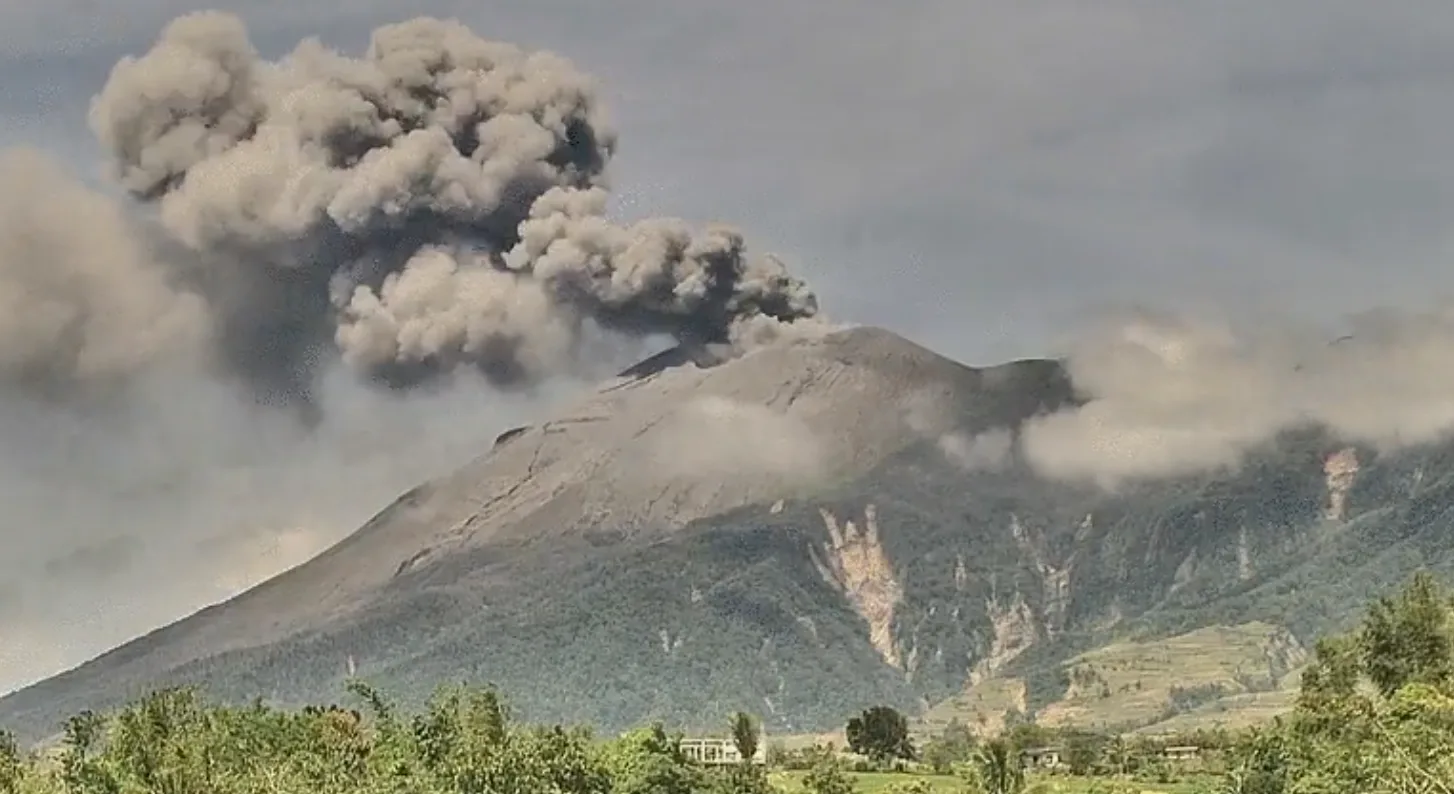
Kanlaon Volcano eruption on February 27, 2026. Credit: PHIVOLCS
The Philippine Institute of Volcanology and Seismology (PHIVOLCS) reported that the initial explosive phase lasted two minutes and was detected by 20 seismic-infrasound stations across the Kanlaon and Hibok-Hibok networks, with the resulting dark gray plume drifting southwest and illuminated by at least three strikes of volcanic lightning.
An explosive shock wave recorded at 218 Pa by an infrasound station approximately 4 km (2.5 miles) southeast of the crater was heard as a loud boom up to 30 km (19 miles) away, while rumbling was reported as far as Southern Leyte, more than 175 km (109 miles) east, likely due to atmospheric refraction of the sound waves.
The blast ejected incandescent ballistic fragments up to 1.5 km (0.9 miles) high, with superheated projectiles landing up to 1 km (0.6 miles) south and 1.5 km (0.9 miles) southeast of the summit, forming a briefly glowing collar around the crater.
Simultaneously, pyroclastic density currents, hazardous avalanches of hot gas, ash, and rock, descended the southeast and eastern upper slopes within 2 km (1.2 miles) of the vent, and the extreme heat from both the ballistics and PDCs ignited two distinct patches of forest fire on the volcano’s upper southern and southeastern slopes.
Camera observations confirmed the fires burned through the night before self-extinguishing at around 08:19 LT on February 27. Following the initial explosion, Kanlaon transitioned into a 77-minute phase of continuous, profuse ash emission, with high-altitude winds of approximately 12 m/s (27 mph) dispersing ash widely across the southern Negros Island Region.
Heavy ashfall blanketed the municipalities of La Castellana and Pontevedra, while 121 barangays across 16 cities and municipalities reported heavy to light ashfall alongside sulfurous odours, before a brief overnight pause gave way to resumed continuous ash emissions at 09:43 LT on February 27.
Prior to the eruption, seismic activity had been relatively low, with only nine volcanic earthquakes recorded on February 26, four of which were low-frequency events associated with volcanic gas activity.
Notably, sulfur dioxide emissions had dropped to just 194 tonnes per day immediately before the blast, a steep decline from the average 2 800 tonnes per day observed since June 2024 and the 1 460 tonnes per day average recorded since January 1.
LOOK: Time-lapse footage of the ash emission from Kanlaon Volcano that occurred at 09:43 AM to 10:53 AM today, 27 February 2026. This event generated voluminous grayish plumes that rose 1000 meters above the summit crater before drifting to the general South as recorded by the IP… pic.twitter.com/jyxwacPtcu
— PHIVOLCS-DOST (@phivolcs_dost) February 27, 2026
Geodetic monitoring using electronic tilt and GPS data showed that the volcano edifice has been swelling at very low, fluctuating rates since 2022, with more pronounced short-term inflation beginning in late January 2026.
PHIVOLCS interprets this as closed-system degassing, where blocked gas pathways from a deep magma source caused pressure to build until it triggered the explosion.
In the 24 hours preceding the eruption, 14 volcanic earthquakes were recorded, 12 of which contained enough data to be accurately mapped.
PHIVOLCS currently maintains Alert Level 2 over Kanlaon but warns that the alert status may be raised in the coming hours should unrest persist or worsen, potentially leading to fully magmatic unrest and hazards within the designated Lava and PDC Hazard Zones.
Authorities are strongly reiterating that entry into the 4 km (2.5 miles) Permanent Danger Zone is strictly prohibited due to the life-threatening risk of sudden steam-driven eruptions, precursory magmatic activity, pyroclastic density currents, rockfalls, and volcanic gas. Communities within the 6 km (3.7 miles) PDC hazard zone are being urged to prepare for immediate evacuation should the alert level be raised.
Residents exposed to ashfall are advised to protect themselves against respiratory irritation and safeguard food and water resources from contamination, while remaining vigilant for lahar formation should heavy rains mobilize the freshly deposited volcanic debris into hazardous mudflows.
Aviation authorities have also been instructed to strictly advise pilots to avoid flying near the volcano’s summit.
References:
1 KANLAON VOLCANO ERUPTION BULLETIN, 27 February 2026, 2:00 PM – PHIVOLCS – February 27, 2026

I’m a science journalist and researcher at The Watchers, contributing to the Epicenter edition, where I cover peer-reviewed scientific research and emerging discoveries across Earth and space sciences. With a background in astronomy and a passion for environmental science, I’ve worked in shark and coral conservation in Fiji, conducting reef and shark-behavior research, contributing to mangrove restoration, and earning PADI Open Water and Coral Reef Certifications. I bring a blend of scientific rigor and storytelling to illuminate the discoveries shaping our planet and beyond.

Our 218 Pa is 140.75 dB (SPL), at 4km, for context this as an impulse-blast will cause catastrophic hearing-damage with vestibular risk in that instant to anyone directly facing, think similar to standing next to a large naval gun being discharged, ‘loud boom’ at 30km perhaps no surprise. “Trapped gas”
I hope everyone affected is doing well in the circumstances, hopefully quieter, better times to come soon for this beautiful area. Our fearsome planet. Any significant marine life impact expected?