
Multiple missing, over 3 million advised to evacuate after extreme rainfall hits Kyushu, Japan
Record August rainfall caused severe flooding and landslides in Kumamoto Prefecture, Japan, on August 10–11, 2025, leaving several people missing and prompting evacuation advisories for over 3 million residents and widespread transport disruptions.
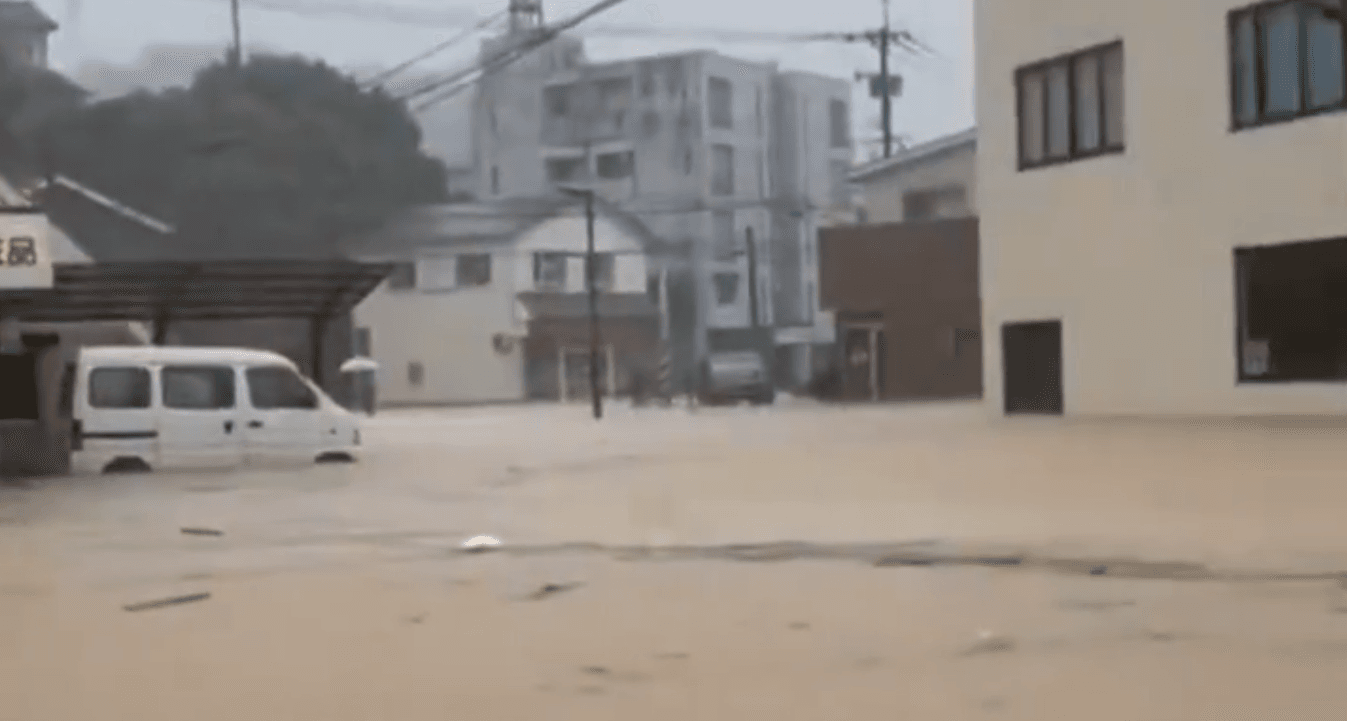
Flooding in Kamiamakusa City, Kumamoto Prefecture, Japan on August 11, 2025. Credit: Weather Monitor
- A stationary low-pressure front dropped more than 370 mm (14.6 inches) of rain in six hours in Tamana City, Kumamoto Prefecture, breaking local records and exceeding double the average August total.
- As of late August 11 (local time), there were no confirmed fatalities, but multiple people were missing, including residents swept into rivers in Kumamoto and Fukuoka Prefectures and one person buried in a mudslide in Yamato Town.
- Floodwaters and landslides cut off roads, stranded communities, suspended Kyushu Shinkansen and local train services, and left about 6 000 households without power at the peak of the disaster.
A stationary low-pressure front over Kyushu produced record-breaking rainfall in southern Japan between August 10 and 11, 2025, with the heaviest impacts in Kumamoto Prefecture.
The Japan Meteorological Agency (JMA) reported more than 370 mm (14.6 inches) of rain in Tamana City in just six hours, a local record and nearly double the average August total. Some areas in Kumamoto received over 400 mm (15.7 inches) in 24 hours.
The deluge caused rivers to overflow, inundating roads and residential areas, while landslides destroyed homes and blocked access routes.
In Kami-Amakusa, residents and campers were stranded by rising waters. Mudslides buried a house in Yamato Town, leaving one person missing and two others rescued. Several people were swept away in swollen rivers in Kumamoto and neighboring Fukuoka Prefecture.

The Fire and Disaster Management Agency (FDMA) said more than 3 million people across Kyushu were under evacuation advisories, including about 384 000 in Kumamoto under the highest warning level.
The Ministry of Defense deployed Self-Defense Forces to assist in rescue and supply delivery, including fresh water to isolated communities.
Kyushu Shinkansen bullet train services and multiple local train lines were suspended, with some partial resumptions later in the day.
Around 6 000 households lost power at the height of the event, though roughly half had service restored by the evening of August 11.
This morning: Flooding in Kamiamakusa City, Kumamoto Prefecture, Japan.
— Weather Monitor (@WeatherMonitors) August 11, 2025
ALERT LEVEL 5: An Emergency Safety evacuation order has been issued for 10,960 households (23,301 people) due to heavy rain and heightened disaster risk. Residents should take immediate life-saving actions. pic.twitter.com/RRE7GbSrDN
Heavy flooding due to torrential rainfall in Kitakyushu, Fukuoka Prefecture, Japan (10.08.2025) pic.twitter.com/TRiqzxm6NN
— Disaster News (@Top_Disaster) August 10, 2025
As of August 11, there were no confirmed fatalities, but multiple people remained missing. This included one resident of Yamato Town, at least two individuals swept into rivers in Fukuoka Prefecture, and a father missing in Kōsa Town whose wife and two children were safe. Several injuries have been reported, though official counts vary between agencies.
The JMA warned that heavy rain is expected to continue through August 12, increasing the risk of further flooding and landslides. Residents have been urged to maintain maximum caution and prioritize life safety.

I’m a science journalist and researcher at The Watchers, contributing to the Epicenter edition, where I cover peer-reviewed scientific research and emerging discoveries across Earth and space sciences. With a background in astronomy and a passion for environmental science, I’ve worked in shark and coral conservation in Fiji, conducting reef and shark-behavior research, contributing to mangrove restoration, and earning PADI Open Water and Coral Reef Certifications. I bring a blend of scientific rigor and storytelling to illuminate the discoveries shaping our planet and beyond.
Published in the last 24 hours
- In September 1859, a solar storm lit up the night sky so brightly that gold miners in the Rocky Mountains woke up after midnight and started cooking breakfast, convinced the aurora glowing over their camp was the sunrise Epicenter
- A patch of warm Pacific water that could become the strongest El Niño in more than 70 years sits thousands of miles from any American town, yet it is already the main reason NOAA expects a wetter winter across the South and a milder one across the North
- A 19-year-old Nebraska teacher reportedly tied her pupils together with twine and led them to safety through a blizzard in January 1888 Epicenter
- NASA built the Opportunity rover to last 90 days on Mars, and Martian winds helped keep it alive for nearly 15 years by blowing dust off its solar panels, until a planet-wide dust storm in 2018 blocked sunlight and silenced the rover Epicenter
