
Hidden geomagnetic reversals found in Earth’s magnetic history
Earth’s magnetic field may have experienced more polarity reversals than currently recorded, according to a new study using statistical modeling. Researchers found anomalies in the geomagnetic reversal frequency, suggesting that some reversals remain undetected. Incorporating recently discovered reversals from Ethiopian flood basalts into the dataset revealed hidden patterns that could refine our understanding of Earth’s magnetic history.
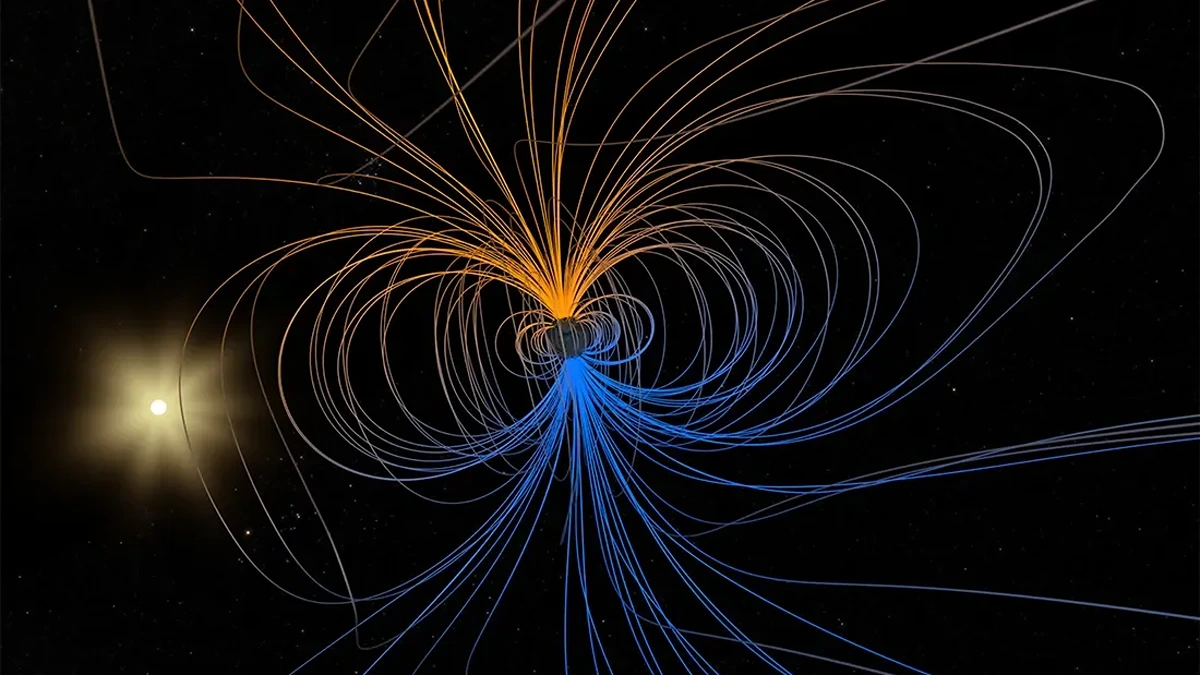
The stereoscopic visualization showing a simple model of the Earth’s magnetic field. Image credit: NASA’s Goddard Space Flight Center
- Four previously unknown geomagnetic polarity reversals were identified in the Ethiopian flood basalts, dated to approximately 31 million years ago during the Oligocene epoch.
- Researchers employed fixed-bandwidth kernel density estimation (KDE) to uncover hidden reversals, avoiding data smoothing issues present in adaptive-bandwidth KDE which may have masked short-lived geomagnetic transitions.
- Integrating the Lima-Limo reversals into the geomagnetic polarity timescale (GPTS) refined reversal frequency models, revealing that previously stable periods may contain undetected magnetic fluctuations which reshapes our understanding of Earth’s magnetic field evolution.
Four previously unknown geomagnetic reversals, named the Lima-Limo reversals, were identified in the Ethiopian flood basalts and dated to approximately 31 million years ago (Ma) during the Oligocene epoch. These findings suggest that additional undetected reversals may exist in Earth’s magnetic history.
A study published on January 28, 2025, by geophysicists from the University of Tokyo and the Geological Survey of Japan applies fixed-bandwidth kernel density estimation (KDE) to reveal previously undetected geomagnetic reversals within periods previously considered geomagnetically stable.
The study analyzed how incorporating the Lima-Limo reversals into geomagnetic polarity timescale (GPTS) models affected the calculated frequency of geomagnetic reversals.
Researchers observed that integrating the Lima-Limo reversals into the GPTS suppressed a previously noted concavity near Chron C12r, suggesting that similar concavities in reversal frequency models may indicate additional undetected geomagnetic reversals.
Discovery of the Lima-Limo reversals
The Lima-Limo reversals are a sequence of geomagnetic polarity reversals identified in the Lima-Limo section of the northwestern Ethiopian plateau. The reversals were discovered through detailed paleomagnetic and rock magnetic analyses of 92 successive volcanic units.
The research team identified three primary polarity zones: R1 (initial reversed polarity zone), N1 (central normal polarity zone), and R4 (subsequent reversed polarity zone), corresponding to reversed, normal, and reversed magnetic polarities. The central normal polarity zone (N1) was recorded in full detail.
Researchers identified short-lived reversed-polarity intervals, designated as R2 and R3, between the primary polarity zones. Collectively known as the “Lima-Limo reversals,” these events are not documented in the existing GPTS, indicating previously unrecognized geomagnetic transitions.
The Lima-Limo reversals (R2 and R3) are brief reversed-polarity intervals occurring within the central normal polarity zone (N1).
High-precision 40Ar/39Ar dating methods placed the age of the reversals at approximately 31 million years ago, during the Oligocene epoch.
The specific names and detailed characteristics of each reversal within the Lima-Limo sequence have not been specified. Individual names and definitions for each reversal are not currently provided while the collective term “Lima-Limo reversals” is used to describe the events.
Use of fixed-bandwidth KDE over adaptive-bandwidth KDE
In paleomagnetic research, various statistical methods are employed to analyze geomagnetic data, each with its strengths and limitations. The research used fixed-bandwidth KDE to capture finer details in the geomagnetic record, unlike previous studies that employed adaptive-bandwidth KDE which may have excessively smoothed reversal frequency models.
Fixed-bandwidth KDE was chosen over adaptive-bandwidth KDE because it provides a consistent level of detail across the entire dataset, making it more effective at detecting short-lived geomagnetic reversals that may be otherwise smoothed out in adaptive models.
Adaptive-bandwidth KDE adjusts the bandwidth based on local data density which can lead to over-smoothing in areas with fewer data points. It can cause short-duration reversals, like the Lima-Limo reversals, to be missed or averaged out.
The fixed-bandwidth KDE, on the other side, applies a uniform bandwidth across all data points, ensuring that even subtle variations in reversal frequency are captured.
Many geomagnetic reversals are short-lived and can be difficult to detect if the modeling technique overly smooths data. Fixed-bandwidth KDE maintains the resolution necessary to identify these brief events, unlike adaptive-bandwidth KDE which might blur these reversals into longer stable periods.
Long chrons (periods of stable magnetic polarity lasting 0.8 million years or more) are susceptible to data smoothing in adaptive-bandwidth KDE. Fixed-bandwidth KDE prevents artificial gaps or smoothing, ensuring that any hidden reversals within these periods remain visible.
Since geomagnetic reversals vary in duration, using an adaptive bandwidth can create inconsistencies in how reversals are detected over different time periods. Fixed-bandwidth KDE treats all data points equally, preventing bias that may arise from variable bandwidth adjustments.
Implications for Earth’s magnetic record
The suppression of the concavity near Chron C12r after incorporating the Lima-Limo reversals into the GPTS provides a more refined understanding of Earth’s magnetic field history by revealing how previous reversal frequency models may have overlooked key transitional events.
The concavity represented an unexplained gap or irregularity in the reversal frequency model before this adjustment, suggesting either a period of unusual magnetic stability or missing data.
The gap was smoothed out with the addition of the Lima-Limo reversals, indicating that previously undetected short-lived reversals may exist within other concavities found in the GPTS. The finding challenges earlier assumptions that long chrons or periods of stable magnetic polarity lasting 0.8 million years or more were devoid of magnetic fluctuations. It suggests instead that some of these extended periods may contain unrecognized reversals, requiring more precise paleomagnetic analysis to uncover hidden transitions.
The study enhances our ability to reconstruct the geomagnetic field’s behavior over millions of years by refining the reversal frequency model, leading to a more accurate representation of how Earth’s magnetic field has evolved and interacted with geodynamic processes.
The research shows the importance of continuous improvements in geomagnetic research methodologies. Future investigations should focus on refining reversal frequency models and conducting targeted studies in geological formations where concavities are present in the existing data.
The application of fixed-bandwidth KDE in the research has demonstrated its potential as a powerful tool for identifying subtle features in geomagnetic records.
References:
1 Hidden geomagnetic reversals? Inference from geomagnetic reversal frequency modeled by kernel density estimation, Yutaka Yoshimura, Masakazu Fujii, Hideitsu Hino, Shotaro Akaho, et. al., ESS – January 28, 2025 – 10.22541/essoar.173809945.54947701/v1 – OPEN ACCESS

Rishika holds a Master’s in International Studies from Stella Maris College, Chennai, India, where she earned a gold medal, and an MCA from the University of Mysore, Karnataka, India. Previously, she served as a Research Assistant at the National Institute of Advanced Studies, Indian Institute of Science, Bengaluru, India. During her tenure, she contributed as a Junior Writer for Europe Monitor on the Global Politics website and as an Assistant Editor for The World This Week. Her work has also been published in The Hindu newspaper, showing her expertise in global affairs. Rishika is also a recipient of the Women Empowerment Award at the district level in Haryana, India, in 2022.

Commenting rules and guidelines
We value the thoughts and opinions of our readers and welcome healthy discussions on our website. In order to maintain a respectful and positive community, we ask that all commenters follow these rules.