
Evidence of supernova explosions and super solar flares hidden in Earth’s history
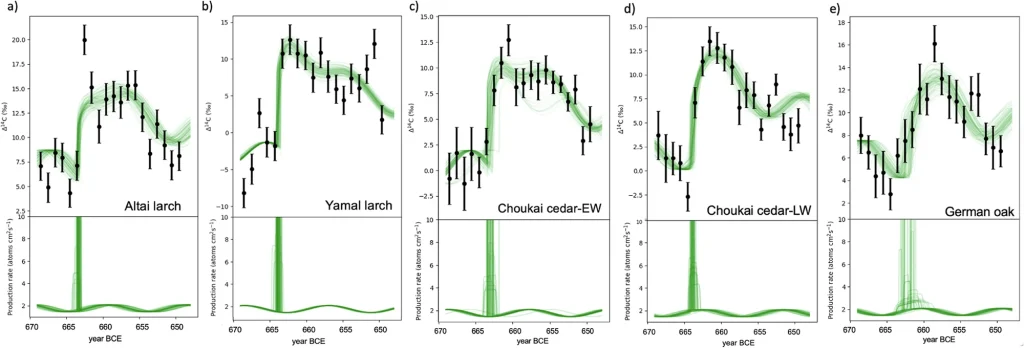
Scientists have discovered new evidence that Earth has been bombarded by extreme cosmic radiation in the past, leaving “fingerprints” of supernova explosions and solar superflares in tree rings and ice cores. These rare events, known as Miyake Events, reveal sudden spikes in radiocarbon (¹⁴C) levels, suggesting that powerful cosmic forces — ranging from massive solar storms to nearby supernovae –may have impacted Earth’s atmosphere far more frequently than previously thought. A newly identified event from 12 350 BCE could be the most intense yet, challenging our understanding of space weather and cosmic threats to our planet.

Image credit: NASA/JPL-Caltech/K. Su (University of Arizona)
Scientists have uncovered new evidence of past cosmic events imprinted in Earth’s tree rings, revealing sudden and dramatic increases in radiocarbon (¹⁴C) levels. These rare events, known as Miyake Events, suggest that Earth has been subjected to extreme cosmic radiation in the past — possibly from super solar flares or even nearby supernova explosions.
Miyake Events are defined by sharp increases in ¹⁴C concentrations, preserved in tree rings worldwide. This isotope forms when high-energy cosmic rays interact with Earth’s atmosphere, leading to a measurable spike in radiocarbon levels.
The first such event was discovered in 2012 by Fusa Miyake, a researcher analyzing a 1 900-year-old Japanese cedar stump. The rings showed a 12% rise in ¹⁴C levels between 774 and 775 CE — a change 20 times larger than normal fluctuations in cosmic radiation.
Since then, five confirmed Miyake Events have been identified, dated to 7176 BCE, 5259 BCE, 660 BCE, 774 CE, and 993 CE, with several more under investigation.
What caused Miyake Events?
Most scientists believe that super solar flares—massive eruptions of energy from the Sun—are the primary cause of Miyake Events. However, alternative explanations remain, including gamma-ray bursts or nearby supernova explosions.
A strong link between solar storms and Miyake Events is supported by the presence of beryllium-10 (¹⁰Be) and chlorine-36 (³⁶Cl) in ice cores, which indicate periods of intense solar activity. The 774 – 775 CE event, for example, coincided with historical reports of auroras in China and England, suggesting a direct connection to extreme solar activity.
However, some events remain difficult to explain solely by solar flares. The scale of cosmic radiation exposure implied by some Miyake Events suggests a broader cosmic origin, such as radiation bursts from a nearby supernova.
The most extreme Miyake Event yet
A newly identified 12 350 BCE event could be the largest Miyake Event ever recorded. Researchers analyzing ancient tree rings from the eroded banks of the Drouzet River in the French Alps found a sharp radiocarbon spike between 12 350 and 12 349 BCE—twice the magnitude of the well-documented 774 CE and 993 CE events.
While this event appears unprecedented in intensity, it has yet to be independently confirmed in tree samples from other regions. Researchers are also searching for corresponding spikes in ¹⁰Be and ³⁶Cl levels in ice cores, which would further support a solar or cosmic origin.
Searching for more cosmic fingerprints
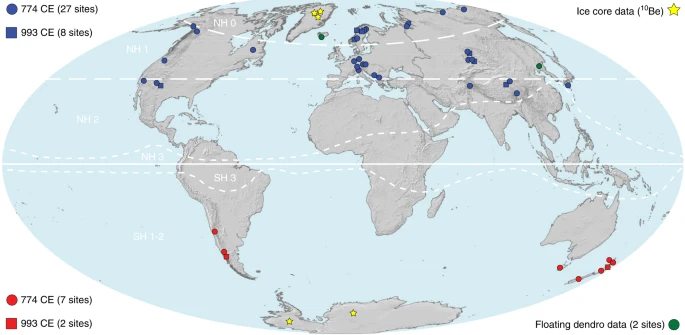
The discovery of Miyake Events has positioned tree-ring scientists (dendrochronologists) at the forefront of space weather research. Since 2012, a global collaboration known as the COSMIC initiative has been systematically searching for more evidence of these extreme cosmic events.
By analyzing ancient tree rings from across the world, the initiative confirmed that the 774 CE and 993 CE events were truly global, with ¹⁴C spikes detected in samples from five continents.
“There could be additional Miyake Events throughout the Holocene,” said Irina Panyushkina of the University of Arizona’s Laboratory for Tree-Ring Research. “Finding them will require a slow and systematic approach.”
Panyushkina highlights floating tree-ring chronologies from Europe and North America as a valuable new source for annual ¹⁴C records. These preserved tree remains could help extend the known record of cosmic radiation events as far back as 15 000 years.
“Eventually, I believe we will compile a complete record of Miyake Events over that timeframe,” she added.
Are we due for another cosmic event?
Current estimates suggest that Miyake Events occur every 400 to 2 400 years, meaning Earth could experience another extreme cosmic radiation event in the future.
While solar storms pose the most immediate risk to modern civilization—disrupting satellites, power grids, and communications—scientists are also investigating whether Earth has been exposed to past supernova radiation. If confirmed, this would dramatically reshape our understanding of cosmic threats to Earth.
Future research will focus on refining Miyake Event detection methods and investigating the potential sources of these extreme cosmic radiation spikes. With new tree-ring data, ice core records, and advanced space weather modeling, scientists hope to uncover whether Earth has experienced the effects of a nearby supernova in its recent past.
References:
1 The timing of the ca-660 BCE Miyake solar-proton event constrained to between 664 and 663 BCE – Irina P. Panyushkina – Nature.com – August 23, 2024 – https://doi.org/10.1038/s43247-024-01618-x
2 A radiocarbon spike at 14 300 cal yr BP in subfossil trees provides the impulse response function of the global carbon cycle during the Late Glacial – Edouard Bard – The Royal Society Publishing Philosophical Transactions A – October 9, 2023 – https://royalsocietypublishing.org/doi/10.1098/rsta.2022.0206
3 Tree rings reveal globally coherent signature of cosmogenic radiocarbon events in 774 and 993 CE – Ulf Büntgen – Nature.com – https://doi.org/10.1038/s41467-018-06036-0

I am an Assistant Editor and Severe Weather & Science Journalist at The Watchers, specializing in real-time severe weather coverage, geophysical event reporting, and research-driven scientific analysis. You can reach me at rishav(at)watchers(.)news.

Thank you for this informative article!