
Effusive eruption at Stromboli volcano, lava flowing down Sciara del Fuoco, Italy
Effusive lava activity has been observed with lava overflowing from the northern summit area at Stromboli volcano, Italy since 07:08 LT (06:08 UTC) on February 6, 2025. The Aviation Color Code remains at Orange.

Lava overflow at Stromboli at 04:30 UTC on February 6, 2025. Image credit: INGV
Lava overflows from the northern summit area have been observed during effusive activity at Stromboli volcano since 07:08 LT (06:08 UTC) on February 6, 2025. The National Institute of Geophysics and Volcanology (INGV) confirmed that the activity follows an increase in spattering that has been ongoing for several days. The Aviation Color Code remains at Orange.
Volcanic ash cloud had been detected thus far and the phenomenon was observed using visible and thermal surveillance cameras.
The lava flow is moving down the upper portion of the Sciara del Fuoco, a prominent collapse scar on the volcano’s northwest flank. Regular explosive activity continues at both the North and Central-South summit areas.
Volcanic tremor levels fluctuated between medium and high throughout the day. The tremor amplitude remains at medium levels according to the latest measurements. No variations have been detected in the frequency or amplitude of explosion earthquakes.
Data from the high-frequency GPS network and the TDF tiltmeter station indicate no notable ground deformation which suggested no immediate changes in magma accumulation or subsurface pressure.
The last time the Aviation Color Code for Stromboli was raised to Red was on July 11, 2024.
The nearest inhabited areas are within 5 km (3.1 miles), home to around 2 225 residents. About 3 894 people live within a 30 km (18.6 mile) radius while the wider region within 100 km (62 miles) has a population exceeding 1.34 million.

Stromboli poses a persistent risk of pyroclastic flows, rockfalls, and tsunamis due to its frequent eruptions and steep terrain.
The volcano exhibited persistent eruptive activity between January 27 and February 2. Surveillance footage showed Strombolian explosions at four vents in Area N, within the upper Sciara del Fuoco, and at two vents in Area C-S on the crater terrace.
Explosions from Area N produced low- to medium-intensity bursts at a frequency of 8 to 9 per hour, launching lapilli and bombs up to 150 m (492 feet) above the vents. Spattering remained intense on January 27 and February 2. Explosions from Area C-S ejected tephra above 150 m at a rate of 2 to 4 events per hour. The alert level remained at Yellow, the second lowest on a four-level scale.
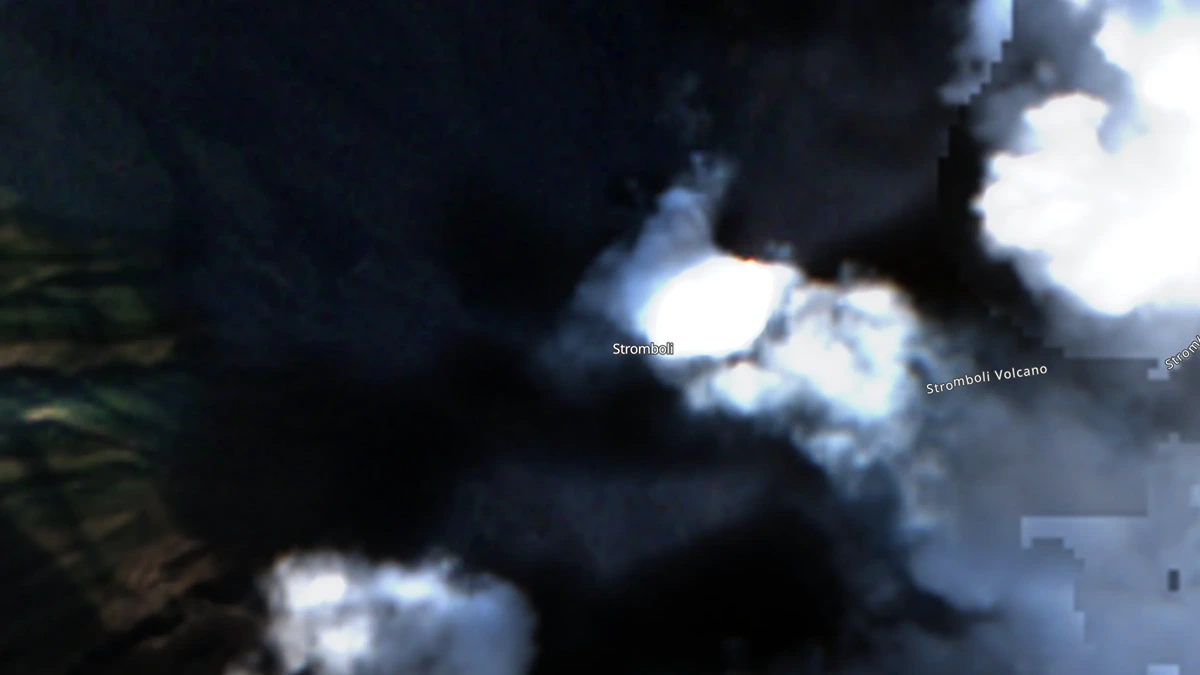
Stromboli is a stratovolcano in the Aeolian Islands and is known for persistent explosive activity. It consists of multiple eruptive centers, with its summit vents positioned at the head of the Sciara del Fuoco, a steep slope formed approximately 5 000 years ago. The volcano has been erupting nearly continuously for over a millennium.
The island itself is part of a volcanic arc created by the subduction of the African Plate beneath the Eurasian Plate. The predominant rock compositions include trachyandesite, basaltic andesite, and basalt. The current eruption phase has been ongoing since February 2, 1934.
References:
1 Stromboli/VONA – INGV – February 6, 2025
2 Stromboli – GVP – February 6, 2025
3 Stromboli/VAAC – INGV – February 6, 2025

Rishika holds a Master’s in International Studies from Stella Maris College, Chennai, India, where she earned a gold medal, and an MCA from the University of Mysore, Karnataka, India. Previously, she served as a Research Assistant at the National Institute of Advanced Studies, Indian Institute of Science, Bengaluru, India. During her tenure, she contributed as a Junior Writer for Europe Monitor on the Global Politics website and as an Assistant Editor for The World This Week. Her work has also been published in The Hindu newspaper, showing her expertise in global affairs. Rishika is also a recipient of the Women Empowerment Award at the district level in Haryana, India, in 2022.

Commenting rules and guidelines
We value the thoughts and opinions of our readers and welcome healthy discussions on our website. In order to maintain a respectful and positive community, we ask that all commenters follow these rules.