
Intense spattering feeds lava overflow at Stromboli, Italy
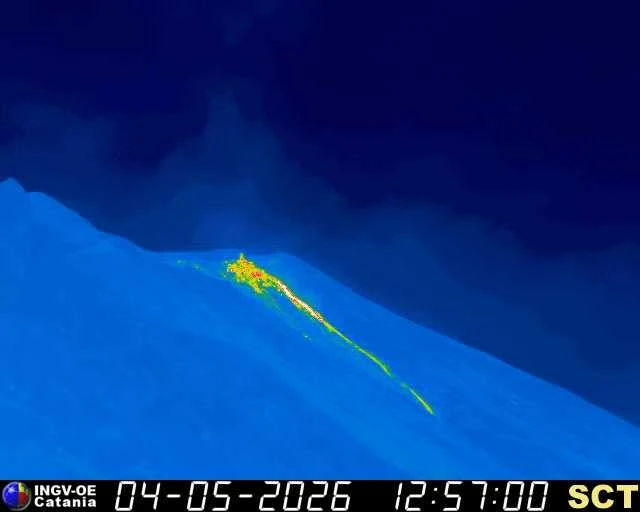
Stromboli’s North Crater area is producing intense spattering on May 4, 2026, feeding a lava overflow onto the Sciara del Fuoco, INGV-OE reported at 11:21 UTC. The lava front was in the middle-upper section of the slope, while volcanic tremor was in the high range.
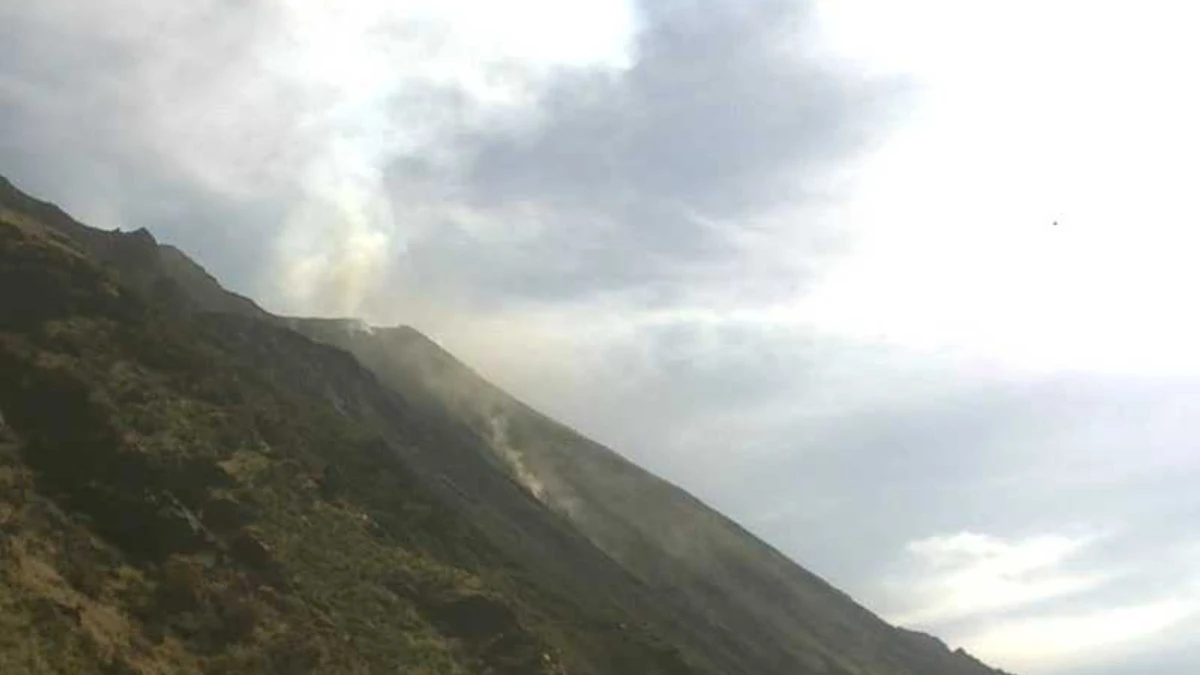
Stromboli volcano at 12:54 UTC on May 4, 2026. Credit: INGV-OE
The National Institute of Geophysics and Volcanology, Etna Observatory (INGV-OE), reports that their surveillance-camera analysis showed intense spattering from the North Crater area on May 4.
The activity fed variable effusive activity in the form of lava overflow, with the most advanced front positioned on the Sciara del Fuoco, the volcanic flank where lava flows can descend toward the sea.
Strombolian activity continued from both the North and Central-South crater areas at the time of the bulletin issued at 11:21 UTC.
The observatory reported no significant change in the occurrence rate or amplitude of explosion quakes, while the mean volcanic tremor amplitude was within the high range. High-frequency GNSS data showed no significant variation at the time of the update.
Italy’s Civil Protection Department keeps Stromboli at a Yellow alert level as of May 4.
The live INGV-OE surveillance feed below includes real-time visual and thermal monitoring views of Stromboli, along with other Aeolian volcano camera feeds
Ordinary Strombolian activity was observed from April 20 to 26, interrupted by spattering and two lava flows from the northern crater area. Total hourly explosion frequency during that reference week ranged from 8–23 events/hour, with mainly low to medium explosion intensity in both the North and Central-South crater areas.
During the April 21–22 effusive episode, the institute reported that a lava flow from the northern crater area reached the middle-upper Sciara del Fuoco. The April 23–24 overflow also came from the northern crater area, with incandescent blocks rolling in the upper Sciara del Fuoco before forming a lava flow.
Stromboli is one of the seven islands that make up the Aeolian archipelago. It is considered one of the most active volcanoes in the world, due to its persistent open-vent eruptive activity, known as “Strombolian.” Moderate-energy explosions occur every 10-20 minutes, projecting fragments of incandescent lava, lapilli, and ash up to a few hundred meters into the air.
The explosions originate from several vents, aligned in a northeast-southwest direction, located within a crater terrace approximately 700 m (2 296 feet) above sea level on the upper part of the Sciara del Fuoco, one of the volcano’s flanks.
Major explosions at Stromboli can occur several times a year and can cause heavy material, rock blocks and volcanic bombs, to fall into the upper reaches of the volcano; while “paroxysmal” explosions have a return period of several years and can hurl heavy material over greater distances, affecting even lower altitudes and even reaching residential areas, as occurred during the eruption of April 5, 2003.
References:
1 Comunicato Stromboli – INGV-OE – May 4, 2026

Teo Blašković founded The Watchers in 2011 and edited it until 2026, covering seismic and volcanic activity, extreme weather, space weather and near-Earth objects. Articles on this page are his archive.
Published in the last 24 hours
- High Risk of excessive rainfall covers Florida’s Space Coast as St. Johns River near Cocoa reaches 5.67 m
- Four small asteroids will pass close to Earth from November 21 to 23
- Cyclone Akvan weakens after landfall near Gopalpur; more than 300 000 evacuated in Odisha, India
- A broad low over southeastern Florida and the northwestern Bahamas has a 30 percent chance of subtropical or tropical development within 48 hours and a 50 percent chance within 7 days, the National Hurricane Center says
