
Impulsive explosion produces brief ash emission at Mount Etna hours after M4.5 earthquake, Italy
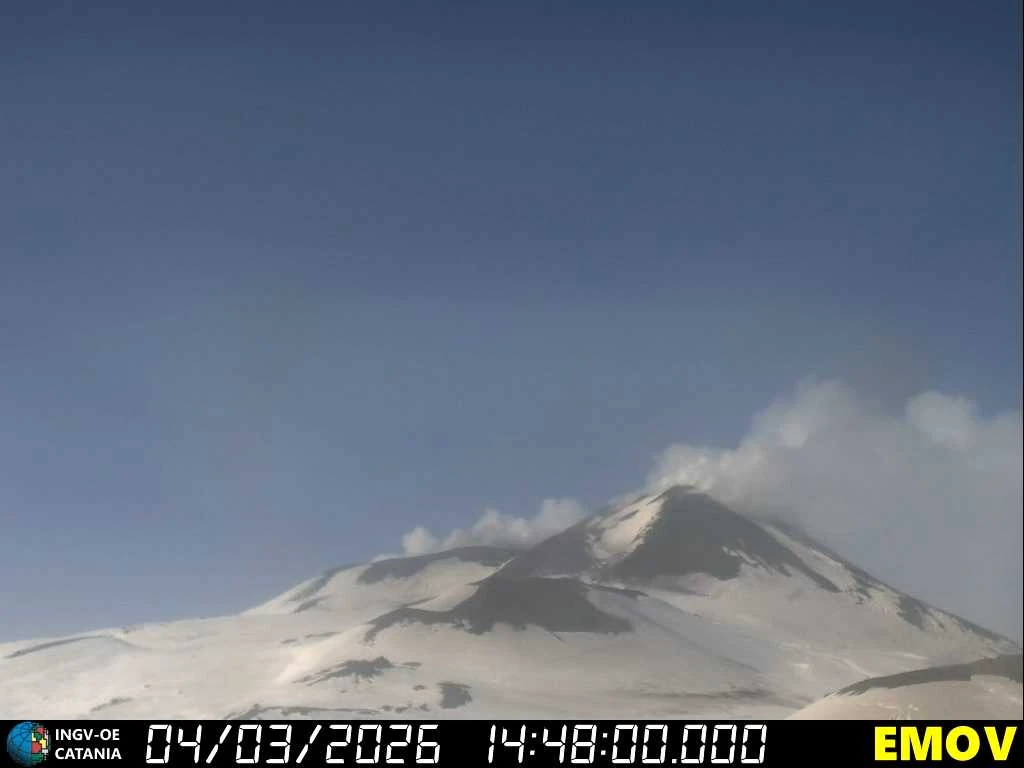
An impulsive explosion from the Bocca Nuova crater at Mount Etna, Italy, generated a short-lived ash emission at 13:12 LT (12:12 UTC) on March 4, 2026. Surveillance cameras recorded the ash plume dispersing quickly toward the eastern side of the volcano. The eruption followed an earthquake swarm on Mount Etna’s southwestern flank earlier in the day, which included a notable ML4.5 earthquake.

Eruption at Etna volcano at 12:15 UTC on March 4, 2026. Credit: INGV
An impulsive explosion occurred at the Bocca Nuova crater of Mount Etna at 13:12 LT (12:12 UTC) on March 4, 2026, producing a short-lived ash emission observed by surveillance cameras operated by the Italian National Institute of Geophysics and Volcanology (INGV) – Etna Observatory.
The ash plume dispersed within minutes and drifted toward the eastern quadrants of the volcano. No persistent ash column or prolonged emission was reported.
Seismic monitoring networks detected a transient amplitude spike at the time of the explosion. According to INGV, the signal exceeded normal background levels and was consistent with the impulsive explosive activity observed at the summit crater.
An infrasonic signal associated with the explosion was also detected and located in the Bocca Nuova crater area. Infrasound monitoring is routinely used at Etna to detect explosive activity occurring at the summit craters.
Volcanic tremor amplitude showed a moderate increase during the early hours of March 4 before stabilizing at average values around 08:40 UTC. At the time of the explosion, tremor amplitude remained within the normal range.
The centroid of tremor sources was located between the Northeast Crater (NEC) and Voragine (VOR) at an average depth of about 3 km (1.9 miles) above sea level.
Ground deformation monitoring networks did not record significant changes associated with the event. Data from permanent GNSS stations and clinometric sensors remained stable during and after the explosion.
Bocca Nuova is one of the four summit craters of Mount Etna and frequently produces short explosive events and ash emissions during periods of summit activity. Such events are usually caused by rapid gas release within the shallow volcanic conduit.
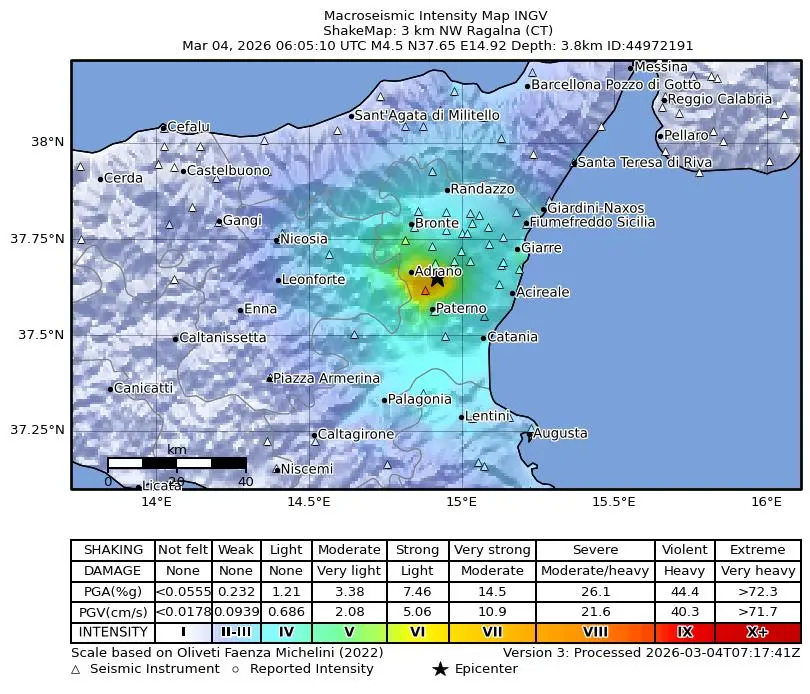
The eruption followed an earthquake swarm on Mount Etna’s southwestern flank earlier in the day, which included a notable ML4.5 earthquake. The earthquake occurred at 07:05 LT (06:05 UTC), with an epicenter located 3 km (1.9 miles) northwest of Ragalna at a depth of approximately 4 km (2.5 miles), according to INGV.
The city of Catania lies about 22 km (13.7 miles) southeast of the epicenter. INGV reported that the event occurred in an area characterized by seismicity associated with Mount Etna’s volcanic activity and nearby tectonic structures.
Seven additional earthquakes with magnitudes between ML2.7 and ML1.2 were subsequently detected, according to an update issued at 09:30 UTC.
References:
1 Comunicato Etna – INGV-OE – Issued at 13:05 UTC on March 4, 2026
2 Evento sismico in provincia di Catania, ML 4.5, 4 marzo 2026 – INGV – March 4, 2026

I'm a dedicated researcher, journalist, and editor at The Watchers. With over 20 years of experience in the media industry, I specialize in hard science news, focusing on extreme weather, seismic and volcanic activity, space weather, and astronomy, including near-Earth objects and planetary defense strategies. You can reach me at teo /at/ watchers.news.

Commenting rules and guidelines
We value the thoughts and opinions of our readers and welcome healthy discussions on our website. In order to maintain a respectful and positive community, we ask that all commenters follow these rules.