
Mount Etna’s Northeast Crater erupts for the first time in 28 years, Italy
Two paroxysmal eruptions occurred at Mount Etna’s Northeast Crater on December 27, 2025, marking the first major eruptive episode from this crater in almost 28 years. The events produced lava fountains up to 500 m (1 640 feet), eruptive columns rising over 10 km (6 miles) above sea level, and a short lava flow from the nearby Voragine Crater. Activity gradually declined by December 28, with continued strombolian explosions and weak effusion.
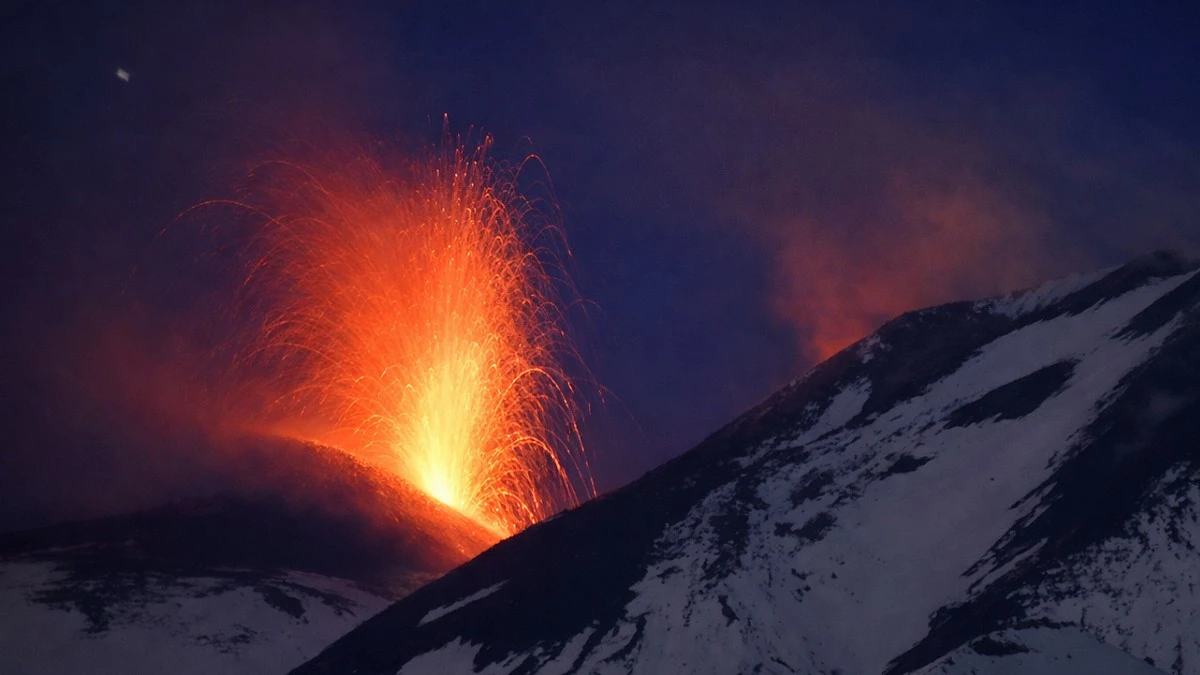
Strombolian eruption at Etna, Italy on December 28, 2025. Credit: Boris Behncke, INGV-OE. Image lightly enhanced for clarity.
Mount Etna’s Northeast Crater reawakened between December 24 and 28, ending nearly three decades of quiet. The activity marked a major change in the volcano’s summit dynamics, observed in real time by the National Institute of Geophysics and Volcanology – Etna Observatory (INGV-OE).
Early signs appeared on December 24, when the INGV monitoring network recorded a marked increase in volcanic tremor amplitude, ground deformation, and infrasonic signals.
During the night between December 25 and 26, strombolian bursts at vent BN-2 inside Bocca Nuova intensified, with incandescent ejections up to 100 m (330 feet) above the rim. At the same time, glows from the Northeast Crater became visible through the cloud cover.
On December 26, persistent bad weather obscured direct observations, but continuous rumbling was audible on the volcano’s slopes. In the early hours of December 27, visibility improved on the western and northern flanks, revealing an increase in activity at the Northeast Crater.
Simultaneously, a vent on the eastern flank of the Voragine began emitting a lava flow toward the Valle del Bove, which by morning extended nearly 2 km (1.2 miles).
The first paroxysmal episode began at around 10:00 LT (09:00 UTC) on December 27. Lava fountains rose 100–150 m (330–490 feet) above the crater rim, producing an ash- and lapilli-rich eruptive column that reached approximately 8 km (5 miles) above sea level. The phase lasted about one hour before gradually waning.
After a brief lull, the second and more intense paroxysm started at 15:15 LT (14:15 UTC). Lava fountains soared between 400 and 500 m (1 300–1 600 feet), and a dense eruptive column climbed beyond 10 km (32 800 feet) a.s.l. This phase lasted roughly 45 minutes and was followed by a sequence of powerful bubble-type strombolian explosions that scattered coarse material across and beyond the cone.
Small incandescent jets were observed from the vent on the upper eastern flank of the Voragine at dusk. Later that evening, the Northeast Crater resumed moderate explosive activity, ejecting incandescent bombs across the summit cone, but the activity did not evolve into further paroxysms.
By dawn on December 28, vigorous strombolian activity continued from the vent high on the eastern flank of the Voragine, while a lava flow from its base remained weakly fed.
According to INGV-OE’s latest bulletin issued at 20:13 UTC on December 28, the vent produced frequent ash emissions carried westward by strong winds, with volcanic tremor maintaining high but stable values. No significant ground deformation was detected, and tremor sources were localized between 2 600 and 2 900 m (8 500–9 500 feet) near the Northeast Crater.
These events concluded a highly active year for Etna, which had already produced three eruptive phases in 2025: from February 8 to March 2, from March 15 to June 19, and from August 14 to September 2.
The December sequence, however, was the most significant, marking the first paroxysmal activity of the Northeast Crater since 1998.
References:
1 Etna, 24-27 dicembre 2025: il grande ritorno del Cratere di Nord-Est – INGV – December 28, 2025
2 Invio comunicato generico di attivita vulcanica – Etna – INGV – December 28, 2025

I'm a dedicated researcher, journalist, and editor at The Watchers. With over 20 years of experience in the media industry, I specialize in hard science news, focusing on extreme weather, seismic and volcanic activity, space weather, and astronomy, including near-Earth objects and planetary defense strategies. You can reach me at teo /at/ watchers.news.

Commenting rules and guidelines
We value the thoughts and opinions of our readers and welcome healthy discussions on our website. In order to maintain a respectful and positive community, we ask that all commenters follow these rules.