
Homes on verge of collapse as 4 km (2.5 miles) landslide destabilizes hillside above Gela plain, Italy
Over 1 500 people have been evacuated from the town of Niscemi after the impact of Storm Harry triggered a major coastal landslide on January 25, 2026, that has left hundreds of homes on the verge of collapse.
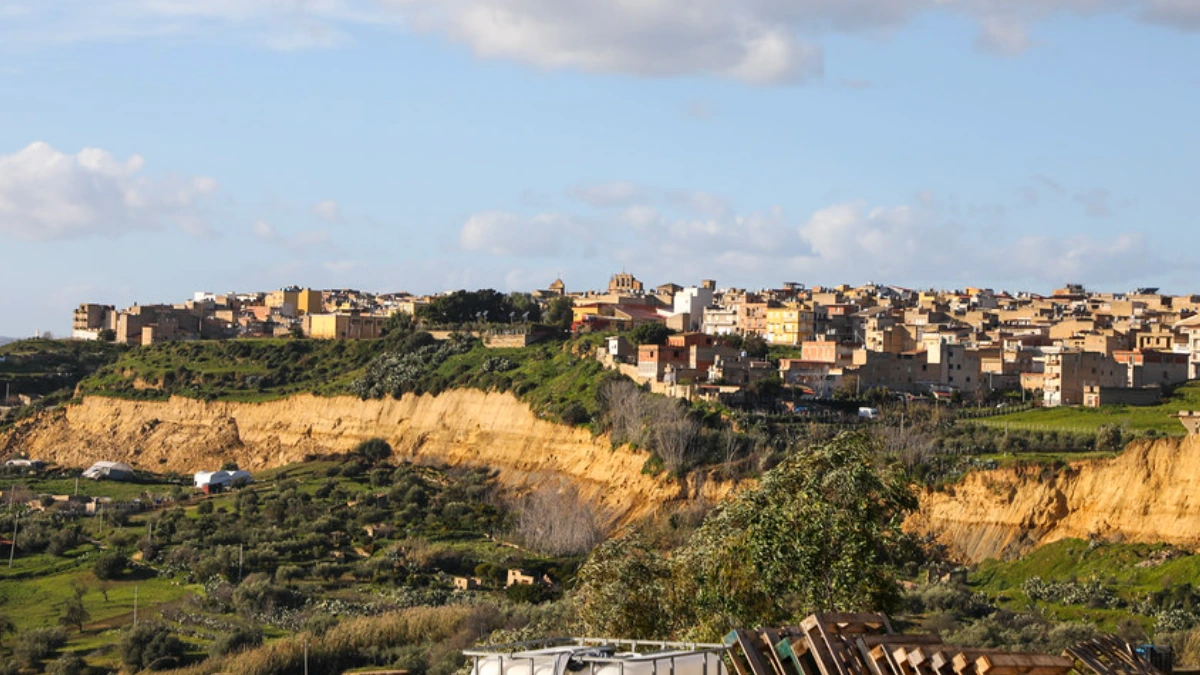
Homes left hanging from a cliff after coastal landslide in Niscemi, Sicily on January 25, 2026. Credit: Dipartimento della Protezione Civile
Italian Prime Minister Georgia Meloni surveyed the town of Niscemi on January 28, after a large landslide left homes on the verge of falling off, forcing over 1 500 people to evacuate since January 25.
The landslide extends for about 4 km (2.5 miles) along the hillside, with an early-mapped frontal width near 1.6 km (1 mile). Preliminary mapping shows an affected area of roughly 1 km² (0.39 mi²), with local vertical displacements up to about 6–7 m (20–23 feet). Officials have cited a provisional displaced volume near 350 million m³ (12.4 billion ft³).
The slide remains active, with ongoing ground deformation and new tension cracks reported by civil protection teams. Authorities are conducting continuous monitoring with drones, helicopter overflights, and instrumented surveys (GNSS, photogrammetry, and InSAR) to track movement rates and identify zones of retrogression.
Further rainfall could accelerate movement, so closures and evacuations will stay in place while officials assess long-term stabilization and relocation options.
The town has been declared a red zone, with civil protection crews establishing a 150 m (492 feet) wide “no go zone” in the town, just inland from the coastal city of Gela.
“The entire hill is collapsing onto the plain of Gela,” civil protection chief Fabio Ciciliano said. “To be honest, there are houses located on the edge of the landslide that obviously can no longer be inhabited, so we need to work with the mayor to find a permanent relocation for these families.”
#Niscemi (CL), frana sulla SP 10: da 48 ore #vigilidelfuoco impegnati nelle operazioni di monitoraggio dell’area e nell’attività di supporto alla popolazione per il recupero di beni dalle abitazioni evacuate. Nella clip il sorvolo dell’elicottero Drago 156 [#27gennaio 11:30] pic.twitter.com/0XCcsJhFec
— Vigili del Fuoco (@vigilidelfuoco) January 27, 2026
Niscemi was built on a hill on layers of sand and clay that become particularly permeable in heavy rain and have shifted before, most recently in a major 1997 landslide that forced the evacuation of 400 people.
“All homes within a 50–70 m (165–230 feet) radius will collapse,” Salvatore Cocina, director general of Sicily’s civil protection authority, said on January 26.
Schools remained closed on January 27, and a road connecting Niscemi with the coastal city of Gela has been closed.
A 12-month State of Emergency has been declared for parts of Sicily, Sardinia, and Calabria affected by Storm Harry, including Niscemi. This allowed an initial allocation of 100 million euros (120 million USD), which will be distributed equally among the affected regions.
Regional officials estimate that the damage across Sicily from Storm Harry amounts to around 2 billion euros (2.3 billion USD), double the preliminary estimate of 1 billion euros (1.1 billion USD).
#Maltempo, prosegue il lavoro #vigilidelfuoco, oltre 3.250 interventi in 6 giorni: dal 19 gennaio svolte 1.900 operazioni in Sicilia, 700 in Calabria, 650 in Sardegna.
— Vigili del Fuoco (@vigilidelfuoco) January 25, 2026
Nella clip Drago 156 in sorvolo sull'isola di Linosa (CL), fortemente colpita dalle mareggiate [#25gennaio… pic.twitter.com/vUh8sSou62
Read more:

I am an Assistant Editor and Severe Weather & Science Journalist at The Watchers, specializing in real-time severe weather coverage, geophysical event reporting, and research-driven scientific analysis. You can reach me at rishav(at)watchers(.)news.

Commenting rules and guidelines
We value the thoughts and opinions of our readers and welcome healthy discussions on our website. In order to maintain a respectful and positive community, we ask that all commenters follow these rules.