
Landslide above Crosia homes triggers evacuations as floods impact Ionian coast of Cosenza, Italy
A landslide struck above residential areas in Crosia, Province of Cosenza, Italy, on March 17, 2026, as severe weather caused the Trionto and Fiumarella rivers to overflow, triggering flooding and emergency evacuations.
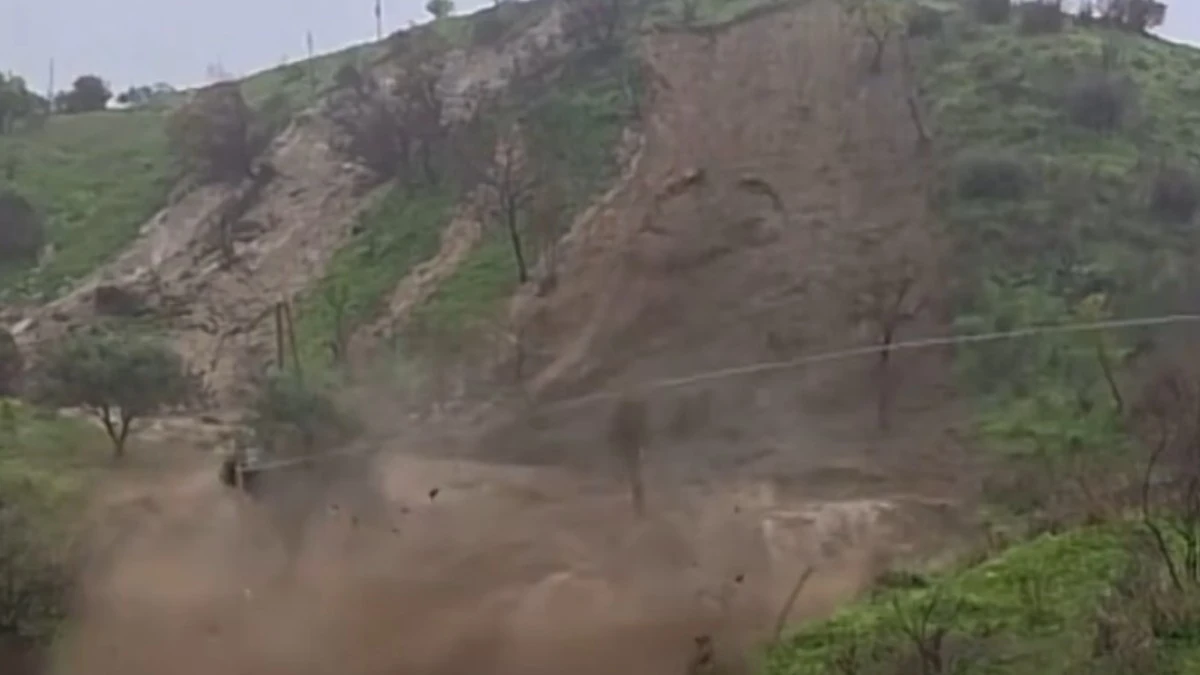
Landslide in Crosia, Calabria, Italy on March 17, 2026. Credit: Serafino Russo/meteonews 24 (stillshot)
A large landslide took place in Crosia, Province of Cosenza, on March 17, amid prolonged heavy rainfall that caused flooding and heightened hydrogeological instability across the Ionian sector of Calabria. Unofficial reports mention over 220 mm (8.6 inches) of rainfall falling over already saturated soils within 30 to 36 hours.
Local media reported that the landslide affected the slope above Via San Francesco di Paola.
The slope failure occurred in the historic center near residential structures and prompted the precautionary evacuation of approximately 80 people after the mass of saturated soil detached.
Local media and video footage show debris moving downslope toward inhabited areas.
According to local authorities, the municipal administration of Crosia issued an immediate evacuation ordinance for homes located near rivers, streams, and waterways. Residents in at-risk zones were ordered to leave their properties and move to safer locations until further notice.
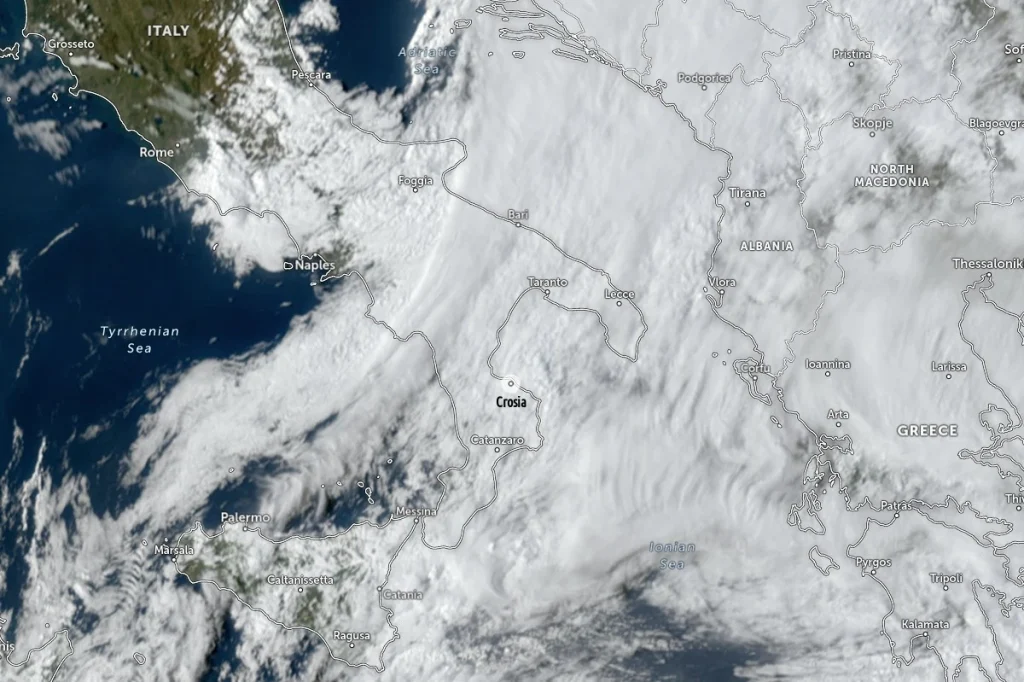
At the same time, the Trionto and Fiumarella rivers exceeded their banks, causing widespread flooding in Crosia and surrounding municipalities. Rising water levels caused flooding and traffic disruptions, while emergency teams were deployed to assist people trapped in vehicles and homes as conditions worsened.
Multiple other municipalities along the Ionian coast of the Province of Cosenza, including Corigliano, Rossano, Mirto, Calopezzati, Pietrapaola, and Mandatoriccio, experienced flooding, landslides, and traffic disruptions as the severe weather system affected a broad section of the coastline.
Emergency coordination structures were activated, with the Municipal Operations Center (COC) overseeing response efforts involving Civil Protection, law enforcement, and local police units. Field teams were deployed across critical areas to support evacuations and monitor evolving hazards.
Local media reported more than 100 intervention requests for the Provincial Fire Brigade Command in Cosenza, prompting the doubling of operational shifts and the deployment of additional personnel from neighboring commands, including units from Crotone.
Specialized water-rescue resources were also requested to manage flooding-related incidents.

References:
1 Crosia travolta dal maltempo: una frana minaccia le abitazioni. Evacuazione immediata per il rischio esondazione – Corriere della Calabria – March 17, 2026
2 Maltempo: diverse criticità nel cosentino, a Crosia evacuate 80 persone per una frana – ABM Report – March 17, 2025

Teo Blašković founded The Watchers in 2011 and edited it until 2026, covering seismic and volcanic activity, extreme weather, space weather and near-Earth objects. Articles on this page are his archive.
Published in the last 24 hours
- Scientists directly observe how submarine landslides unfold in western Canada Epicenter
- Odisha evacuated 983,642 people before Phailin crossed near Gopalpur on 12 October 2013 with winds of 200-210 km/h gusting to 220, and 44 died, against 9,885 in the 1999 super cyclone. Cyclone Akvan crossed the same coast on 20 November 2026. Epicenter
- Lava fountains reached 1,900 feet (580 m) at Kīlauea Iki in 1959, the highest ever recorded at Kīlauea, as USGS forecasts episode 57 fountaining at Halemaʻumaʻu for November 22-26. Epicenter
- Novarupta in Alaska erupted about 3 cubic miles of magma in roughly 60 hours from 6 June 1912, 30 times Mount St. Helens in 1980, and strong northwesterly winds lifted that same loose ash on 16 November 2026, prompting an NWS SIGMET. Epicenter
