
Bright daytime meteor produces sonic boom over Pennsylvania and Ohio on March 17
A bright daylight meteor accompanied by a loud boom was observed over parts of Pennsylvania and Ohio at around 13:01 UTC (09:01 local time) on March 17, 2026. The event was detected by satellite-based lightning mapping systems and reported widely by residents. No confirmed impacts have been reported.

Daylight fireball seen from Pittsburgh on March 17, 2026. Credit: Jared Rackley
A meteor entered Earth’s atmosphere over the northeastern United States at approximately 13:01 UTC on March 17, producing a bright fireball visible in daylight conditions and a loud sonic boom reported across western Pennsylvania and eastern Ohio.
Reports of a loud explosion-like sound were received across a wide area, with observers describing a sharp boom and, in some cases, brief shaking consistent with an atmospheric shockwave. The geographic spread of reports suggests the event occurred at high altitude, allowing both visual and acoustic effects to propagate over multiple states.
The fireball was recorded by Jared Rackley, one of the NWS Pittsburgh employees.
The event was also confirmed using satellite-based Geostationary Lightning Mapper (GLM) data, which recorded a short-duration optical flash consistent with a high-energy atmospheric entry.
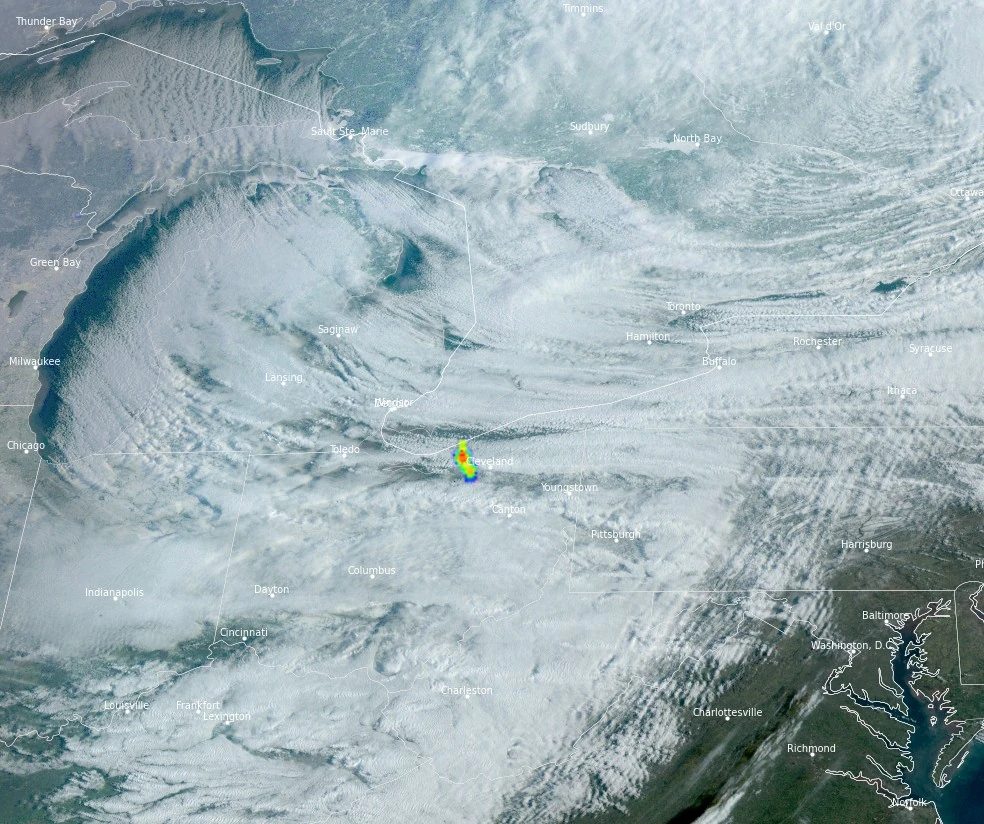

GLM instruments, designed primarily to detect lightning activity, are capable of capturing transient optical emissions associated with meteors when the brightness exceeds detection thresholds. In this case, the recorded signal aligned temporally with public reports of the fireball and subsequent acoustic disturbance.
Daytime fireballs are less frequently observed than nighttime events due to reduced contrast against the sky, but larger or faster meteoroids can produce sufficient luminosity to remain visible under daylight conditions.
No confirmed reports of injuries, structural damage, or meteorite recovery have been issued as of the time of writing.

I'm a dedicated researcher, journalist, and editor at The Watchers. With over 20 years of experience in the media industry, I specialize in hard science news, focusing on extreme weather, seismic and volcanic activity, space weather, and astronomy, including near-Earth objects and planetary defense strategies. You can reach me at teo /at/ watchers.news.

From the NNE, in over Lake Erie, fragmenting above Valley City 30 miles (49km) up.
A series of sonic booms, approximately 250 US tons TNT equivalent on fragmentation; should also show on the seismic network, handy arrival-times test-opportunity and cross-check.
Weakening magnetosphere etc., less ionisation at height, Tunguska 1908 airburst circa 5 miles (8km) up in the low megatons TNT equivalent, Chelyabinsk 2013 circa 19 miles (30km) up one half megaton TNT equivalent. 40 000mph the most common speed for meteors.
Event ID 20260317-125642
Date (UTC) March 17, 2026
Time (UTC) 12:56:42
AMS Event 1828-2026
Size 6 feet (1.8m) or 7 tons (6.4Tonne)
Origin asteroidal
Chicken Little Start Lat/Lon +41.598, -82.109
Chicken Little End Lat/Lon +41.229, -81.920
Chicken Little Altitude 80.6 km → 49.0 km ( 50.1 miles→ 30.5 miles)
Chicken Little Speed 17.5 km/s (39,200 mph)
Supporting data supplied by the American Meteor Society