
New crater discovered at Popocatépetl volcano, Mexico

Image credit: CENAPRED
A new crater was discovered at Mexico's Popocatépetl volcano and authorities expect the volcano to continue throwing new material towards the surface in the coming days, Dr. Carlos Valdés, the director of Mexico's National Center for Disaster Prevention (CENAPRED) announced.
The new crater has a diameter of 370 m (1 213 feet) and is 110 m (361 feet) deep.
"There is no dome. It is considered an open system, which facilitates the release of recent ash emissions," Valdés said.
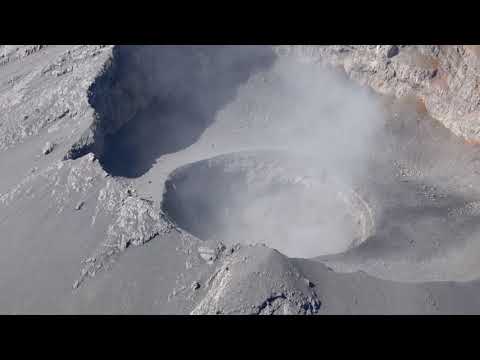
The discovery revealed that in the coming days it is expected that the volcano will continue throwing new material towards the surface and that the internal crater will be gradually filled, at least by a partial new lava dome.

New crater discovered at Popocatepetl volcano, Mexico – November 2017. Credit: CENAPRED
Over the past 24 hours (by 17:00 UTC), the Popocatépetl volcano monitoring system recorded 708 low-intensity exhalations accompanied by water vapor and gas, one volcanotectonic earthquake with magnitude Mc 2.3, and 238-minute long tremor.
At this moment the volcano has a light emission of gas and steam towards north-northeast.
CENAPRED urges people not to approach the volcano and especially the crater. In case of heavy rains, stay away from the ravines due to the danger of landslides and debris flows.

Teo Blašković founded The Watchers in 2011 and edited it until 2026, covering seismic and volcanic activity, extreme weather, space weather and near-Earth objects. Articles on this page are his archive.
Published in the last 24 hours
- High Risk of excessive rainfall covers Florida’s Space Coast as St. Johns River near Cocoa reaches 5.67 m
- Asteroid 2026 WJ to pass Earth at 1.7 lunar distances at 04:20 UTC on November 22, with 2026 WD following at 4.4 lunar distances on November 23
- Cyclone Akvan crossed the north Andhra Pradesh and south Odisha coasts close to Gopalpur on November 20 with 70-80 km/h winds gusting to 90, and has weakened into a deep depression
- A broad low over southeastern Florida and the northwestern Bahamas has a 30 percent chance of subtropical or tropical development within 48 hours and a 50 percent chance within 7 days, the National Hurricane Center says
