
Strong eruption at Mayon volcano generates large pyroclastic flows, heavy ashfall in Albay, Philippines
Pyroclastic density currents generated by a lava collapse at Mayon volcano in Albay, Philippines, on May 2, 2026, reached an estimated runout distance of 4 km (2.5 miles) along Mi-isi Gully and produced ashfall affecting 52 barangays across Guinobatan, Camalig, and Ligao City. Ashfall reduced visibility to near zero in parts of Camalig, blanketed homes, roads, crops, and grazing land, and prompted face mask distribution and health advisories.
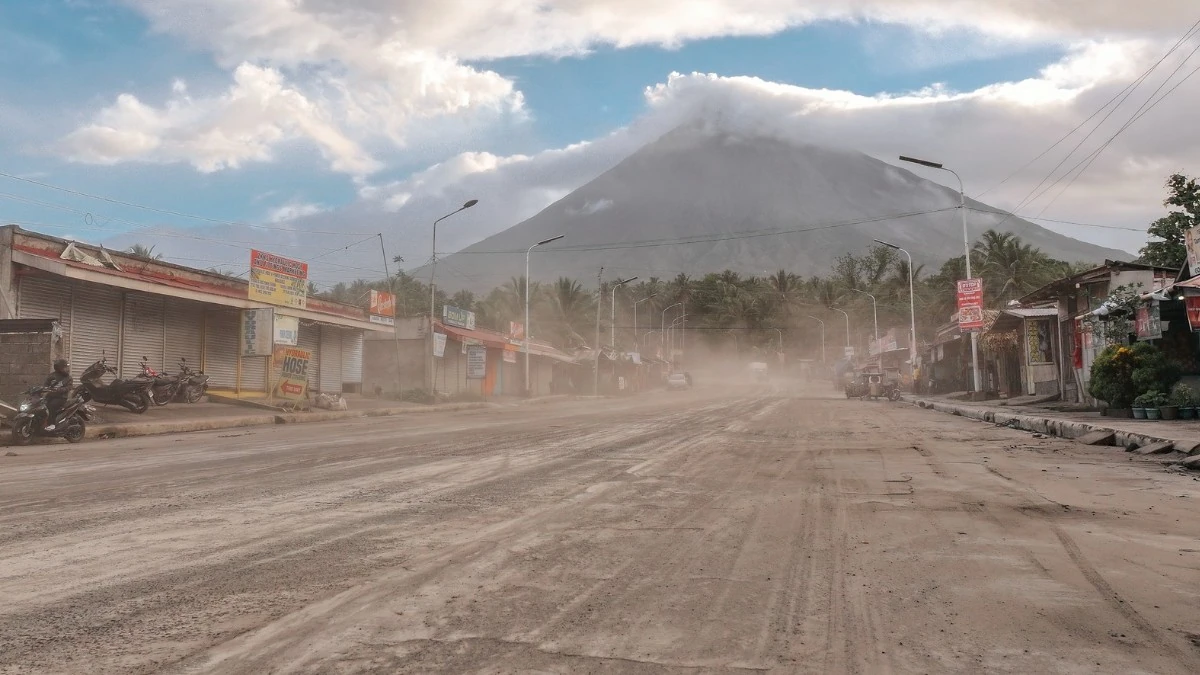
Camalig, Albay on May 3, 2026, following strong eruption on May 2. Credit: Municipality of Camalig, Albay - Public Information Office
Pyroclastic density currents (PDCs) were generated at Mayon volcano in Albay, Philippines, on May 2, 2026, following a lava collapse at the summit, with flows descending along Mi-isi Gully on the southwestern slopes. PHIVOLCS reported the currents reached an estimated runout distance of 4 km (2.5 miles) and remained within the 6 km (3.7 miles) Permanent Danger Zone.
PHIVOLCS monitoring recorded sustained eruptive activity on May 2, characterized by episodic Strombolian explosions, short-lived lava fountaining, and continuous lava effusion. Lava flows extended 3.8 km (2.4 miles) along Basud Gully, 3.2 km (2 miles) along Bonga Gully, and 1.6 km (1 mile) along Mi-isi Gully.
The agency recorded 32 volcanic earthquakes, 25 volcanic tremor events lasting 2–15 minutes, 284 rockfall events, and 14 pyroclastic density current signals within the 24-hour observation period. Sulfur dioxide emissions reached 1 586 tonnes per day on May 1. Ground deformation showed short-term deflation with inflation on the northeastern flank, while crater glow remained visible.
Volcanic plumes drifted west–southwest following the eruption, carrying ash across populated areas of Albay Province. The Office of Civil Defense Region 5 reported ashfall affecting 52 barangays, including 18 in Guinobatan, 17 in Camalig, and 17 in Ligao City.
Ashfall reduced visibility to near zero in parts of Camalig, where motorists were advised to use headlights as roads were covered by volcanic ash. Authorities distributed approximately 250 boxes of face masks to affected municipalities, the Philippine News Agency (PNA) reported.
By the morning of May 3, thick ash deposits continued to blanket homes and roads in Camalig, with local authorities reporting persistent accumulation following the previous day’s activity. Camalig Mayor Carlos Irwin Baldo Jr. advised residents to remain indoors and use N95 masks if going outside, citing risks of respiratory exposure.
Ash deposits accumulated across agricultural areas in Camalig, covering crops and grazing land with a dense layer of volcanic material. Fields were blanketed in gray ash that clung to leaves and stems, weighing down vegetation and coating entire plant surfaces. Such conditions can block sunlight and interfere with photosynthesis, while abrasive particles can damage leaf tissue.
Livestock in exposed areas were also affected by the ashfall, with animals observed coated in ash and local reports describing some deaths as conditions persisted after the eruption. Local authorities have begun assessing agricultural damage as ash continues to affect farmland near the volcano.
Local media quoted farmers saying the sudden disaster has disrupted their primary source of income, heightening concerns over food security and the pace of livelihood recovery.
On May 3, PNA reported the Philippine National Police (PNP) ramped up security and disaster response operations after ashfall raised concerns over public safety.
PNP chief Gen. Jose Melencio Nartatez Jr. said the Police Regional Office in Bicol Region deployed personnel to secure affected communities and support evacuation efforts.
“We have mobilized a sufficient number of personnel and resources to assist in the conduct of disaster response protocols and ensure maximum visibility in affected communities. We will be sending more once needed,” Nartatez said.
“We are coordinating closely with local government units and disaster response agencies to provide timely and efficient support on the ground. The PNP has instructed commanders to prioritize public safety, enforce restricted zones, and remain on heightened alert while Mayon’s activity persists,” Nartatez said.
Operational response was coordinated among the Office of Civil Defense, PHIVOLCS, local government units, the Philippine Coast Guard, and the Bureau of Fire Protection. The Philippine Coast Guard District 5 placed more than 124 personnel on standby for potential evacuation support, while fire services deployed teams to affected areas and maintained full operational readiness.
PHIVOLCS maintains Alert Level 3 over the volcano. Entry into the 6 km (3.7 miles) Permanent Danger Zone remains prohibited due to risks from pyroclastic density currents, ballistic fragments, rockfalls, and sudden explosive activity. Aviation authorities were advised to avoid flying near the summit due to ash hazards.
References:
1 Thick ashfall from Mayon affects 52 Albay villages – PNA – May 3, 2026
2 PNP mobilizes officers, resources amid Mayon ashfall – PNA – May 3, 2026

I'm a dedicated researcher, journalist, and editor at The Watchers. With over 20 years of experience in the media industry, I specialize in hard science news, focusing on extreme weather, seismic and volcanic activity, space weather, and astronomy, including near-Earth objects and planetary defense strategies. You can reach me at teo /at/ watchers.news.

Commenting rules and guidelines
We value the thoughts and opinions of our readers and welcome healthy discussions on our website. In order to maintain a respectful and positive community, we ask that all commenters follow these rules.