
Potomac Interceptor collapse among largest municipal wastewater spills in U.S. history
A section of the Potomac Interceptor sewer line failed on January 19, 2026, in Montgomery County, Maryland, releasing more than 920 million liters (243 million gallons) of untreated wastewater into the Potomac River. By volume, the incident ranks among the largest documented municipal wastewater spills in U.S. history. Elevated bacterial concentrations prompted recreational advisories and shellfish closures while emergency bypass operations continued into mid-February.
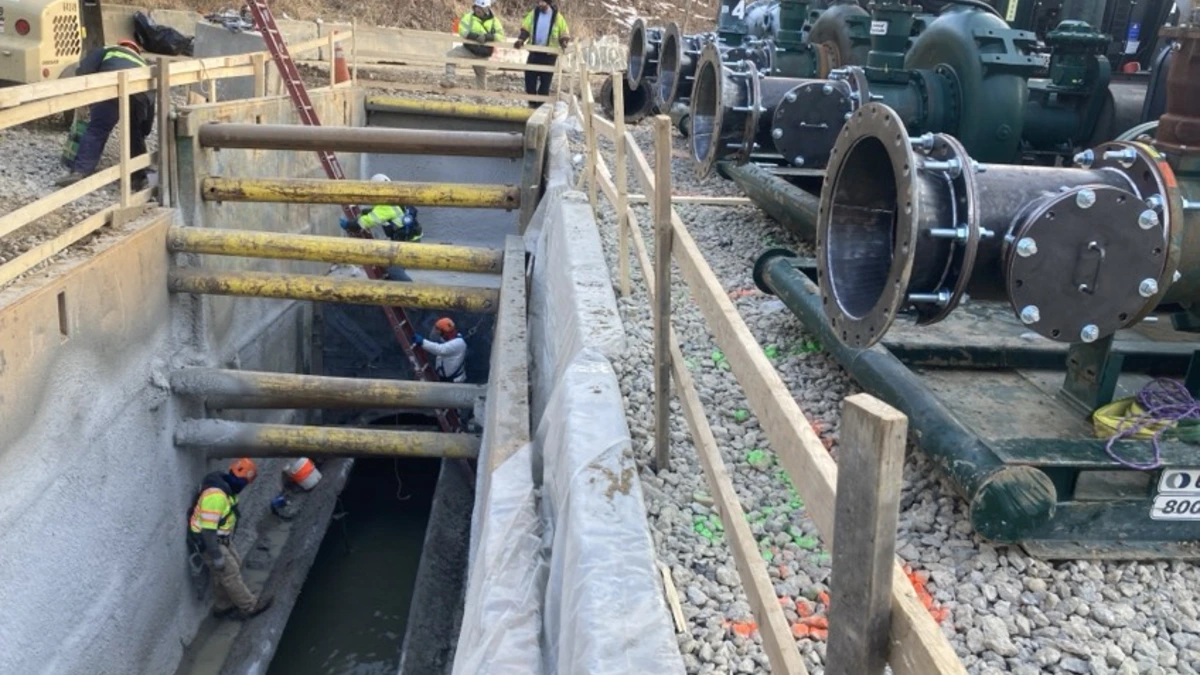
Repair work continues inside Potomac Interceptor access shaft following January 19, 2026 collapse. Credit: DC Water
- Public health agencies in Maryland, Virginia, and the District of Columbia issued advisories recommending that residents avoid direct contact with river water following the spill.
- More than 920 million liters (243 million gallons) of untreated wastewater entered the Potomac River, placing the incident among the largest documented municipal wastewater spills in U.S. history.
- E. coli concentrations near the discharge point reached up to 4 880 000 MPN/100 mL during the early phase of the spill, significantly exceeding the U.S. Environmental Protection Agency recreational freshwater threshold of 410 MPN/100 mL.
The Potomac Interceptor is an 87 km (54 miles) sanitary trunk line conveying approximately 227 million liters (60 million gallons) of wastewater per day. The collapsed segment is a 1.83 m (72-inch) diameter sewer constructed more than 60 years ago and undergoing phased rehabilitation since September 2025 as part of a USD 625 million infrastructure upgrade program.
The failure occurred along Clara Barton Parkway near Lock 10 inside the Chesapeake & Ohio Canal National Historical Park.
During the first days following the collapse, discharge rates were estimated at roughly 151 million liters (40 million gallons) per day before temporary containment systems were established. By early February, DC Water reported cumulative releases exceeding 920 million liters (243 million gallons).
By volume, this places the Potomac Interceptor collapse among the largest documented municipal wastewater spills in U.S. history, comparable in scale to major overflow events such as the 1994 Milwaukee Deep Tunnel discharge to Lake Michigan, though smaller than certain hurricane-related combined sewer overflows.
The primary hazard associated with the release is microbiological contamination of surface waters. Elevated fecal indicator bacteria concentrations increase risk during primary-contact recreation and may persist in sediments, particularly during rainfall or snowmelt events.
Environmental advocacy organizations, including Potomac Conservancy and Potomac Riverkeeper Network, have estimated total discharges could exceed 1.14 billion liters (300 million gallons), though official totals remain under review.
Bypass pumping operations began on January 23 and became operational the following day. Wastewater was diverted through an isolated portion of the C&O Canal and reintroduced into the interceptor downstream of the damaged section.
Between February 11 and February 15, additional high-capacity pumps were installed, bringing total pumping capability to approximately 432 million liters (114 million gallons) per day. Updates issued February 13–15 reported no overflow events impacting surface waters during the preceding 24-hour reporting periods.
Crews completed two new access pits to support the enhanced bypass system. Fabrication of a steel bulkhead is underway and scheduled for installation to block upstream flow. Once in place, the bulkhead will allow safe removal of a rock obstruction inside the collapsed segment, stabilization of surrounding soils, and initiation of structural reconstruction. Until the obstruction is removed and full conveyance restored, overflow risk remains during periods of elevated flow.
Water quality monitoring began on January 29 at six upstream and downstream locations. At the drainage channel near Swainson Island, DC Water recorded an E. coli concentration of 242 000 MPN/100 mL on February 6 following correction of an earlier reporting error. The U.S. Environmental Protection Agency (EPA) advises against primary contact recreation in freshwater when single-sample E. coli concentrations exceed 410 MPN/100 mL.
Independent sampling conducted by Potomac Riverkeeper Network in coordination with University of Maryland researchers measured concentrations up to 4 880 000 MPN/100 mL near the discharge point during the early phase of the spill, equivalent to approximately 12 000 times the EPA single-sample recreational threshold. These measurements were collected separately from DC Water’s monitoring program.
Downstream sampling stations, including Fletcher’s Boathouse, Georgetown at Wisconsin Avenue, National Harbor, and the Anacostia River at South Capitol Street, showed lower bacterial counts in mid-February compared to initial readings. Historical monitoring indicates typical E. coli concentrations in the Potomac River range from 10–5 000 MPN/100 mL, with variability influenced by precipitation, runoff, and seasonal watershed dynamics.
The Maryland Department of the Environment implemented shellfish harvesting restrictions in affected portions of the river. On February 13, the Virginia Department of Health issued a 117 km (72.5-mile) recreational advisory extending from Interstate 495 to the Route 301 bridge, advising against swimming, kayaking, fishing, and other direct-contact activities.
Drinking water supplies remain unaffected. The Washington Aqueduct intake at Great Falls is located upstream of the discharge point, and downstream intakes at Little Falls were temporarily closed in coordination with federal authorities as a precautionary measure.
Winter conditions in the Mid-Atlantic region typically include freeze–thaw cycles and episodic snowmelt, both of which can influence wastewater flow volumes and bacterial transport in receiving waters. DC Water continues to monitor forecast rainfall and temperature fluctuations while maintaining round-the-clock pumping operations.
An environmental restoration framework is being developed in coordination with federal, state, and local regulatory agencies. Continued sampling, removal of internal obstructions, and reconstruction of the damaged interceptor will determine the timeline for full system recovery.
References:
1 The latest updates from the Potomac Interceptor Sewage Spill – Potomac Conservancy – February 13, 2026
2 Potomac Interceptor Collapse – DC Water – Accessed February 16, 2025

I’m a science journalist and researcher at The Watchers, contributing to the Epicenter edition, where I cover peer-reviewed scientific research and emerging discoveries across Earth and space sciences. With a background in astronomy and a passion for environmental science, I’ve worked in shark and coral conservation in Fiji, conducting reef and shark-behavior research, contributing to mangrove restoration, and earning PADI Open Water and Coral Reef Certifications. I bring a blend of scientific rigor and storytelling to illuminate the discoveries shaping our planet and beyond.

Commenting rules and guidelines
We value the thoughts and opinions of our readers and welcome healthy discussions on our website. In order to maintain a respectful and positive community, we ask that all commenters follow these rules.