
Driest short rains season since 1981 push over 2 million people into crisis-level food insecurity in Kenya
Severe drought conditions are affecting over 2 million people across Kenya as of February 2026, following the failure of the short rain season between October and December 2025, which was the driest since 1981. Rainfall across most arid and semi-arid counties reached only 30%–60% of the long-term average, significantly worsening food and water insecurity.
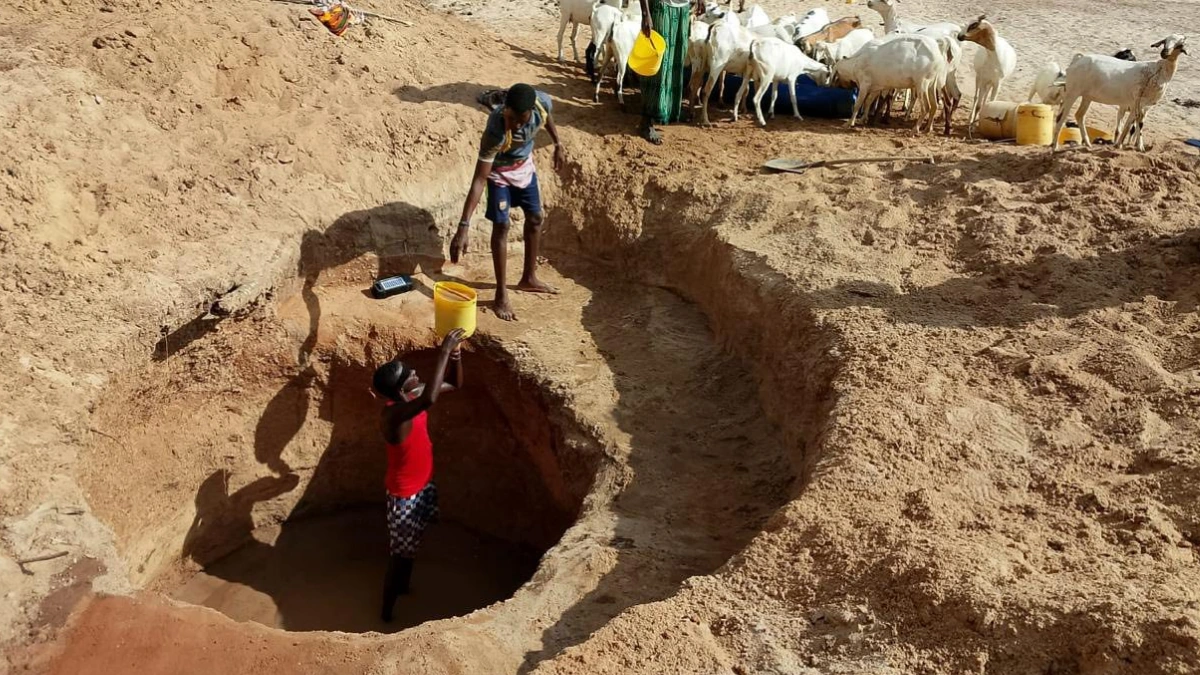
Severe drought conditions in Tana River County forces people to dig wells around dry riverbed in search of water. Credit: Kenya Red Cross
Severe drought conditions are affecting more than 2 million people in Kenya after the driest short rain season since 1981.
Cumulative rainfall in most arid and semi-arid counties, including Turkana, Marsabit, Garissa, Mandera, Wajir, Isiolo, and Samburu, reached only 30% to 60% of the long-term average, resulting in widespread drought.
According to the National Drought Management Authority (NDMA), 10 counties are experiencing drought conditions. Nine counties–Wajir, Garissa, Kilifi, Marsabit, Kitui, Kwale, Kajiado, Isiolo, and Tana River– are in the alert phase, while Mandera is in the critical alarm phase.
Thirteen other counties in the Arid and Semi-Arid Lands (ASAL) region, currently categorized as normal, are showing increasing signs of drought stress, particularly in water and livestock indicators. The Kenyan government has warned that 2.5 million citizens are at risk of severe hunger and water scarcity if the drought persists.
The drought’s severe impacts are also being felt in neighboring countries such as Somalia, Tanzania, and Uganda, where millions more are at risk due to similar weather patterns and water shortages.
“We are seeing multiple health threats converging,” said Dr. Martins, Head of Emergency Preparedness and Response at the World Health Organization (WHO) Kenya.
“Water scarcity is forcing families to rely on unsafe sources, raising the risk of cholera, typhoid, and diarrheal diseases. Drought-induced heat and limited vegetation are concentrating disease vectors near scarce water points, heightening transmission risk. Livestock herds, which provide a vital food source for pastoralist communities, have been affected, leaving children and pregnant women at severe risk of acute malnutrition.”
According to the NDMA and the World Food Programme (WFP), more than 2 million people currently face crisis-level food insecurity (IPC Phase 3 and above).
The decline followed five consecutive below-average rainy seasons since 2020, extending a multi-year dry period that has eroded water resources and soil-moisture reserves throughout Kenya’s arid zones.
Drought conditions began worsening in 2024 following the failure of seasonal rains. The NDMA released the Kenya IPC Short Rains Assessment (SRA) in February 2025.
The assessment, covering the post-harvest period from February to March 2025, found that approximately 2.2 million people were experiencing acute food insecurity (IPC Phase 3 or higher—Crisis or worse).
Among them, about 266 000 people were classified in IPC Phase 4 (Emergency), primarily in Turkana, Mandera, Garissa, Wajir, and Marsabit counties. By June 2025, it was expected that around 292 000 people would be in IPC Phase 4 and 2.5 million in IPC Phase 3 (Crisis).
The acute food insecurity situation for February–March 2025 and the projection for April–June 2025 in ASAL areas showed a significant increase in the food-insecure population compared to the same period in the previous year. Kenya had a total of 23 ASAL counties, of which nine were classified as arid and fourteen as semi-arid.
By late 2025 or early 2026, Kenya’s drought worsened due to another failed short rains season, leaving millions at risk of food insecurity, water shortages, and livestock losses, especially across the ASAL counties.

I am an Assistant Editor and Severe Weather & Science Journalist at The Watchers, specializing in real-time severe weather coverage, geophysical event reporting, and research-driven scientific analysis. You can reach me at rishav(at)watchers(.)news.

Commenting rules and guidelines
We value the thoughts and opinions of our readers and welcome healthy discussions on our website. In order to maintain a respectful and positive community, we ask that all commenters follow these rules.