
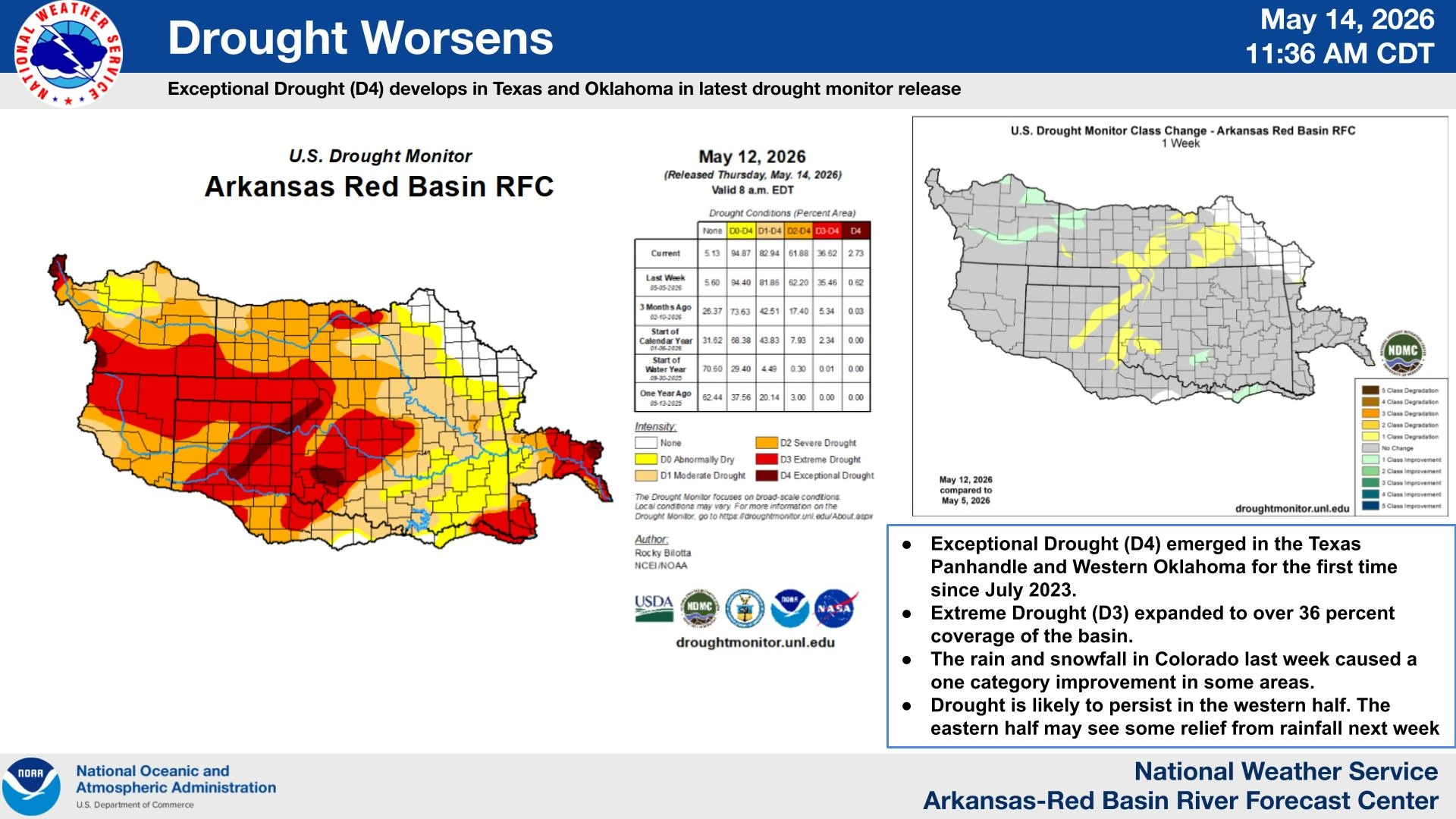
Exceptional drought returns to Texas Panhandle and western Oklahoma for first time since July 2023
Exceptional drought (D4) has returned to parts of the Texas Panhandle and western Oklahoma for the first time since July 2023, according to the National Weather Service Arkansas-Red Basin River Forecast Center (ABRFC). Drought conditions continue worsening across large parts of the Southern Plains following one of the driest and warmest starts to spring on record. Extreme Drought (D3) conditions are already affecting 36% of the Arkansas-Red Basin, while forecasters warned that very dry conditions are expected to persist across western portions of the region.
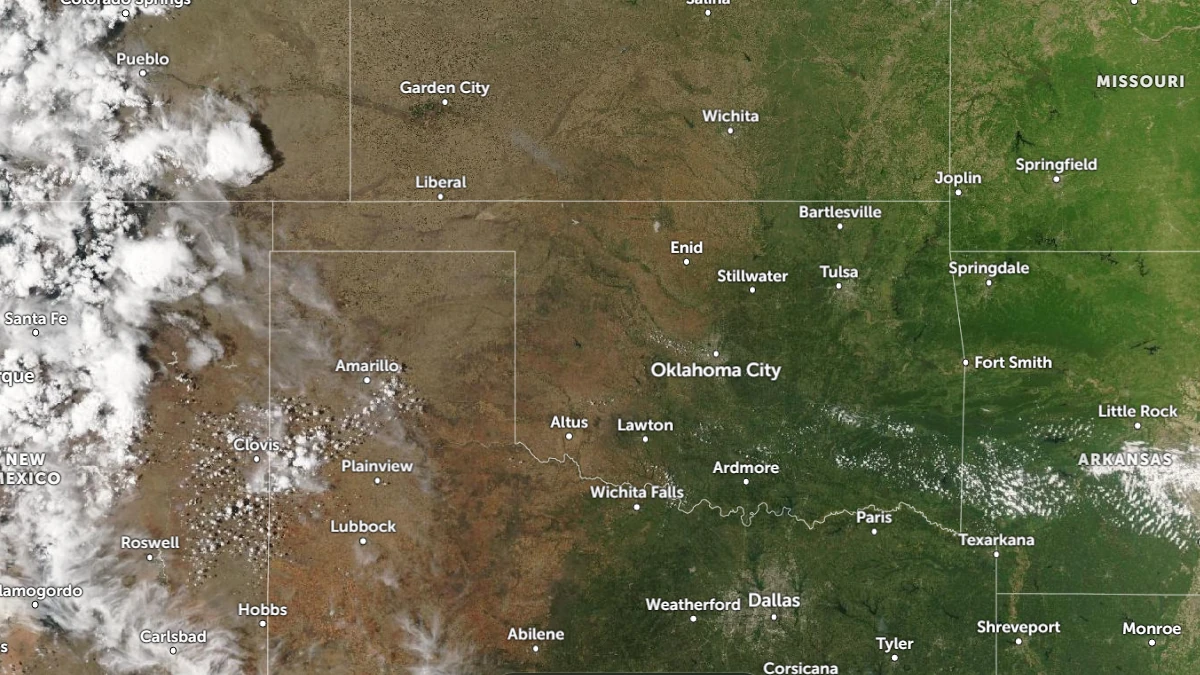
Satellite image of the Arkansas Red Basin region on May 13, 2026. Credit: NOAA/GOES-19, Zoom Earth, The Watchers
Key takeaways:
- D4 drought emerged in the Texas Panhandle and western Oklahoma for the first time since July 2023.
- D3 drought expanded to more than 36% of the Arkansas-Red River Basin.
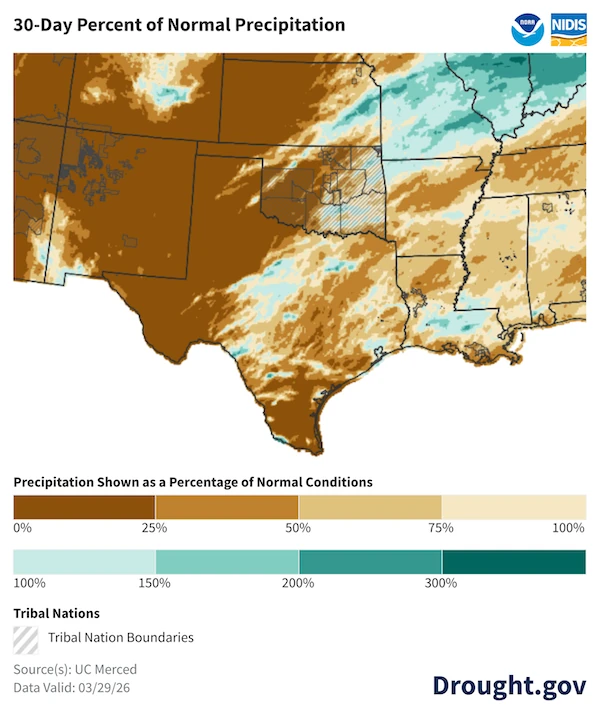
- March 2026 was ranked among the driest on record across portions of the Southern Plains.
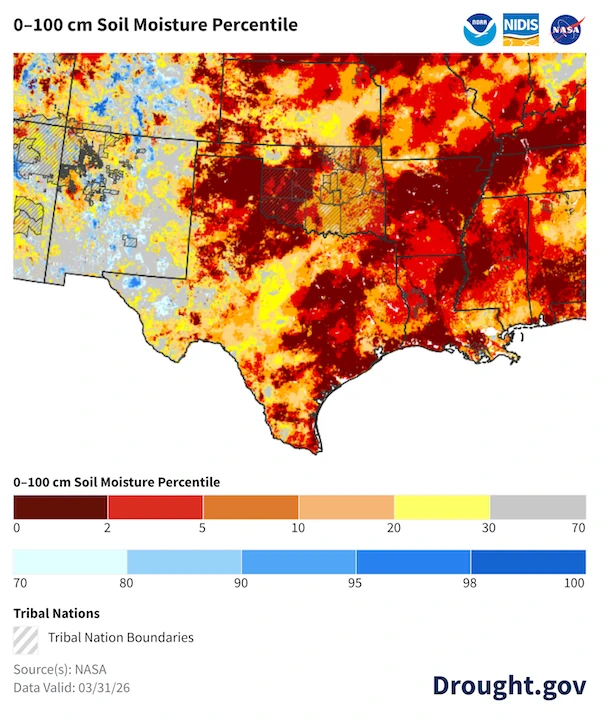
- Soil moisture dropped below the 10th percentile across large areas.
- Reservoir levels in parts of Texas reached historically low levels.
- More than 1.1 million acres burned across the High Plains by late March.
- NOAA outlooks continue favoring above-normal temperatures and persistent dryness in western sectors.
Exceptional Drought (D4) conditions are developing across parts of western Oklahoma and the Texas Panhandle, while Extreme Drought (D3) conditions are affecting more than 36% of the Arkansas-Red Basin.
The basin includes large portions of Oklahoma, Texas, Arkansas, Louisiana, Colorado, Kansas, Missouri, and New Mexico.
Drought conditions worsened rapidly across Texas and Oklahoma during March, following exceptionally dry and unusually warm conditions.
March 2026 ranked among the driest on record across large parts of the Southern Plains, while portions of western Kansas, Oklahoma, and the Texas Panhandle were likely experiencing their warmest March on record.
While some weather stations surpassed previous March temperature records by 0.6°C (1°F), it is also worth noting that the winter of 2025–26 was the warmest on record for Oklahoma and Texas and the second warmest for Kansas.
Approximately 89% of Texas and 99% of Oklahoma were in drought as of March 31, according to the U.S. Drought Monitor.
The drought is already affecting agriculture and water supplies. Drought.gov reported that some South Texas farmers stopped operations because of worsening conditions and low commodity prices. Winter wheat and oat crops were heavily stressed, with some fields used for livestock grazing instead of grain production.
Combined storage at Lake Corpus Christi and Choke Canyon Reservoir fell below 9% capacity, the lowest level on record. Elephant Butte Reservoir stood at 12.6% capacity, while Falcon Reservoir was at 19.2%.
The prolonged dry pattern has also increased wildfire risk across the region. More than 1.1 million acres had burned across the High Plains by March 23, including impacts from the Morrill Fire in Nebraska and the Ranger Road Fire affecting Kansas and Oklahoma.
Soil moisture levels in the area have fallen below 10% across much of Texas, Oklahoma, and western Kansas. Meanwhile, the Evaporative Demand Drought Index (EDDI) remains extremely high, allowing faster evaporation and drying.
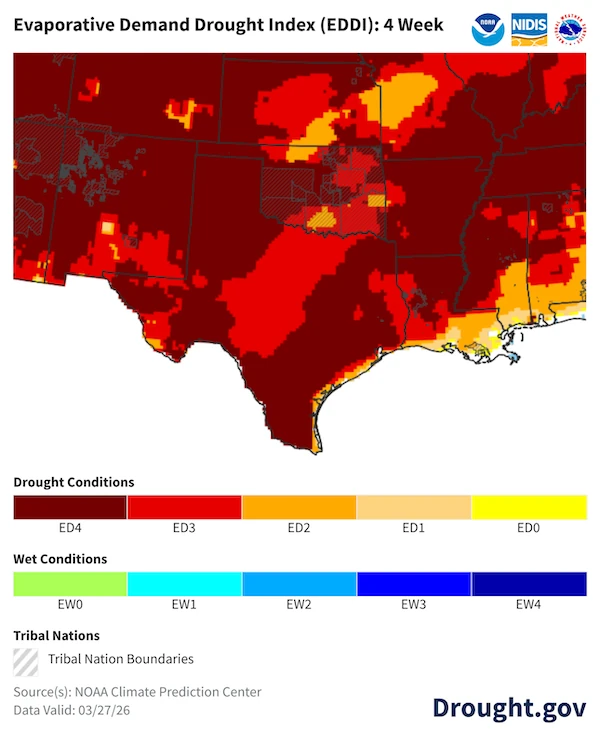
Very dry conditions are forecast to continue across western parts of the basin, while eastern areas could receive some rainfall relief during the coming week. NOAA outlooks continue to favor above-normal temperatures and below-normal precipitation across parts of western Kansas and the Oklahoma and Texas Panhandles during the April-to-June period.
The U.S. Drought Monitor classifies D4 as Exceptional Drought, the highest drought category in the United States. These conditions are associated with widespread crop losses, severe water shortages, and elevated wildfire danger during prolonged dry periods.
References:
1 Drought Status Update for the Southern Plains – Drought.gov – April 2, 2026

I am an Assistant Editor and Severe Weather & Science Journalist at The Watchers, specializing in real-time severe weather coverage, geophysical event reporting, and research-driven scientific analysis. You can reach me at rishav(at)watchers(.)news.

Commenting rules and guidelines
We value the thoughts and opinions of our readers and welcome healthy discussions on our website. In order to maintain a respectful and positive community, we ask that all commenters follow these rules.