
Severe drought triggers water restrictions in Southwest Florida
Modified Phase III “Extreme” Water Shortage restrictions will take effect across the Southwest Florida Water Management District region on April 3, 2026, following severe drought conditions and declining water supplies. The order imposes one-day-per-week irrigation limits and additional conservation measures, with stricter enforcement and localized rules implemented by utilities such as Pinellas County.
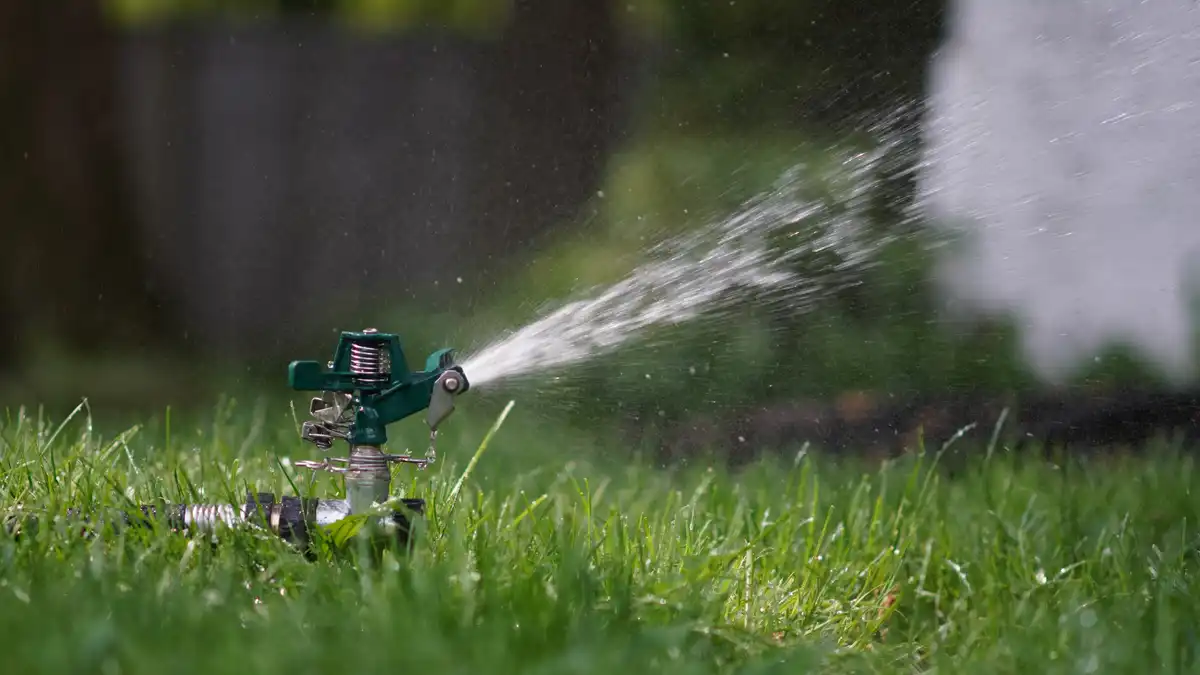
Image credit: Paul Moody
Modified Phase III “Extreme” Water Shortage restrictions will take effect on April 3, across areas managed by the Southwest Florida Water Management District (SWFWMD), as prolonged drought conditions continue to reduce available water resources.
The district reported a rainfall deficit of 348 mm (13.7 inches) compared to the average 12-month total. Water levels in aquifers, rivers, and lakes are declining and described as severely abnormal, while public water supplies are extremely low for this time of year.
March through May represents the driest period in the regional seasonal cycle, with the summer rainy season typically beginning in June. The last time SWFWMD declared a Phase III water shortage order was in May 2017.
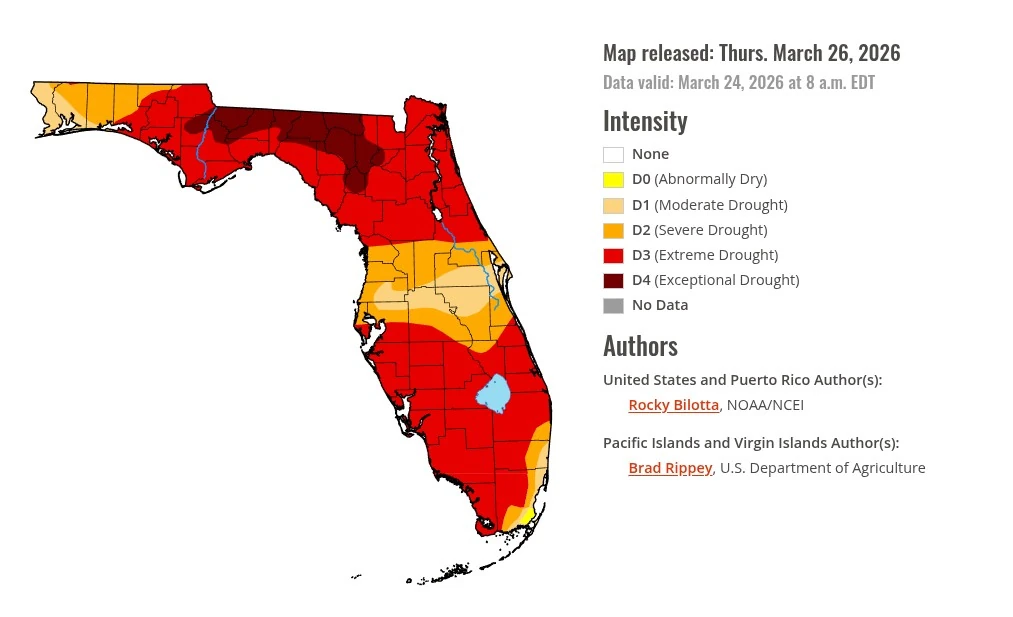
The March 26 U.S. Drought Monitor showed drought conditions across the entire state of Florida, with an estimated 18 663 014 people affected.
Severe drought (D2-D4) covered 90.71% of the state, while Extreme to Exceptional drought (D3-D4) affected 72.89%. Exceptional drought (D4), the highest category, expanded to 9.50%, up from 1.60% a week earlier.
Water restrictions apply to Citrus, DeSoto, Hardee, Hernando, Hillsborough, Manatee, Pasco, Pinellas, Polk, Sarasota, and Sumter counties, as well as portions of Charlotte, Highlands, and Lake counties. Additional jurisdictions include the City of Dunnellon, The Villages in Marion County, and the portion of Gasparilla Island in Charlotte County.
Outdoor water use remains the primary target of restrictions. District-wide, lawn and landscape irrigation is limited to one day per week based on address numbering, with standard schedules assigning watering days according to the last digit of an address.
Local utility regulations may impose stricter requirements and supersede the district schedule. In Pinellas County Utilities service areas, watering schedules are determined by geographic location relative to State Road 580, with separate assigned days for properties north and south of this boundary and additional enforcement measures.
Watering hours are restricted to 00:01–04:00 LT or 20:00–23:59 LT. Properties smaller than 0.4 ha (1 acre) may use only one of these time windows per designated day, while properties 0.4 ha (1 acre) or larger may irrigate during both permitted periods.
The restrictions apply to all residents, including those using private wells. Reclaimed water systems are subject only to voluntary watering hours unless restricted by local governments or utilities. Low-volume watering of plants and shrubs, including microirrigation and handwatering, is permitted daily but limited to hours before 08:00 LT and after 18:00 LT.
New lawns and plants are subject to a 60-day establishment period. During the first 30 days, watering is allowed daily. During days 31–60, watering is limited to three designated days per week based on address parity, and residents must maintain a written schedule documenting compliance. Authorities advise delaying new landscaping until the onset of the summer rainy season due to high water demand during establishment.
Additional restrictions limit non-essential water use. Residential car washing is permitted only on designated watering days using a hose with a shutoff nozzle. Car wash fundraisers are prohibited except for pre-scheduled one-day events.
Pressure washing is allowed only for necessary maintenance, such as preparation for painting or removal of mold and hazardous buildup, and not for aesthetic compliance with homeowner association requirements.
Ornamental fountains and aesthetic water features may operate for no more than four hours per day, with operating schedules required to be posted. Restaurants are required to serve water only upon request. Water use necessary for public health, safety, and livestock maintenance remains permitted.
Household irrigation accounts for a significant portion of total water demand across the district, representing approximately 20% of overall water use, while bottled water withdrawals account for less than 1%. Total daily water use across the district exceeds 3.8 billion liters (1 billion gallons).
Enforcement is conducted by local utilities in coordination with district requirements. Utilities must increase monitoring efforts, including responding to complaints and tracking usage. Beginning 14 days after the effective date, violations are subject to immediate citation without warning.
In Pinellas County Utilities service areas, staff are authorized to issue fines of USD 193 for violations, with warnings discontinued after April 17. Other jurisdictions within the SWFWMD region may apply different enforcement structures.
Commercial and agricultural water users are also subject to restrictions. Golf course irrigation is limited to once per week for fairways and driving ranges, up to three times per week for greens and tees, while irrigation of rough areas is prohibited.
Long-term water supply planning is conducted through the district’s Regional Water Supply Plan, which evaluates projected demand and identifies future sources, including alternative supplies such as reservoirs and desalination. Desalination remains the most costly supply option and is used selectively within the region’s water portfolio.
“Every household, business, and community space plays a role in protecting our water supply,” said Jeremy Waugh, Pinellas County Utilities Director. “Our staff works tirelessly to deliver high-quality, safe drinking water to our residents, and I urge you to make the most of it by making water conservation a priority in your daily routines.”
The SWFWMD stated that the restrictions are temporary measures designed to stabilize water resources during extended dry conditions as regional hydrological deficits persist.
References:
1 District Water Restrictions – SWFWMD – Accessed March 27, 2026
2 Modified Phase III “Extreme” Water Shortage Order issued for Pinellas – Pinellas County – March 25, 2026

I’m a science journalist and researcher at The Watchers, contributing to the Epicenter edition, where I cover peer-reviewed scientific research and emerging discoveries across Earth and space sciences. With a background in astronomy and a passion for environmental science, I’ve worked in shark and coral conservation in Fiji, conducting reef and shark-behavior research, contributing to mangrove restoration, and earning PADI Open Water and Coral Reef Certifications. I bring a blend of scientific rigor and storytelling to illuminate the discoveries shaping our planet and beyond.

Commenting rules and guidelines
We value the thoughts and opinions of our readers and welcome healthy discussions on our website. In order to maintain a respectful and positive community, we ask that all commenters follow these rules.