
Weak La Niña and disrupted vortex forecast to bring colder 2025/26 winter to northern U.S., southern Canada, and parts of Europe
A weak La Niña and signs of a disrupted polar vortex are forecast to shape colder-than-average winter conditions across the northern United States, southern Canada, and parts of Europe during the 2025/26 season. Early seasonal outlooks suggest a higher likelihood of Arctic air intrusions and persistent cold anomalies from December 2025 through February 2026.

3D rendition of the polar vortex split. Credit: StratObserve
The latest long-range forecasts from ECMWF, CanSIPS, and the U.S. Climate Prediction Center indicate a developing weak La Niña in the tropical Pacific during December–February 2025/26.
Sea surface temperature anomalies in the Niño 3.4 region are projected to remain below average, favoring the typical La Niña circulation pattern: a high-pressure anomaly over the North Pacific and a low-pressure region over Alaska and eastern Canada.
This pressure configuration tends to shift the polar jet stream southward into the northern United States, drawing cold Arctic air into the central and eastern regions.
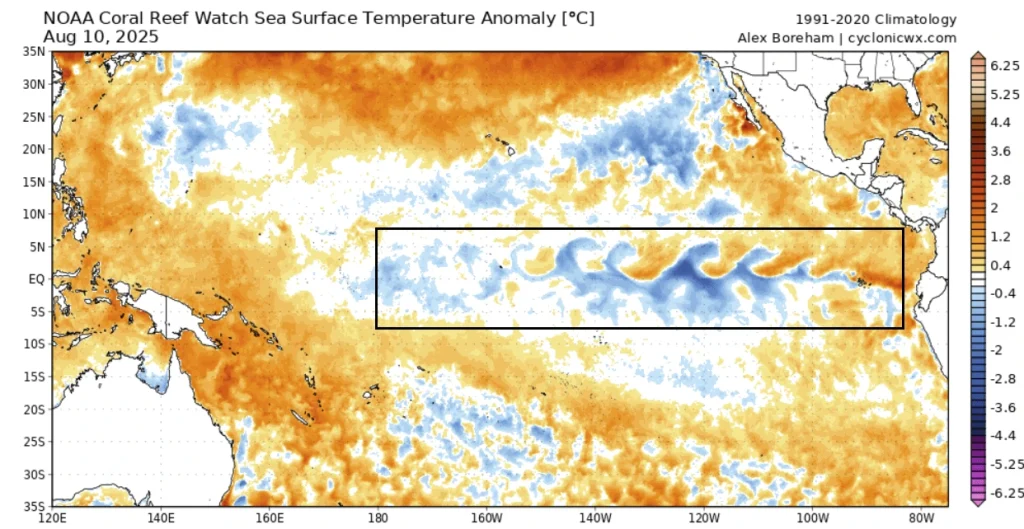
It also enhances storm activity over the Pacific Northwest, Great Lakes, and parts of the Northeast, while maintaining warmer and drier conditions across much of the southern tier.
Seasonal model guidance suggests the stratospheric polar vortex will be weaker than normal in early to mid-winter. A negative Quasi-Biennial Oscillation phase, reduced Arctic sea ice, and the historical La Niña association with Sudden Stratospheric Warming events support the forecast of increased high-latitude blocking. Such conditions can disrupt the polar circulation, allowing cold Arctic air to penetrate into mid-latitudes.
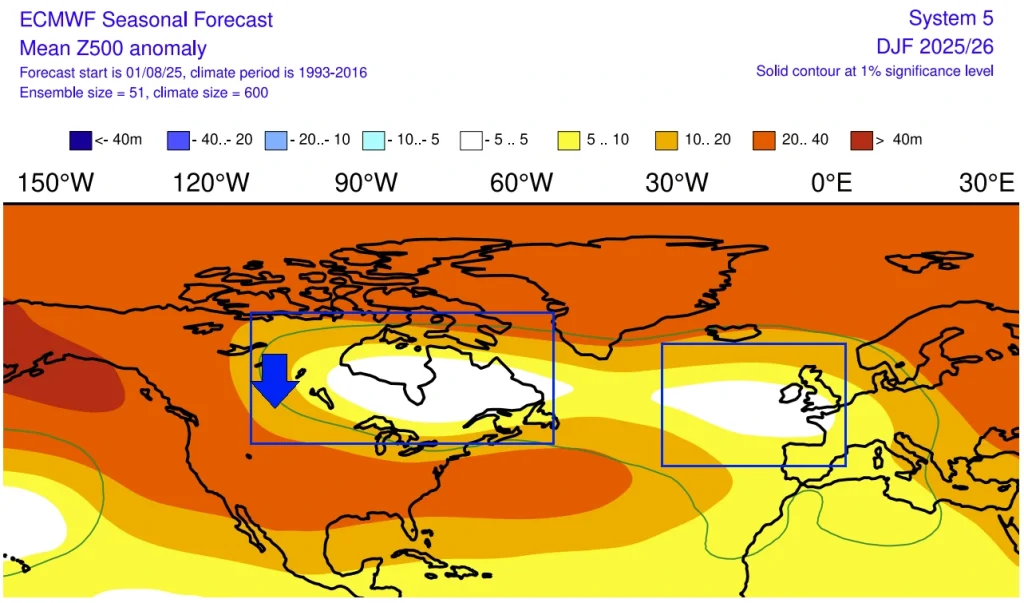
ECMWF ensemble forecasts show high-pressure anomalies over polar regions in December and January, with a low-pressure anomaly over eastern Canada. This setup is favorable for repeated northerly flow into the north-central and eastern United States.
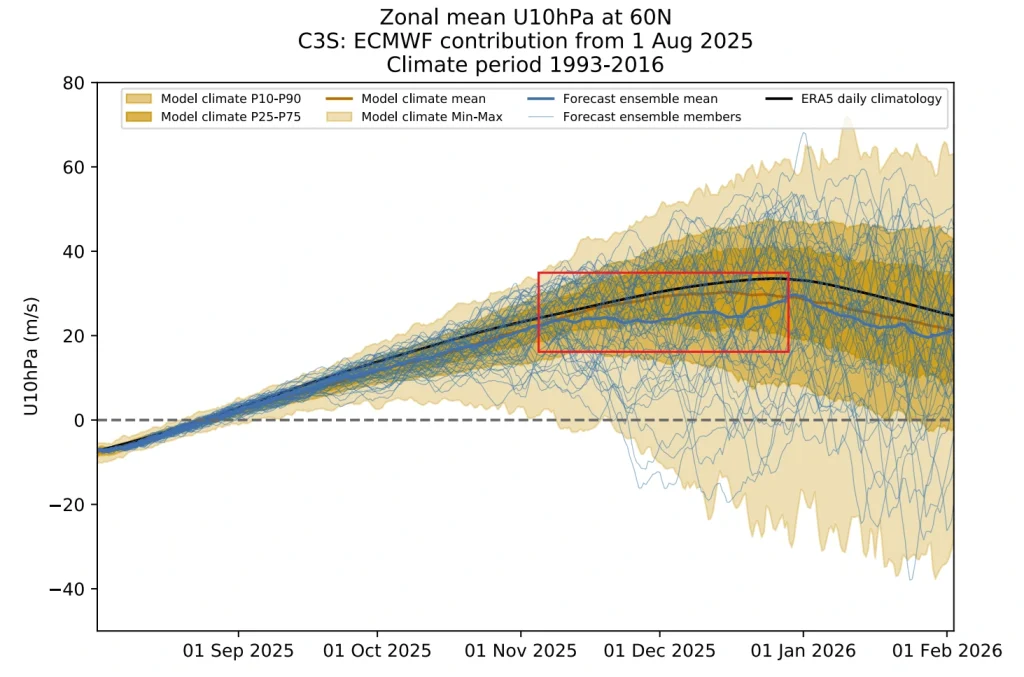
The ECMWF seasonal outlook shows above-average precipitation in the northwestern and northeastern United States and across southern Canada, with drier-than-normal conditions in the south.
The CanSIPS model projects below-average temperatures over southern Canada and the northern United States, consistent with enhanced cold air advection from the Arctic.
NOAA’s official winter outlook highlights an increased probability of below-normal temperatures in the northern tier, above-normal temperatures in the Southwest and along the East Coast, and a classic La Niña precipitation pattern which is wetter north, drier south.
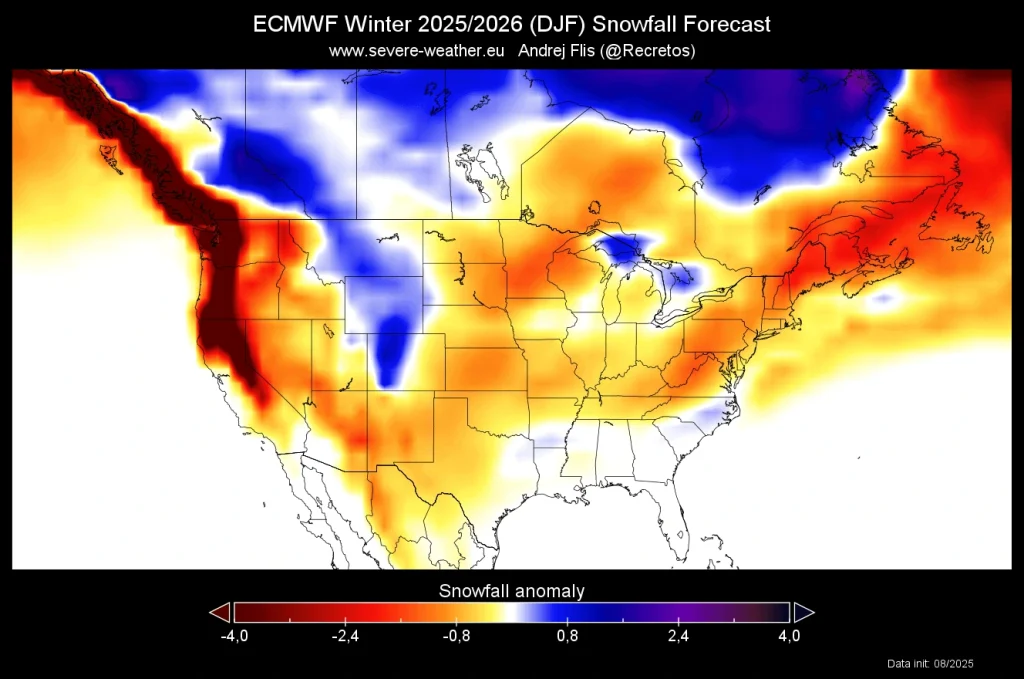
While early seasonal model runs often bias warm, the ECMWF snowfall anomaly forecast indicates above-average snow cover east of the Rockies and around the Great Lakes.
CanSIPS projects increased snowfall potential over the northern Plains, Midwest, and Northeast. The southern United States is likely to remain below average for snowfall totals.
Over Europe, ECMWF suggests warmer-than-average conditions for much of the winter, but January 2026 features a blocking high over the Arctic, driving a northerly to northeasterly flow across northern, central, and western Europe.
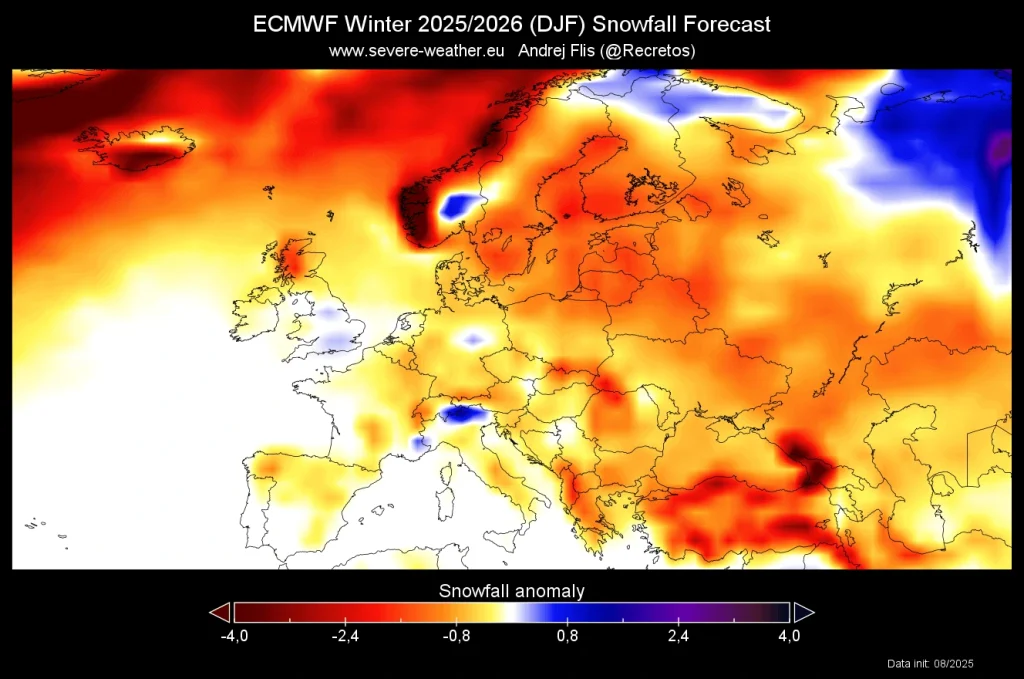
Such a pattern can support below-average temperatures and increased snowfall, particularly if the polar vortex experiences further disruption.
The combination of a weak La Niña and a weaker-than-normal polar vortex increases the likelihood of cold outbreaks and enhanced snowfall in the northern United States and southern Canada, with potential late-winter impacts extending into Europe.
Although the La Niña is forecast to fade by early spring 2026, residual impacts combined with snowpack feedback may sustain colder anomalies into March, particularly in interior regions.
Southern U.S. regions are likely to experience a warmer, drier winter. Model confidence remains moderate at this stage, and monthly forecast updates will refine the outlook.
References:
1 Winter 2025/2026 Early Forecast: La Nina and Polar Vortex Shape a Cold Surprise Ahead – Severe Weather Europe – August 13, 2025

I’m a science journalist and researcher at The Watchers, contributing to the Epicenter edition, where I cover peer-reviewed scientific research and emerging discoveries across Earth and space sciences. With a background in astronomy and a passion for environmental science, I’ve worked in shark and coral conservation in Fiji, conducting reef and shark-behavior research, contributing to mangrove restoration, and earning PADI Open Water and Coral Reef Certifications. I bring a blend of scientific rigor and storytelling to illuminate the discoveries shaping our planet and beyond.

Thank you Reet Kaur but this is not a reference, which is usually a single sentence or paragraph,but the entire post is copied from the site. When doing so, please at the very topgive then credit for the article. Thanks.