
La Niña breakdown underway as models point to ENSO-neutral conditions in early 2026
La Niña conditions in the equatorial Pacific show signs of a transition toward ENSO-neutral conditions, with potential for El Niño development later in 2026. Observations from the National Oceanic and Atmospheric Administration (NOAA) and the European Centre for Medium-Range Weather Forecasts (ECMWF) show subsurface ocean warming and westerly wind anomalies across the central Pacific, indicating the breakdown of the three-year La Niña phase.

Sea Surface Temperature anomaly map for January 9, 2026. Credit: Climate Reanalyzer / NOAA OISST
Subsurface and surface observations across the equatorial Pacific suggest that the La Niña episode dominating the global climate since 2023 is weakening. Climate Prediction Center (CPC) forecasts show the Niño 3.4 region, a key ENSO indicator, has warmed toward the −0.5°C, the threshold of transition from La Niña to ENSO-neutral conditions.
Westerly wind bursts along the equator have disrupted the easterly trade-wind pattern, allowing deeper, warmer water to surface and spread eastward.
According to NOAA’s ENSO Diagnostic Discussion issued on January 9, there is a 75% probability that ENSO-neutral conditions will emerge between January and March 2026.

Beyond that period, ensemble forecasts from NOAA, ECMWF, and the Japan Meteorological Agency (JMA) show a gradual rise in the likelihood of El Niño development by late boreal summer or early autumn 2026, with probabilities near 35–40 %.
At present, no agency has confirmed an El Niño event, but model consensus points to an increasing probability later in the year.
ENSO-neutral periods often persist for several months before a new phase is fully established. The physical mechanisms driving the collapse are consistent with previously observed ENSO reversals.

Weakened trade winds reduce upwelling of cold subsurface water in the eastern Pacific, allowing accumulated subsurface heat to surface.
This process flattens the thermocline–the layer separating warm and cool ocean water; and initiates a basin-wide warming phase. If this ocean-atmosphere coupling continues, a full El Niño phase could be established by the second half of 2026.
If El Niño develops, global atmospheric circulation is expected to adjust accordingly. Historically, El Niño years feature a strengthened and south-shifted Pacific jet stream, increasing precipitation across the southern United States while bringing milder and drier conditions to the northern tier and western Canada.

Meanwhile, northern and central regions generally experience warmer winters, while southern states typically record above-average rainfall.
In Europe, ENSO’s influence is indirect but detectable through changes in the North Atlantic Oscillation (NAO) and broader jet-stream positioning. These shifts could modify storm tracks and seasonal temperature anomalies, sometimes favoring wetter winters in southern Europe and drier conditions in the north.
El Niño phases are typically associated with enhanced vertical wind shear across the tropical Atlantic, which suppresses hurricane formation and intensification. If El Niño conditions develop by mid-year, this could lead to a below-average hurricane season for the 2026 Atlantic hurricane season.
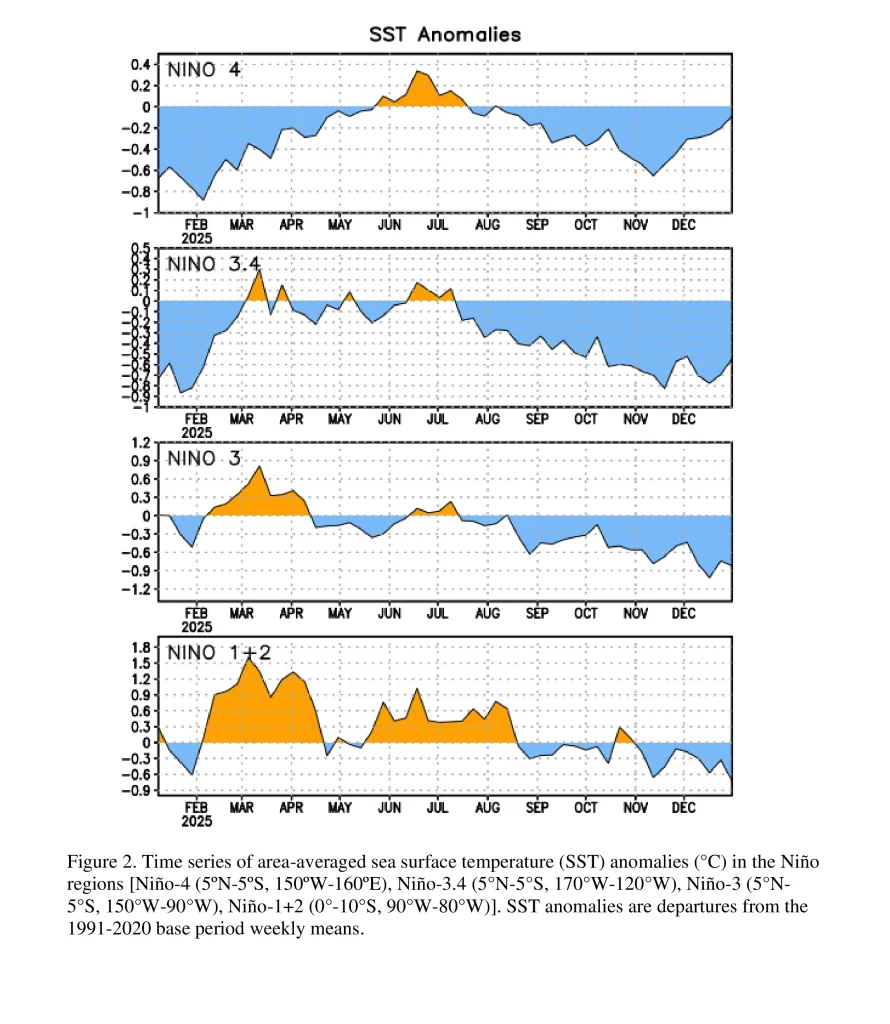
Global ocean heat content remains exceptionally high, according to the Copernicus Climate Change Service (C3S). Record ocean temperatures in 2024 and 2025 have contributed to persistent marine heatwaves and elevated subsurface warmth in the Pacific.
Elevated background heat can amplify ENSO transitions, potentially increasing the magnitude and persistence of upcoming El Niño effects.
ENSO transitions are non-linear, and model divergence increases beyond mid-2026. Continuous monitoring of subsurface anomalies and wind patterns through early spring will be needed to determine whether neutral conditions stabilize or El Niño begins to emerge later this year.
References:
1 La Niña collapse begins: How a major Pacific flip will change the 2026 weather pattern – SWE – January 9, 2026
2 ENSO Diagnostic Discussion – NOAA/CPC – January 8, 2026

I am an Assistant Editor and Severe Weather & Science Journalist at The Watchers, specializing in real-time severe weather coverage, geophysical event reporting, and research-driven scientific analysis. You can reach me at rishav(at)watchers(.)news.

Commenting rules and guidelines
We value the thoughts and opinions of our readers and welcome healthy discussions on our website. In order to maintain a respectful and positive community, we ask that all commenters follow these rules.