
Seismic swarm with more than 700 low-magnitude earthquakes detected beneath Teide, Tenerife
More than 750 volcano-tectonic and hybrid earthquakes were recorded beneath the Teide–Pico Viejo volcanic complex in Tenerife, Canary Islands between August 6 and 7, 2025. This includes two seismic swarms at depths of 8–14 km (5–9 miles), with the largest event reaching M1.5.

Earthquakes detected under Teide, Tenerife on August 6 and 7, 2025. Credit: INVOLCAN
Hundreds of low-magnitude earthquakes were detected beneath the Teide–Pico Viejo volcanic complex in Tenerife, Canary Islands between August 6 and 7, according to the Canary Islands Seismic Network (Red Sísmica Canaria, INVOLCAN) and Spain’s National Geographic Institute (Instituto Geográfico Nacional, IGN).
The activity consisted of two distinct seismic swarms occurring within an 11-hour window.
The first swarm occurred between 21:30 LT on August 6 and 00:10 LT on August 7, consisting of more than 55 volcano-tectonic earthquakes, 50 of which were successfully located. These earthquakes were interpreted as fracturing of brittle rock and reached a maximum magnitude of 1.5, with focal depths between 8 and 14 km (5–9 miles).
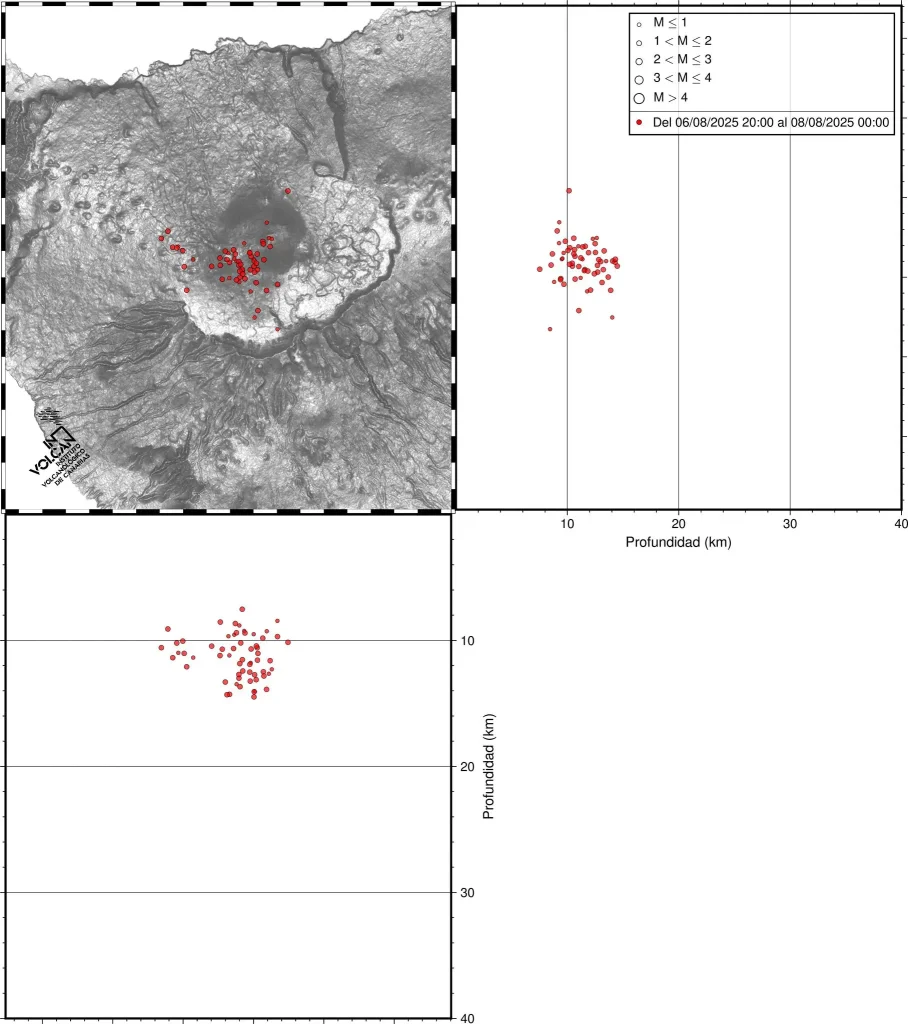
Over 700 hybrid-type events were recorded in the second swarm between approximately 02:00 and 07:30 UTC on August 7. These were characterized by very low magnitudes, generally below 1, and could not be felt at the surface.
Hybrid events like these typically indicate the movement of fluids, such as magmatic gases or hydrothermal waters, through cracks within the volcanic system.
The events were concentrated in the same area as the previous swarm, beneath the southwestern flank of Pico Viejo, at a depth of around 10 km (6.2 miles).
Nuevos enjambres sísmicos en Tenerife (6-7 agosto 2025)
— INVOLCAN (@involcan) August 7, 2025
La Red Sísmica Canaria (INVOLCAN) ha detectado dos enjambres sísmicos bajo el complejo volcánico Teide-Pico Viejo. pic.twitter.com/qIudkZKrI6
According to INVOLCAN and IGN, there are no signs indicating an impending eruption. The activity is interpreted as part of a prolonged process of magmatic fluid injection into the hydrothermal system, a phenomenon observed since 2016.
This marks the sixth hybrid-type seismic swarm recorded on the island since October 2016. Previous swarms occurred in October 2016, June 2019, June and July 2022, and November 2024.
Itahiza Domínguez, director of the IGN in the Canary Islands, said the current seismic activity beneath Teide is not comparable to the sequence that preceded the 2021 eruption of Tajogaite volcano on La Palma. That episode involved an intensifying earthquake sequence that shifted in depth and location, and was accompanied by ground deformation and a significant increase in sulfur dioxide emissions, conditions that are not present in the current swarm.
According to Domínguez, this activity is not related to a magmatic intrusion preceding an imminent eruption.
The long-term volcanic risk assessment for Tenerife remains unchanged. IGN estimates a 30–40% probability of an eruption within the next 50 years.
No emergency protocols or alert levels have been activated, and volcanic monitoring continues under normal conditions.

I'm a dedicated researcher, journalist, and editor at The Watchers. With over 20 years of experience in the media industry, I specialize in hard science news, focusing on extreme weather, seismic and volcanic activity, space weather, and astronomy, including near-Earth objects and planetary defense strategies. You can reach me at teo /at/ watchers.news.

A massive volcanic eruption in this region can generate tsunami that sinks many cities on the US east coast. We are living in a dangerous time