
Swarm of 500 earthquakes detected at Teide volcano, Tenerife, Spain
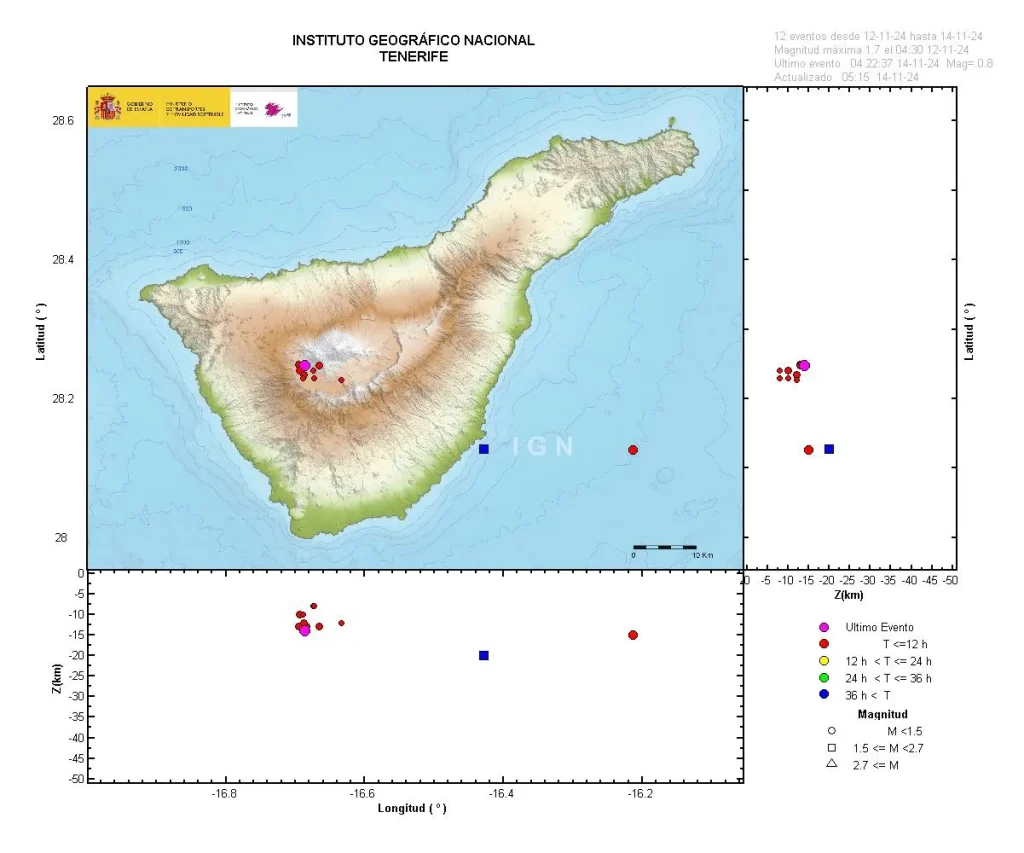
An earthquake swarm was recorded at Teide volcano, Tenerife, Canary Islands, Spain, between 04:00 and 07:20 UTC on November 14, 2024. The seismic activity occurred in the Las Cañadas del Teide area, southwest of Pico Viejo, and consisted of 500 microearthquakes with magnitudes below 1.1.

Map showing the location of earthquake swarm near Teide volcano on November 14, 2024. Image credit: IGN
An anomalous microseismic activity was recorded in the Las Cañadas del Teide area, southwest of Pico Viejo, Tenerife, with at least 500 earthquakes detected between 04:00 and 07:20 UTC on November 14.
The activity began with 10 small earthquakes, each registering less than M1.1, at depths of 8 – 12 km (5 – 7.5 miles). These initial quakes were followed by long-duration signals characterized by undefined seismic phases and high-frequency content.
Subsequently, a prolonged sequence of hundreds of small, similarly-sized events occurred at nearly regular intervals. This pattern closely resembled what is often referred to as a “drumbeat.”
While some lower-magnitude earthquakes were detected by the automatic system, their seismic parameters were too weak for inclusion in the official Instituto Geográfico Nacional (IGN) database.
Notably, this seismic activity occurred in an area where similar events have been recorded in recent years, specifically in October 2016, June 2019, and June – July 2022.
The Teide volcano is located in Tenerife, the largest island of the Canary Islands archipelago. Tenerife’s volcanic landscape is a complex of overlapping stratovolcanoes, ranging from Miocene to Quaternary in age.
The island’s NE-trending Cordillera Dorsal massif connects the older volcanic regions with the Las Cañadas volcano, forming the largest volcanic complex in the Canary Islands.
The Las Cañadas caldera, measuring 10 x 17 km (6 x 10.5 miles), is a prominent feature partially filled by the Teide stratovolcano. Its origin has been attributed to either a collapse following explosive eruptions, a massive landslide similar to the earlier formations of La Orotava and Guimar valleys, or a combination of these processes.
The most recent volcanic activity began in the late Pleistocene and led to the formation of the Pico Viejo and Teide volcanic edifices.
Historically, Tenerife may have been observed in eruption by Christopher Columbus in 1492. Since then, several flank vents of the Teide volcano have shown activity, making it the most active volcano in the Canary Islands.
References:
1 Enjambre sísmico en Las Cañadas del Teide (Tenerife) – IGN – Issued at 11:15 UTC on November 14, 2024
2 Tenerife geological summary – GVP – Accessed on November 16, 2024

I am an Assistant Editor and Severe Weather & Science Journalist at The Watchers, specializing in real-time severe weather coverage, geophysical event reporting, and research-driven scientific analysis. You can reach me at rishav(at)watchers(.)news.

Commenting rules and guidelines
We value the thoughts and opinions of our readers and welcome healthy discussions on our website. In order to maintain a respectful and positive community, we ask that all commenters follow these rules.