
Record-breaking heatwave triggers rare alerts and emergencies across Europe
Multiple countries across Europe established new June temperature records this week as an exceptional heatwave continued to intensify, pushing temperatures above 40°C (104°F) across large parts of the continent. In France, authorities said at least 55 people had drowned while attempting to cool off during the prolonged heatwave, as hospitals, emergency services, and governments struggled to respond to its escalating impacts, while Spain reported at least 212 heat-related fatalities from June 21 to 24.
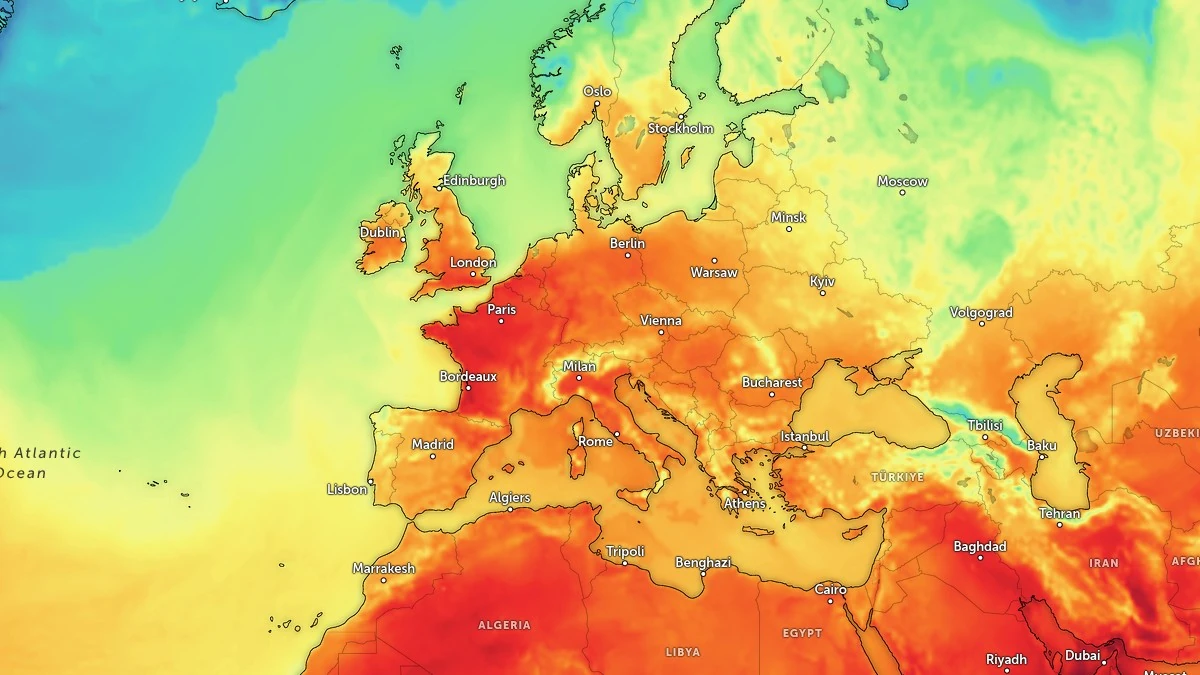
Feels like temperatures GFS model for 13:00 UTC on June 25, 2026. Credit: Zoom Earth, The Watchers
An exceptional heatwave continued to push temperatures to record levels across Europe on Friday, June 26, triggering rare emergency measures and widespread red heat alerts across Europe.
Although temperatures were beginning to ease across parts of western Europe, meteorological agencies warned that dangerous heat would persist through the weekend across central and southeastern Europe.
Météo-France said Wednesday, June 24, became the hottest day ever recorded nationally based on the 24-hour average temperature, which reached 30°C (86°F) for the first time.
The country also recorded its hottest national afternoon on record, with an average afternoon temperature of 38.5°C (101.3°F), while temperatures exceeded 40°C (104°F) across large parts of France. Exceptionally warm nights further increased health risks by limiting opportunities for people and infrastructure to recover from prolonged daytime heat.
The heatwave has also intensified secondary hazards. Météo-France warned that worsening drought conditions and exceptionally dry vegetation had significantly increased wildfire danger, with more than 30 departments classified as facing high wildfire risk and some reaching the very high category.
Soil moisture across several regions is approaching the driest levels observed since records began in 1959, raising concerns for agriculture, ecosystems, and water resources.
French Prime Minister Sébastien Lecornu announced activation of the Level 3 ORSAN health emergency plan, the country’s highest level of healthcare mobilization, after hospitals and emergency services came under increasing pressure.
Health Minister Stéphanie Rist warned that emergency department visits and calls to emergency services had risen sharply because of the heatwave, while Paris Police Prefect Patrice Faure said hospitals in Paris and the surrounding region were already overwhelmed.
The prolonged heat has also contributed to a growing number of indirect fatalities. At least 55 people had drowned while attempting to cool off during the heatwave since June 18, Sports Minister Marina Ferrari told Franceinfo on Friday.
Around 13 500 schools were closed or operating under adapted schedules in France because of dangerous indoor temperatures.
Authorities warned the toll could increase as 61 departments remained under red heat alerts and another 25 under orange alerts on Friday. Paris authorities also prohibited public alcohol consumption from midday as part of measures intended to reduce heat-related risks.
Forecasts by the German Weather Service and the European Commission Joint Research Center population projections indicate that more than 101 million people are expected to experience temperatures above 35°C (95°F), while more than 380 million could see temperatures exceed 30°C (86°F) in the days ahead.
Rail operators imposed speed restrictions to reduce the risk of heat-related infrastructure damage, while state-owned utility EDF pledged EUR 80 million (approximately USD 91 million) to install cooling systems in schools, kindergartens, and childcare centers.
Cultural events were also disrupted after police asked organizers of the Solidays music festival to cancel the event, while organizers of Paris Pride announced plans to reschedule celebrations because of the extreme conditions.
Elsewhere in Europe, infrastructure has come under growing strain. In Germany, sections of the A2 motorway buckled under the heat, damaging vehicles and forcing closures, while Deutsche Bahn warned passengers of possible disruption caused by heat, wildfires, and severe thunderstorms.
The Netherlands issued its first nationwide red heat alert, closing schools in several regions and reducing rail services as temperatures approached 40°C (104°F). Belgium also declared a rare red alert, with farming organizations warning that prolonged heat had begun reducing livestock productivity.
The United Kingdom remained under its third consecutive day of Red heat warnings across much of southern England. Temperatures reached 36.7°C (98.1°F) at Merryfield, Somerset, on June 25, provisionally making it the hottest June day on record in the United Kingdom, according to the UK Met Office. The agency also reported new provisional June records in Wales and record-equalling heat in Northern Ireland.
The London Ambulance Service responded to 642 Category 1 emergencies, the highest number of life-threatening calls in its history.
Schools and nurseries closed in several areas, transport services were disrupted, and water restrictions were introduced in parts of southeast England. London Mayor Sadiq Khan called for wider installation of air conditioning in schools, hospitals, and public buildings as the capital adapts to increasingly frequent extreme heat.
Several Italian regions prohibited outdoor work during the hottest hours of the day as temperatures approached 40°C (104°F), while courts in Palermo suspended non-urgent hearings because of air-conditioning failures.
The Italian government said companies forced to suspend work because of dangerous heat could access financial support for furloughed workers, while labor organizations warned that up to 1.5 million outdoor workers could face hazardous conditions if the heat persists.
In Spain, the national meteorological agency (AEMET) reported new June records for both maximum and minimum temperatures at multiple observatories on Wednesday and Thursday, with many of the records occurring across the northern half of the country rather than the south, underscoring the unusual geographic extent of the event.
Bilbao Airport established consecutive June maximum records, reaching 42.7°C (108.9°F) on Wednesday after recording 41.3°C (106.3°F) the previous day. The station also registered exceptionally warm overnight minimum temperatures of 20.5°C (68.9°F) and 20.7°C (69.3°F), reflecting the persistence of the heat.
Other records included 41.8°C (107.2°F) in Pamplona and 40.6°C (105.1°F) in both Valladolid and Zamora. Overnight temperatures also remained unusually high, reaching 28.4°C (83.1°F) in Jaén and 25.8°C (78.4°F) at Madrid Retiro, highlighting one of the defining characteristics of the heatwave—persistently warm nights that limited overnight cooling.
Earlier, Spain’s public mortality-monitoring system (MoMo) estimated that high temperatures were linked to 212 deaths between June 21 and 24, as the country’s first official heat wave of 2026 brought temperatures near 40°C (104°F) and higher across large areas.
The heat is expected to shift east over the weekend, bringing very high temperatures to Poland, Czechia, Slovakia, and neighboring countries through the end of the month.
References:
1 Europe on high alert as killer heat spreads – Reuters – June 26, 2026
2 Code Red heat alarm for temps up to 40°C: Many schools closed; Stay off the roads – NL Times – June 26, 2026
3 Over 100 million Europeans experiencing temperatures over 35C – RTE – June 25, 2026

I am an Assistant Editor and Severe Weather & Science Journalist at The Watchers, specializing in real-time severe weather coverage, geophysical event reporting, and research-driven scientific analysis. You can reach me at rishav(at)watchers(.)news.

Commenting rules and guidelines
We value the thoughts and opinions of our readers and welcome healthy discussions on our website. In order to maintain a respectful and positive community, we ask that all commenters follow these rules.