
WMO confirms megaflash spanning 829 km (515 miles) as the longest on record
The World Meteorological Organization confirmed a new lightning flash record spanning 829 km (515 miles) across the Great Plains, United States, observed on October 22, 2017.

Image credit: Edward Mitchell/WMO
The World Meteorological Organization (WMO) announced a new record for the longest lightning flash on July 31. The record was awarded to a 829 km (515 miles) long megaflash observed on October 22, 2017, during a major thunderstorm over the Great Plains.
The megaflash extended from eastern Texas to Kansas City, Missouri. The distance is equivalent to a trip from Paris, France to Venice, Italy—coverable by a commercial jet in approximately 90 minutes, or by car in about 8 to 9 hours.
The new record has a margin of error of ±8 km (5 miles). It exceeds the previous record by 61 km, which was 768 ±8 km (477.2 ±5 miles) long, observed across parts of the southern United States on April 29, 2020.
The Great Plains of North America are known hotspots for Mesoscale Convective Systems (MCS) thunderstorms, which create conditions favorable for such megaflashes.
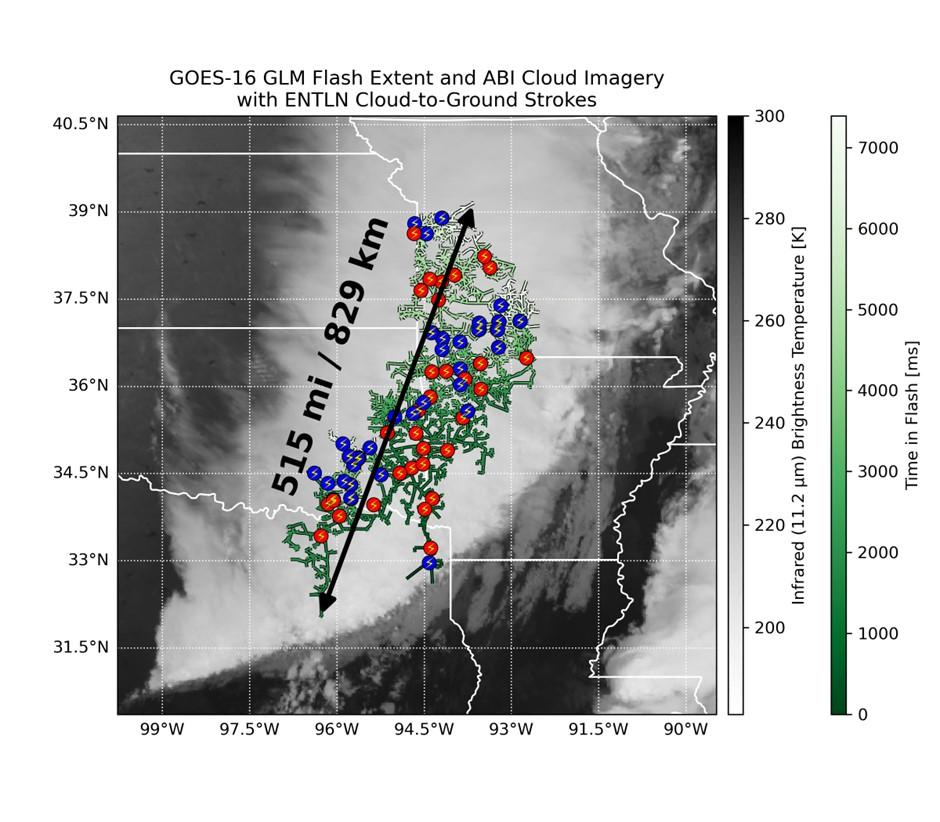
This specific flash was not identified during the initial 2017 analysis but was later discovered through a re-examination of the thunderstorm.
“This new record clearly demonstrates the incredible power of the natural environment. Additionally, WMO assessment of environmental extremes such as this lightning distance record testify to the significant scientific progress in observing, documenting and evaluating such events. It is likely that even greater extremes still exist, and that we will be able to observe them as additional high-quality lightning measurements accumulate over time,” said Professor Randall Cerveny, rapporteur of Weather and Climate Extremes for WMO.
Both the previous and current records were measured using the same maximum great-circle distance methodology. The 2017 event is particularly significant as it was among the first storms to be documented by the National Oceanic and Atmospheric Administration’s (NOAA) Geostationary Operational Environmental Satellite (GOES-16) with lightning ‘megaflashes’—extremely long duration and distance lightning discharges.
Previous assessments relied on data from ground-based Lightning Mapping Array (LMA) networks. However, many lightning scientists acknowledged the observational limits of existing LMA systems.
Identifying megaflashes beyond those limits requires broader domain coverage, which modern lightning mapping technologies now provide.
Recent advancements in space-based lightning mapping now allow continuous measurement of flash extent and duration over wide geospatial domains. These include the Geostationary Lightning Mappers (GLMs) on the R-series GOES satellites (GOES-16, 17, 18, and 19), which recorded the new lightning record, as well as orbiting counterparts from Europe—the Meteosat Third Generation (MTG) Lightning Imager—and China—the FY-4 Lightning Mapping Imager.
The WMO also mentioned some existing lightning records (dating back to 1873) in their report:
The longest-duration flash on record lasted more than 17 seconds over parts of Uruguay and northern Argentina in June 2020.
The most fatalities caused by a single lightning strike occurred in Zimbabwe in 1975 when the 21 individuals were killed by a direct strike while huddling in a hut for safety.
Meanwhile, the record for the most fatalities due to an indirect strike is held by a lightning strike that occurred in 1994 claiming 469 lives in Egypt. The incident occurred on November 2, 1994, when a thunderstorm affecting 124 villages struck Dronka with a lightning strike that set fire to oil tanks in the village.
The region had already been experiencing severe flooding which now carried burning, setting fire to the settlement. At least 469 individuals were killed and more than 200 homes were destroyed due to the incident.

I am an Assistant Editor and Severe Weather & Science Journalist at The Watchers, specializing in real-time severe weather coverage, geophysical event reporting, and research-driven scientific analysis. You can reach me at rishav(at)watchers(.)news.

Commenting rules and guidelines
We value the thoughts and opinions of our readers and welcome healthy discussions on our website. In order to maintain a respectful and positive community, we ask that all commenters follow these rules.