
Historic flooding hits Milwaukee region after record-breaking rainfall, Wisconsin
Milwaukee recorded its second-wettest day on August 9, 2025, with 146 mm (5.74 inches) of rain causing historic flooding across the city and nearby areas.

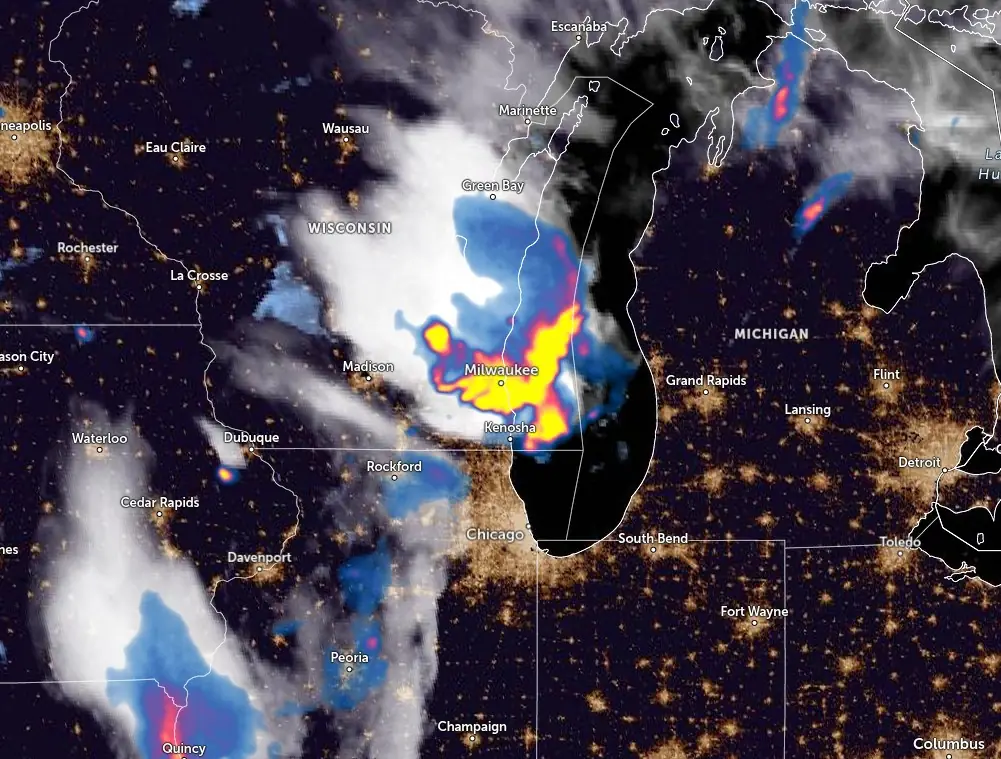
Image credit: NOAA/GOES-East, Zoom Earth, The Watchers. Acquired at 13:40 UTC on August 10, 2025
Milwaukee, Wisconsin, experienced widespread flooding after 146 mm (5.74 inches) of rain fell on August 9, according to the National Weather Service (NWS).
This was the city’s second-highest single-day rainfall since records began, exceeded only by the 173 mm (6.81 inches) recorded on August 6, 1986. Storm totals reached nearly 178 mm (7 inches) in Milwaukee by the morning of August 10, while surrounding locations reported 250–279 mm (10–11 inches).
The Milwaukee River at Estabrook Park crested at 3.41 m (11.19 feet), surpassing the previous record of 3.20 m (10.5 feet) set in 2010, pushing the river into major flood stage and inundating low-lying neighborhoods, parks, and transportation corridors.

Flash flooding forced the closure of the Wisconsin State Fair in West Allis on August 9, leading to the cancellation of scheduled performances, including a Lynyrd Skynyrd concert, and preventing the fair from reopening on its final day. USA Triathlon events were also canceled.
Roads became impassable, underpasses filled with water, and hundreds of vehicles were stranded forcing emergency services to responded to hundreds of water rescue calls.

Power outages affected approximately 47 000 customers across southeastern Wisconsin.
The Brewers–Mets baseball game at American Family Field proceeded on August 10 under the stadium’s retractable roof, but half of the venue’s parking lots were inaccessible. Ticket holders unable to attend were offered credits for future games.
According to NWS, slow-moving frontal boundary extending from the central Plains to the Midwest is expected to remain a focus for additional rounds of strong to severe thunderstorms and heavy rainfall over the next couple of days.
Periodic upper-level disturbances from the central Rockies will provide dynamics for the development of thunderstorm complexes, particularly from eastern Colorado to the central Plains and Midwest through tonight. The most severe storms may produce very large hail, damaging winds, and isolated tornadoes.
“The slow and chaotic movement of these storm clusters combined with intense rainfall rates over saturated grounds will mean that any flash flooding will have the heightened potential to produce significant impacts,” NWS forecasters Kong and Miller noted.
As storm clusters merge and track over the same areas, cumulative rainfall is forecast to cause numerous instances of flash flooding. The Weather Prediction Center (WPC) has issued a Slight Risk of excessive rainfall for the broader region, with a Moderate Risk across eastern Kansas into Missouri through Monday morning.
Meanwhile, another nearly stationary frontal boundary will be associated with the potential of flood-producing heavy rains across the southeastern U.S. through the next couple of days. The heaviest rainfall is expected to be near the Atlantic coast where moisture from the Atlantic converges.

Teo Blašković founded The Watchers in 2011 and edited it until 2026, covering seismic and volcanic activity, extreme weather, space weather and near-Earth objects. Articles on this page are his archive.
Published in the last 24 hours
- In September 1859, a solar storm lit up the night sky so brightly that gold miners in the Rocky Mountains woke up after midnight and started cooking breakfast, convinced the aurora glowing over their camp was the sunrise Epicenter
- A patch of warm Pacific water that could become the strongest El Niño in more than 70 years sits thousands of miles from any American town, yet it is already the main reason NOAA expects a wetter winter across the South and a milder one across the North
- A 19-year-old Nebraska teacher reportedly tied her pupils together with twine and led them to safety through a blizzard in January 1888 Epicenter
- NASA built the Opportunity rover to last 90 days on Mars, and Martian winds helped keep it alive for nearly 15 years by blowing dust off its solar panels, until a planet-wide dust storm in 2018 blocked sunlight and silenced the rover Epicenter
