
Moondust meteor storm from lunar asteroid impact possible in December 2032
Asteroid 2024 YR4 has a 4 % chance of striking the Moon on December 22, 2032, potentially ejecting up to 100 million kg of lunar debris into space, with as much as 10 % of it reaching Earth and producing a rare, slow-moving meteor storm.

A recently updated orbital analysis by NASA’s Center for Near-Earth Object Studies (CNEOS) and the European Space Agency (ESA) indicates that asteroid 2024 YR4, measuring an estimated 53–67 m (174–220 feet) in diameter, has a probability of about 4 percent of colliding with the Moon on December 22, 2032.
While there is no risk to Earth from a direct impact, the lunar strike could trigger a notable debris event visible from our planet.
If the asteroid impacts the Moon, the kinetic energy released would be equivalent to approximately 6.5 megatonnes of TNT, excavating a crater about 1 km (0.62 miles) in diameter.
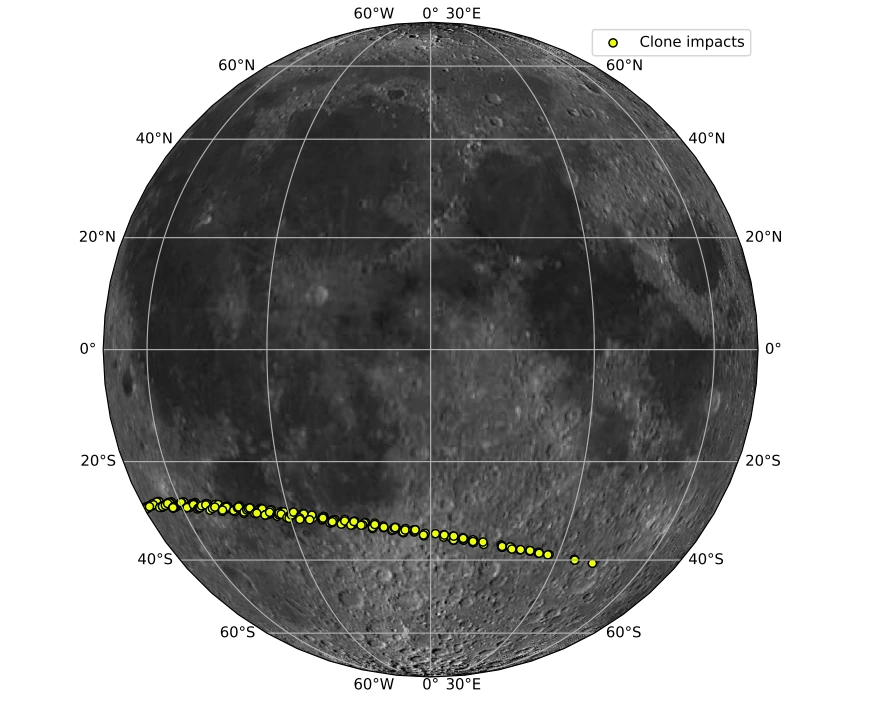
Numerical modeling suggests that such an event could eject up to 1 × 10⁸ kg of lunar regolith into space. Depending on the impact location and the Moon’s orbital position, up to 10 percent of this ejecta could intersect Earth’s orbit within days.
Unlike high-velocity meteors from typical showers such as the Perseids (about 60 km/s or 37 miles/s), lunar ejecta would arrive at speeds of about 11 km/s (7 miles/s).
The lower velocity would produce longer-lasting, dimmer meteors—silver-white streaks sometimes persisting for over a second—rather than bright, fast flashes. The apparent radiant point for these meteors would be close to the Moon’s position in the sky at the time of arrival, and the activity could continue for several days rather than peaking sharply.
If the impact occurs on the Moon’s near side, the flash of the collision could itself be visible to small telescopes or even binoculars from Earth, appearing as a short-lived brightening on the lunar surface. Some astrophotographers may also record a faint halo or haze near the Moon if fine dust lingers in its immediate vicinity.

While the meteor display would be harmless for observers on Earth’s surface, the space environment could be temporarily hazardous.
Modeling indicates that the debris flux for particles in the 0.1–10 mm size range could rise to 10–1 000 times the usual background rate in low-Earth orbit (LEO), compressing years of micrometeoroid exposure into just a few days. This presents a measurable risk to satellites, lunar orbiters, surface assets, and future cis-lunar infrastructure such as the planned Lunar Gateway.
The asteroid is currently unobservable due to its position relative to the Sun and will remain so until late 2028, when further measurements will significantly refine its trajectory and clarify the lunar impact risk. Until then, the probability of a 2032 lunar strike remains near 4 percent, and researchers continue to model both the potential meteor storm and its implications for space operations.

I’m a science journalist and researcher at The Watchers, contributing to the Epicenter edition, where I cover peer-reviewed scientific research and emerging discoveries across Earth and space sciences. With a background in astronomy and a passion for environmental science, I’ve worked in shark and coral conservation in Fiji, conducting reef and shark-behavior research, contributing to mangrove restoration, and earning PADI Open Water and Coral Reef Certifications. I bring a blend of scientific rigor and storytelling to illuminate the discoveries shaping our planet and beyond.

Commenting rules and guidelines
We value the thoughts and opinions of our readers and welcome healthy discussions on our website. In order to maintain a respectful and positive community, we ask that all commenters follow these rules.