
JWST observations eliminate lunar impact probability of asteroid 2024 YR4 in 2032
Astronomers have ruled out a potential Moon impact by asteroid 2024 YR4 on December 22, 2032, after precise measurements from the James Webb Space Telescope refined the object’s orbit. The asteroid, once briefly considered among the most closely monitored impact risks discovered in the past two decades, will instead pass safely beyond 20 000 km (12 400 miles) from the Moon.
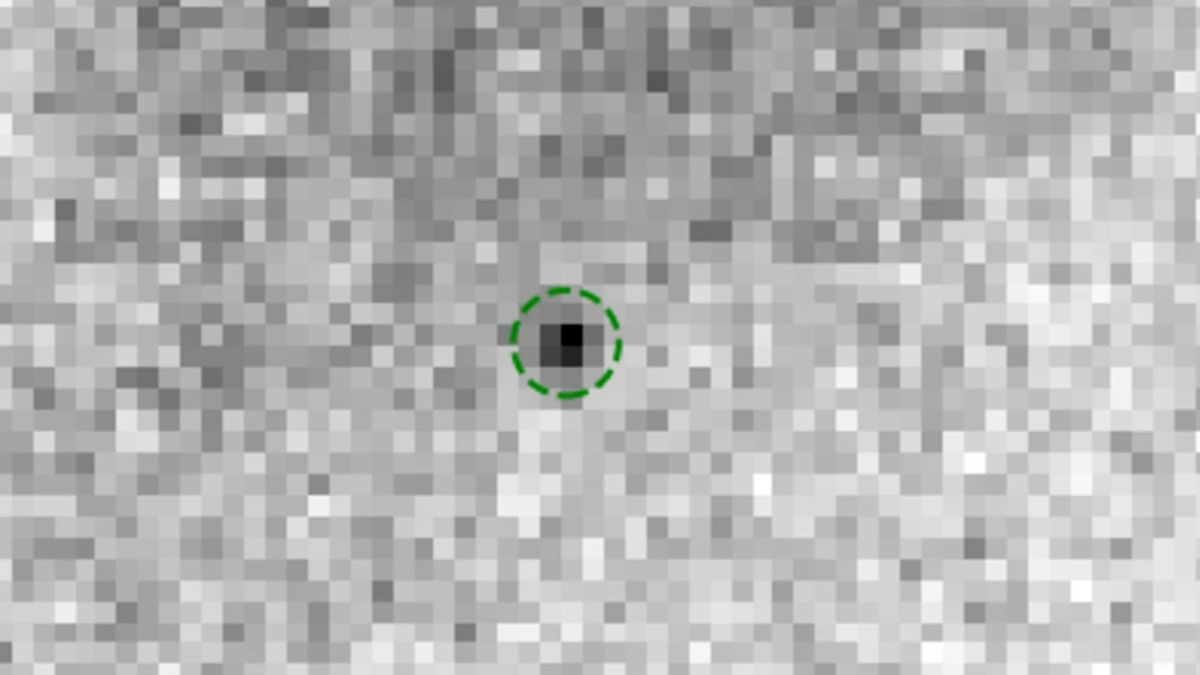
James Webb Space Telescope spots faint asteroid 2024 YR4 on February 18, 2026. Credit: NASA, ESA, CSA, STScI, M. Micheli (ESA NEOCC)
Asteroid 2024 YR4 will safely pass the Moon on December 22, 2032, after new observations obtained with the James Webb Space Telescope (JWST) eliminated the previously estimated probability that the object could strike the lunar surface.
The asteroid, estimated to measure roughly 60 m (197 feet) in diameter, briefly drew global attention in early 2025 when preliminary orbital solutions suggested a small probability of an Earth impact in 2032.
While additional observations quickly ruled out any collision with Earth, subsequent calculations indicated a residual possibility (about 4%) that the object could strike the Moon during the same close approach.
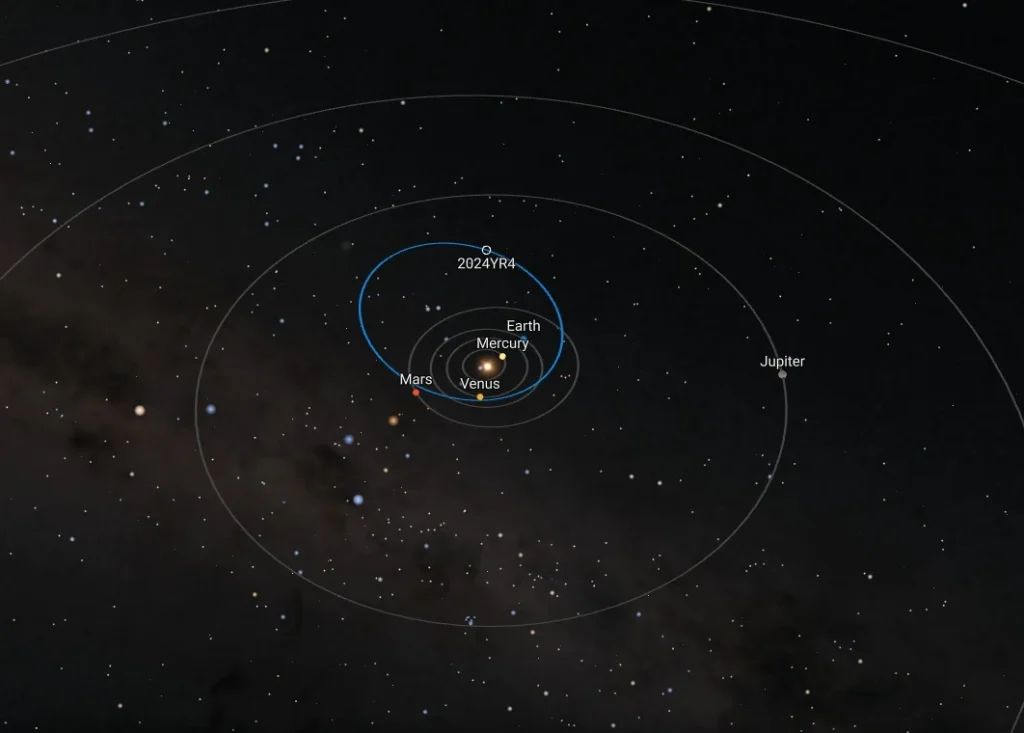
As the asteroid moved farther from Earth during 2025, it became increasingly faint and eventually disappeared from the reach of most ground-based telescopes. Without additional observations, astronomers expected the object to remain unobservable until it returned to a more favorable viewing geometry in 2028.
However, in February 2026, an international team of astronomers identified two narrow observation windows during which the asteroid might be detectable with JWST.
Tracking the asteroid presented a significant technical challenge as JWST’s field of view is extremely narrow, and detecting a faint object moving millions of kilometers away required highly accurate predictions of its position and careful observation planning.
The telescope’s Near-Infrared Camera (NIRCam) was used to search for the faint object against a background of stars precisely mapped by the European Space Agency’s Gaia mission.


Observations conducted on February 18 and February 26, 2026, successfully detected the asteroid and allowed astronomers to measure its position relative to background stars with sufficient precision to significantly refine its orbit.
Updated orbital calculations derived from those measurements show the asteroid will pass the Moon at a distance exceeding 20 000 km (12 400 miles) on December 22, 2032, eliminating the possibility of a lunar impact.
Objects the size of asteroid 2024 YR4 are capable of producing regional damage if they were to strike Earth, although impacts of this scale occur only on timescales of thousands of years.
References:
1 Asteroid 2024 YR4 will not impact the Moon – ESA – March 5, 2026

I'm a dedicated researcher, journalist, and editor at The Watchers. With over 20 years of experience in the media industry, I specialize in hard science news, focusing on extreme weather, seismic and volcanic activity, space weather, and astronomy, including near-Earth objects and planetary defense strategies. You can reach me at teo /at/ watchers.news.

Commenting rules and guidelines
We value the thoughts and opinions of our readers and welcome healthy discussions on our website. In order to maintain a respectful and positive community, we ask that all commenters follow these rules.