
How humans adapted to increased cosmic radiation during geomagnetic excursion 41 000 years ago
Around 41 000 years ago, Earth’s magnetic field weakened by up to 90 percent during a geomagnetic excursion known as the Laschamps event. This rare event reduced the planet’s natural shielding against solar and cosmic radiation, exposing the surface to increased ultraviolet energy. A new study combining space weather modeling and archaeological evidence shows that early humans adapted to these extreme conditions through the use of ochre, clothing, and caves, while Neanderthals may have lacked such protective strategies, which may have contributed to their extinction.
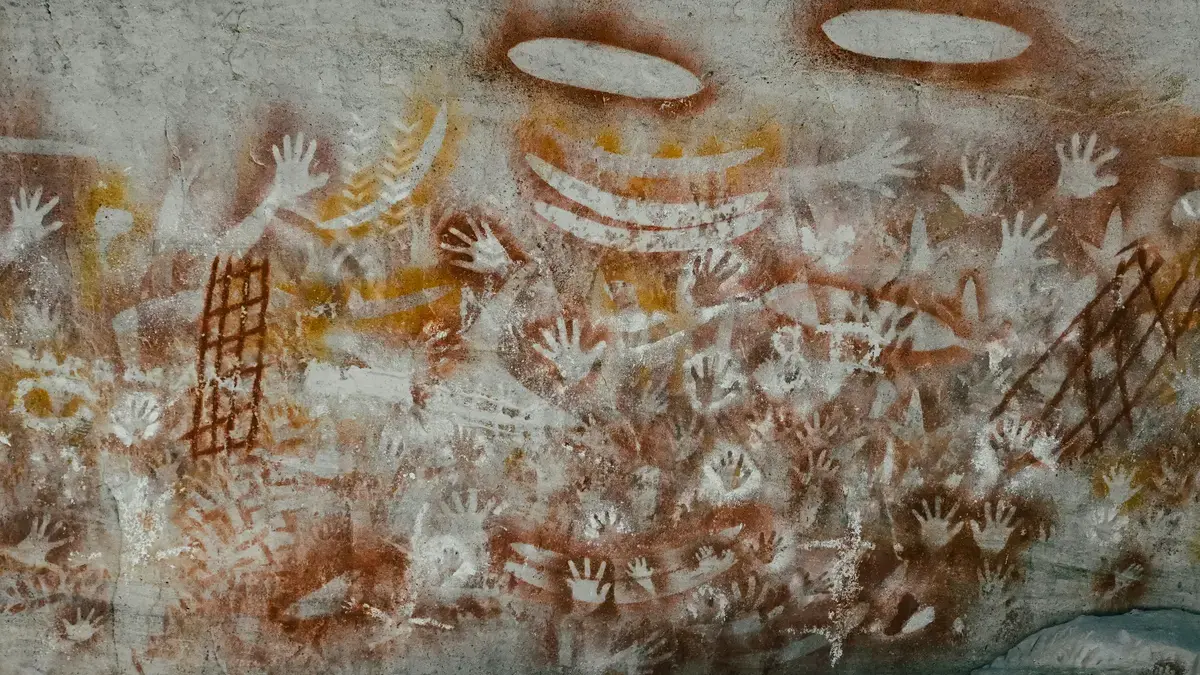
Image credit: Athithan Vignakaran
A study by the University of Michigan, published in Science Advances on April 16, examines the Laschamps geomagnetic excursion, a short-lived but intense event that occurred around 41 000 years ago. During this period, Earth’s magnetic field weakened to about 10 percent of its present-day strength, reducing the planet’s shielding capacity and allowing increased ultraviolet (UV) radiation to reach the surface. The research, led by Agnit Mukhopadhyay, presents the first space plasma simulation of the excursion’s effects on Earth’s magnetosphere.
The Laschamps excursion, dated between 42 200 and 41 500 years ago, was a geomagnetic excursion—a temporary disturbance in Earth’s magnetic field that did not result in a permanent polarity reversal.
The event involved significant pole shifts and a sharp decline in field strength, with the most intense weakening and dipole tilting occurring over a period of about 300 years. This interval coincided with a time when early human populations in Europe and northern Africa were exposed to changing environmental conditions. During the excursion, auroral zones expanded toward lower latitudes, making auroras visible in regions where they are rarely observed today.
Homo sapiens, who arrived in Europe around 56 000 years ago, likely used ochre as a natural form of protection against ultraviolet radiation. Archaeological evidence indicates that they applied the mineral to their skin, which may have helped reduce UV-related damage. This behavioral adaptation was particularly important in regions experiencing increased solar exposure during the geomagnetic excursion.

The study also shows that Homo sapiens wore tailored clothing to shield themselves from UV rays. These garments allowed them to move safely in open environments during daylight. Caves served as another refuge for them during the excursion. By seeking shelter in cave systems, they minimized exposure to harmful radiation.
In contrast, Neanderthals, who disappeared around 40 000 years ago, appear to have lacked comparable protective strategies. According to the study, their limited adaptation to increased ultraviolet radiation during the geomagnetic excursion may have been a contributing factor in their extinction.
The research team used the Space Weather Modeling Framework to simulate Earth’s magnetic field and atmospheric conditions during the Laschamps excursion. The simulations showed that the dayside magnetosphere contracted to approximately 5.3 Earth radii—about half of its current extent—allowing increased penetration of cosmic rays and solar energetic particles into the upper atmosphere.

The study notes that the weakened magnetic field led to changes in atmospheric circulation and composition. Increased radiation is likely to have affected the biosphere, although the specific impacts on early humans remain under exploration.
Comparisons with other planetary magnetospheres, like those of Jupiter and Neptune, reveal differences in size and structure. Earth’s magnetosphere during the excursion temporarily resembled those of planets with complex, multipolar fields.
The research also explores the potential consequences of a similar geomagnetic excursion occurring today. A significant weakening of Earth’s magnetic field would reduce protection against high-energy particles, increasing exposure to cosmic radiation. This could severely impact modern technological systems, including satellite operations, global communication networks, and power infrastructure, which are highly sensitive to space weather disturbances.

Archaeological evidence supports the study’s findings, with records of ochre use, tailored clothing, and cave dwellings among Homo sapiens. These artifacts align with the timeline of the Laschamps excursion, reinforcing the proposed survival strategies.
The research team included international collaborators from institutions like the GFZ Helmholtz Centre in Germany and the University of Oulu in Finland.
“Many people say that a planet cannot sustain life without a strong magnetic field,” Mukhopadhyay said. “Looking at prehistoric Earth, and especially at events like this, helps us study exoplanetary physics from a very different vantage point. Life did exist back then. But it was a little bit different than it is today.”
Geomagnetic excursions and reversals in Earth’s history
The Laschamps event is one of several documented geomagnetic excursions—short-lived periods during which Earth’s magnetic field weakens significantly and may temporarily reverse.
Unlike full geomagnetic reversals, which involve a long-term and complete switch in magnetic polarity, excursions are shorter and involve partial or temporary changes in field orientation. Despite their brevity, these events can substantially reduce the planet’s shielding capacity against cosmic and solar radiation.
Several such events have been identified in the geologic record. In addition to the Laschamps excursion (~41 000 years ago), others include the Mono Lake excursion (~34 000 years ago), the Blake excursion (~120 000 years ago), and the Norwegian–Greenland Sea excursion (~60 000 years ago). Full geomagnetic reversals, such as the Brunhes–Matuyama reversal that occurred approximately 780 000 years ago, are rarer but more stable and long-lasting.
Paleomagnetic data from marine sediments, volcanic rocks, and ice cores have helped reconstruct the timing and intensity of these events. While their exact causes remain under investigation, most are associated with changes in core convection patterns that generate Earth’s geomagnetic field. The recurrence interval of major reversals is highly variable, ranging from 200 000 to over 1 million years, with no clearly predictable cycle.
Evidence of more frequent recent disturbances
A study published in Pacific Geology in September 2024 analyzed peat deposits to identify geomagnetic excursions over the past 10 000 years. The research uncovered evidence of multiple short-lived magnetic field disturbances, suggesting that such events may occur more frequently than previously believed.
One of the study’s primary results is a clear link between the 1 700-year harmonic and multiple Bond events, which are significant climatic occurrences associated with changes in global temperature and environmental circumstances.
This correlation suggests a potential connection between geomagnetic behavior and climate change. Such findings enhance the ability to use geomagnetic data to study past climate patterns and understand how they might influence or be influenced by geomagnetic fluctuations.
Signs of ongoing magnetic field changes
Earth’s magnetic field has been gradually weakening since at least the mid-19th century, with measurements indicating a global decline of roughly 10 percent over the past 150 years. The weakening is not uniform across the planet.
One of the most significant regional anomalies is the South Atlantic Anomaly, a zone of markedly reduced magnetic field intensity stretching from South America into southern Africa. In this area, the magnetic field strength is nearly half of the global average, exposing satellites and spacecraft passing overhead to increased radiation levels and causing frequent technical anomalies.
At the same time, the magnetic north pole has been migrating at an accelerating rate. After centuries of relatively stable position in the Canadian Arctic, it began moving more rapidly in the late 20th century, now shifting toward Siberia at a rate of up to 55 km (34 miles) per year. The World Magnetic Model, which guides navigation systems globally, is now updated more frequently to account for this movement.
Some researchers interpret the rapid pole movement and regional field weakening as potential indicators of an evolving geomagnetic excursion or the early stages of a polarity reversal. Others caution that while such changes are significant, similar fluctuations have occurred in the past without leading to a full transition.
However, what distinguishes the current period is the rate and scale of change, combined with the unprecedented vulnerability of modern technological systems to geomagnetic disturbances. Even in the absence of a full reversal or excursion, the ongoing decline in field strength and the expansion of weak-field regions like the South Atlantic Anomaly pose measurable risks to satellite operations, radiation exposure at flight altitudes, and the stability of electrical infrastructure.
Modern vulnerability to geomagnetic instability
The Laschamps event offers a valuable analogy for understanding how geomagnetic instability could impact modern technological society. Unlike Homo sapiens 41 000 years ago, today’s human systems—such as navigation, aviation, power grids, and satellite infrastructure—are highly dependent on stable geomagnetic conditions.
A significant weakening of the geomagnetic field would increase the penetration of solar energetic particles and cosmic rays into the upper atmosphere, elevating the risk of satellite malfunctions, communication blackouts, GPS errors, and power grid disruptions. Modern aircraft flying at high altitudes and latitudes could be exposed to higher radiation doses, and pipelines might experience increased corrosion from induced electrical currents.
Although a geomagnetic excursion would not pose an immediate health risk for most people at the surface, increased radiation levels in the upper atmosphere and at high latitudes could affect certain populations—such as airline crews, frequent flyers, and astronauts—over extended periods. The disruption of technological infrastructure, including satellite operations, navigation systems, aviation, and power grids, could have serious indirect consequences for modern societies.
Although the timing of the next geomagnetic excursion or reversal is uncertain, historical and geological records show that such events are a recurring feature of Earth’s internal dynamics.
References:
1 Wandering of the auroral oval 41,000 years ago – Agnit Mukhopadhyay, Sanja Panovska, Raven Garvey et al. – Science Advances – April 16, 2025 – https://doi.org/10.1126/sciadv.adq7275 – OPEN ACCESS
2 Sunscreen, clothes and caves may have helped Homo sapiens survive 41,000 years ago – University of Michigan – April 16, 2025

I’m a science journalist and researcher at The Watchers, contributing to the Epicenter edition, where I cover peer-reviewed scientific research and emerging discoveries across Earth and space sciences. With a background in astronomy and a passion for environmental science, I’ve worked in shark and coral conservation in Fiji, conducting reef and shark-behavior research, contributing to mangrove restoration, and earning PADI Open Water and Coral Reef Certifications. I bring a blend of scientific rigor and storytelling to illuminate the discoveries shaping our planet and beyond.

Commenting rules and guidelines
We value the thoughts and opinions of our readers and welcome healthy discussions on our website. In order to maintain a respectful and positive community, we ask that all commenters follow these rules.