
Gravitational anomaly in 2007 hints at rapid changes near Earth’s core
A gravity anomaly recorded by NASA–German GRACE satellites in early 2007 over the Atlantic Ocean points to mass redistribution near Earth’s core–mantle boundary, around 2 700–2 900 km (1 700–1 800 miles) deep. Researchers suggest a perovskite-to-post-perovskite mineral phase change produced decimetric boundary shifts, offering the first evidence that deep mantle processes can unfold within just a few years and potentially affect Earth’s magnetic field.
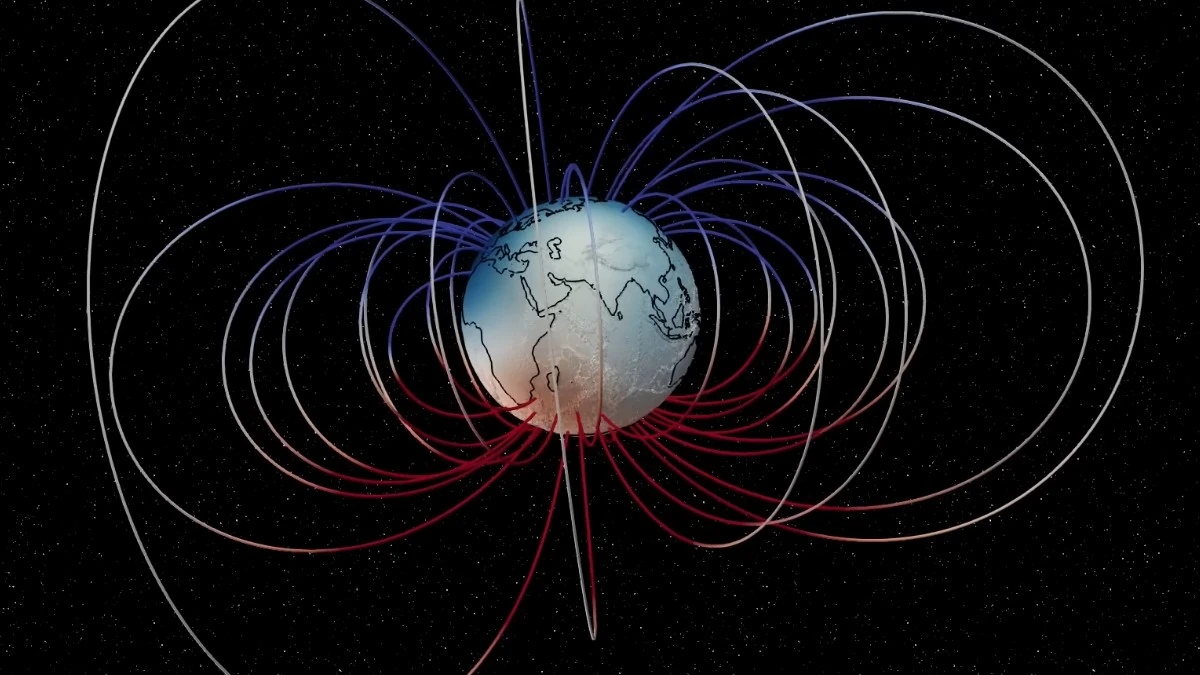
Image credit: ESA/SWARM
- GRACE satellites revealed a 2007 gravitational anomaly likely caused by a mineral phase transition near the core–mantle boundary, 2 700–2 900 km (1 700–1 800 miles) deep.
- The anomaly suggests that structural changes in mantle minerals can occur within just a few years, far faster than the millions of years usually assumed for deep Earth processes.
- The event coincided with geomagnetic disturbances, hinting that mantle–core dynamics may directly influence Earth’s magnetic field, though this connection remains under study.
Between 2006 and 2008, Earth experienced a subtle but measurable internal change that went unnoticed until researchers re-examined satellite data years later. Using the Gravity Recovery and Climate Experiment (GRACE), a pair of satellites jointly operated by the United States and Germany, scientists identified a gravitational anomaly centered off Africa’s Atlantic coast.
The signal, described in Geophysical Research Letters in August 2025, suggests that part of Earth’s deep interior briefly redistributed mass, marking the first time a process near the core–mantle boundary has been observed unfolding on human timescales rather than over millions of years.
The GRACE mission, active from 2002 to 2017, was designed to map Earth’s gravitational field by tracking the exact distance between two satellites flying in tandem. When one spacecraft passed over a mass anomaly such as a mountain or a groundwater reservoir, gravity caused a detectable tug that changed their separation.
Most GRACE studies have focused on surface processes, including ice loss, groundwater depletion, and sea-level rise. But Isabelle Panet, a geophysicist at the University Gustave Eiffel, and her colleagues extended the analysis to greater depths. They found that the data contained a unique anomaly peaking in early 2007, a large-scale gravitational change that could not be explained by water or surface mass redistribution alone.
The most likely explanation involves a structural shift in mantle minerals under extreme conditions. At depths close to the core–mantle boundary, pressures exceed 130 GPa, more than 1.3 million times atmospheric pressure at sea level, and temperatures surpass 3 000°C (5 400°F). Under these conditions, the mineral perovskite can transform into a denser structure known as post-perovskite.
This mineral phase transition would locally increase rock density, producing a redistribution of mass large enough to register in GRACE’s measurements. The researchers suggest that the change may have involved decimetric topographic adjustments, on the order of tens of centimetres, at the core–mantle boundary.
Around the same time as the gravitational anomaly, satellites tracking Earth’s magnetic field recorded unusual disturbances known as geomagnetic jerks. These short-term changes in the magnetic field are thought to originate from variations in fluid flow within the outer core.
The coincidence of timing between the gravitational signal and the geomagnetic perturbations suggests a possible connection: mineral changes near the base of the mantle may have influenced conditions at the boundary, indirectly affecting core dynamics. However, this link remains tentative, and more data will be required to confirm whether the two signals are causally related.
The detection is remarkable because it shows that deep Earth processes, typically assumed to unfold over geological timescales, can instead occur on the order of years. This means that parts of the mantle and core may be far more dynamic than previously understood.
Barbara Romanowicz, a seismologist at the University of California, Berkeley, who was not involved in the study, described the findings as the “first convincing evidence of dynamic processes at the base of the mantle occurring quickly enough to study as they happen.”
Such evidence could refine models of how Earth’s magnetic field evolves, how mantle dynamics influence the boundary with the core, and how planetary interiors behave more generally.
The lowermost mantle, known as the Dʺ layer, extends several hundred kilometres above the core–mantle boundary. It is a zone of extreme physics, where high pressures and temperatures reshape the properties of minerals. Studying it directly is impossible, so scientists rely on indirect tools: seismic waves, laboratory experiments, and computer simulations.
The GRACE detection shows that satellite observations provide a new window into this inaccessible region. By measuring tiny gravitational variations from orbit, researchers can detect processes invisible to ground-based instruments, offering a complementary view to seismology and geomagnetism.
So far, Panet and her colleagues have identified only this single anomaly in the GRACE dataset. Whether the 2007 signal was unique or part of a recurring phenomenon is unknown. Successor missions, including GRACE Follow-On launched in 2018, continue to monitor Earth’s gravity field and may reveal additional events.
If similar anomalies are detected in the future, scientists could begin to track the frequency and scale of mineral phase transitions at the base of the mantle. This would provide unprecedented insights into how Earth’s interior evolves, how the magnetic field responds, and whether such rapid deep processes are common.
References:
1 Mysterious changes near Earth’s core revealed by satellites in space – Nature – September 16, 2025 – DOI: https://doi.org/10.1038/d41586-025-03007-6
2 GRACE Detection of Transient Mass Redistributions During a Mineral Phase Transition in the Deep Mantle – Gouranton, Panet et al. – Geophysical Research Letters – August 2025 – DOI: https://doi.org/10.1029/2025GL123456 – OPEN ACCESS
3 ESA Swarm mission overview – ESA/SWARM – Accessed on September 17, 2025
4 GRACE Mission: Mapping Earth’s Gravity – NASA/JPL – Accessed on September 17, 2025

I'm a dedicated researcher, journalist, and editor at The Watchers. With over 20 years of experience in the media industry, I specialize in hard science news, focusing on extreme weather, seismic and volcanic activity, space weather, and astronomy, including near-Earth objects and planetary defense strategies. You can reach me at teo /at/ watchers.news.

Commenting rules and guidelines
We value the thoughts and opinions of our readers and welcome healthy discussions on our website. In order to maintain a respectful and positive community, we ask that all commenters follow these rules.