
Mass extinctions on Earth linked to nearby supernova explosions
A new study suggests that supernova explosions occurring within 1 000 light-years of Earth may have contributed to past mass extinctions, after finding evidence linking two mass extinction events during Devonian and Ordovician periods to supernovae.

Image of hot star Wolf-Rayet 124 (WR 124) by James Webb Telescope. Image credit: NASA
A new astronomical study suggests that nearby supernova explosions—powerful cosmic events marking the deaths of massive stars—may have contributed to mass extinction events on Earth.
Researchers at Keele University and Universidad de Alicante analyzed thousands of massive stars within 1 000 light-years of the Sun to determine the frequency of nearby supernova explosions.
Their findings suggest that mass extinctions during the Devonian and Ordovician periods may be linked to the effects of nearby supernovae. The Devonian mass extinction is estimated to have occurred approximately 372 million years ago, while the Ordovician extinction event took place around 445 million years ago.
Previous research couldn’t find a definitive cause for either event, though both have been associated with ozone layer depletion, which may have been triggered by a supernova.
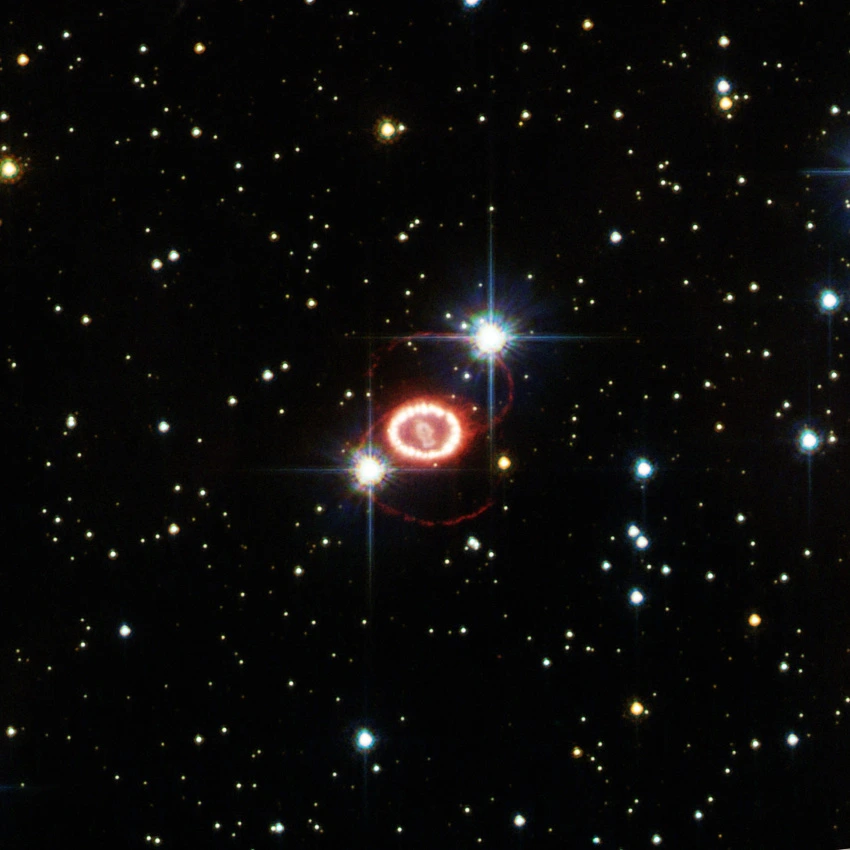
According to the study, the rate of core-collapse supernovae (ccSN) near Earth is approximately 2 – 2.5 ccSNe per billion years within about 65 light-years of the Sun.
Nearby supernovae can significantly impact Earth’s environment by damaging the ozone layer, increasing cosmic radiation, and potentially triggering severe climate changes that contribute to mass extinctions.
The authors describe this as “a great illustration of how massive stars can act as both creators and destructors of life,” as supernovae also distribute heavy elements essential for the formation and support of life throughout the universe.
Supernovae occur when massive stars exhaust their fuel, cool, and collapse under gravitational pressure. These explosions are among the most powerful events observed in the universe.
“Supernova explosions release heavy chemical elements into the interstellar medium, which are then used to form new stars and planets. But if a planet, including Earth, is too close to such an event, the effects can be devastating,” said lead author Dr. Alexis Quintana, formerly of Keele University and now at the University of Alicante.
Dr. Nick Wright from Keele University added, “Supernova explosions are among the most energetic events in the universe.”

The researchers arrived at the conclusions after conducting a “census” of massive stars within a kiloparsec (approximately 3 260 light-years) of the Sun.
They examined the distribution of these massive stars, known as OB stars, to understand star clusters and galaxy formation, using the Milky Way as a reference and analyzing the star formation rate in our galaxy.
This census allowed the researchers to calculate the rate at which supernovae occur within the galaxy, which is important for observations of supernovae, and the production of supernova remnants and massive stellar remnants such as black holes and neutron stars throughout the universe.
References:
1 A census of OB stars within 1 kpc and the star formation and core collapse supernova rates of the Milky Way – Alexis L. Quintana, Nicholas J. Wright, and Juan Martínez García – March 11, 2025 –
https://doi.org/10.48550/arXiv.2503.08286
2 Violent supernovae ‘triggered at least two Earth extinctions’ – Royal Astronomical Society – March 12, 2025

I am an Assistant Editor and Severe Weather & Science Journalist at The Watchers, specializing in real-time severe weather coverage, geophysical event reporting, and research-driven scientific analysis. You can reach me at rishav(at)watchers(.)news.

Commenting rules and guidelines
We value the thoughts and opinions of our readers and welcome healthy discussions on our website. In order to maintain a respectful and positive community, we ask that all commenters follow these rules.