
5 350 aftershocks recorded in Cuba following damaging M6.8 quake on November 10
As many as 5 350 aftershocks have shaken Cuba since the M6.8 earthquake on November 10, 2024, with 125 of these noticeable to the public, according to the National Center for Seismological Research (CENAIS).

Damage caused by the M6.7 in Cuba on November 10, 2024. Image credit: Weather Monitor
- Since the damaging M6.8 earthquake on November 10, Cuba has experienced over 5 350 aftershocks, with 125 being strong enough to be felt by the public.
- 172 earthquakes were recorded between November 21 and 22, primarily in the Pilón-Chivirico region, ranging from M1.1 to M4.0.
According to data provided by CENAIS, a total of 5 350 aftershocks have been recorded as of November 22, following a shallow M6.8 earthquake that struck Granma Province, Cuba on November 10.
At least 125 of the aftershocks were noticeable to the public, with the most significant aftershock registered by the USGS as M4.6 at 18:45 UTC on November 10 — two hours after the mainshock. Most of the aftershocks have been minor and despite their intensity and quantity, no significant damage has been reported.
The initial M6.8 earthquake on November 10, however, caused significant damage across the country, with videos circulating on social media showing collapsed homes and severely damaged buildings due to the tremors.
The earthquake had a maximum Modified Mercalli intensity of VIII (Severe), with about 2.1 million people feeling moderate shaking or stronger. Light shaking was also felt in Jamaica and western Haiti, with reports from Florida and the Cayman Islands.
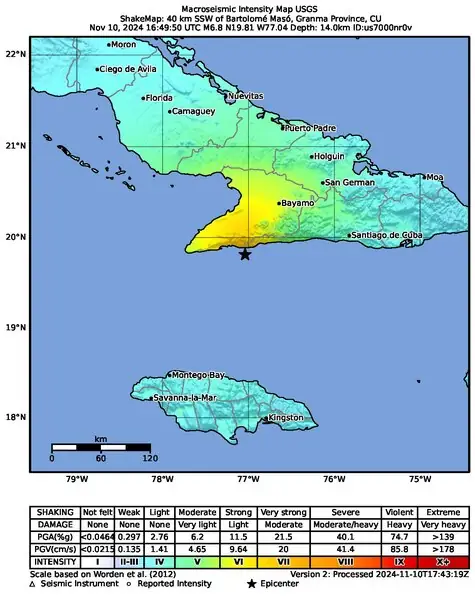
At least 7 people, including 2 minors, were injured, over 2 000 homes were damaged and 26 were destroyed.
CENAIS reported over 2 000 damaged homes and 26 destroyed, as well as structural impacts on 30 healthcare facilities and 40 educational institutions, as of November 13. The seismic event also triggered a series of over 1 130 aftershocks over the next 48 hours, with 47 of them felt in areas like Pilón in Granma.
More than 12 000 people were left without power.
By November 17, the number of damaged homes rose to 5 116 and the number of destroyed to 28. In addition, 474 public buildings, a dock, and the Faro Vargas lighthouse were damaged.
The quake severely impacted the municipalities of Pilon, Media Luna, and Campechuela. Pilon experienced the worst effects, including house collapses, cracked walls, and fallen ceiling tiles in key facilities such as the Comandante Félix Lugones Hospital. A 5-year-old girl and a 48-year-old woman sustained injuries.
Santiago de Cuba was impacted to a lesser extent but still recorded structural damage to 234 homes, mostly involving compromised walls, roofs, and ceilings.
According to CENAIS, around 172 earthquakes were recorded across Cuba between November 21 and 22. Of these, 160 occurred in the Pilón-Chivirico area, ranging from M1.1 to M4.0. In Santiago-Bacano, 11 earthquakes ranging from M0.8 to M2.1 were recorded, while one M2.3 event was recorded at Moa Purial.
An M4.2 earthquake was felt across Granma and Santiago de Cuba on Tuesday, November 19. Another M4.0 earthquake occurred on Thursday, November 21, with the epicenter located 19 km (11.8 miles) southeast of Pilón.
According to Enrique Diego Arango Arias, head of the National Seismological Service, it is normal to experience aftershocks following a significant seismic event, and these could persist for weeks or even months.
“The aftershocks result from the adjustment of the rupture zone and are generally smaller than the main event,” he explained.
Authorities have urged citizens to remain calm and follow safety protocols, such as seeking safe locations for shelter and avoiding weakened structures.
References:
1 Sismicidad- Parte Diario – CENAIS – November 22, 2024

I am an Assistant Editor and Severe Weather & Science Journalist at The Watchers, specializing in real-time severe weather coverage, geophysical event reporting, and research-driven scientific analysis. You can reach me at rishav(at)watchers(.)news.

Commenting rules and guidelines
We value the thoughts and opinions of our readers and welcome healthy discussions on our website. In order to maintain a respectful and positive community, we ask that all commenters follow these rules.