
Imelda strenghtens into a hurricane after killing 2 in Cuba
Hurricane Imelda formed over the Atlantic on September 30, 2025, after 2 fatalities were confirmed in Cuba due to heavy rain and flooding in the Santiago de Cuba and Guantánamo. Imelda is now the fourth hurricane of the season, following Hurricane Humberto which continues to send dangerous rip currents to the U.S. East Coast.
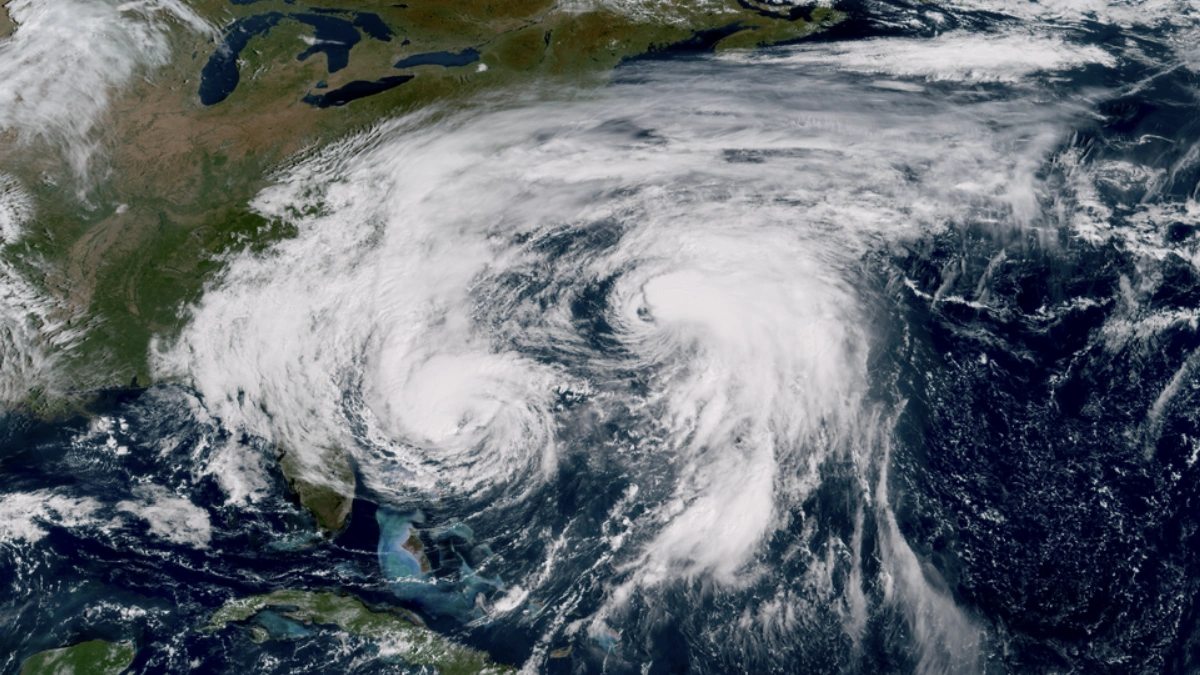
Satellite image of Hurricane Imelda and Hurricane Humberto at 15:00 UTC on September 30, 2025. Credit: NOAA/GOES-West, RAMMB/CIRA, The Watchers
Imelda intensified into the fourth hurricane of the 2025 Atlantic hurricane season on the morning of September 30.
At 08:00 EDT (12:00 UTC) on September 30, Imelda was located roughly 290 km (180 miles) north of Great Abaco Island, and 1 215 km (755 miles) west-northwest of Bermuda. Maximum sustained winds (averaged over 1-minute) reached 120 km/h (75 mph).
The system was moving northeastward at 11 km/h (7 mph), with an estimated minimum central pressure of 980 hPa. The general northeastward motion is forecast to continue through October 30, before it begins to move away from the Bahamas and U.S. Coast on October 2, and quickly approach Bermuda.
Cuban Prime Minister Manuel Marrero said late on September 29 that two people died due to Imelda’s impacts in eastern Cuba. Marrero said the two people died in Santiago de Cuba and Guantánamo provinces. However, details of the fatalities were not provided.
The media reported that a 60-year-old man died in Santiago de Cuba, the island’s second-largest province, when his house collapsed due to rainfall and a landslide on September 28. Meanwhile, the details of the second death remain unknown.
Apart from the two, one person was reported dead in Florida after getting pulled into the ocean by rip currents generated from the interaction of Humberto and Imelda.
 Image credit: Gobierno Provincial del Poder Popular Santiago de Cuba
- Image credit: Gobierno Provincial del Poder Popular Santiago de Cuba
- Image credit: Gobierno Provincial del Poder Popular Santiago de Cuba


Rainfall totals of over 100 mm (4 inches) were recorded in multiple regions, with extreme accumulations reaching 500 mm (20 inches) in Hatibonico, in the Guantánamo Valley, through September 28.
Up to 340 mm (13.4 inches) of rainfall was recorded in La Campana, while 330 mm (13 inches) was recorded in Tele-correo Aserrado, in 24 hours between September 28 and 29.
The capital city of Santiago de Cuba recorded around 250 mm (10 inches) of rain, triggering floods and landslides that cut off 17 communities. More than 24 000 people live in these affected communities.
In Guantánamo, another impacted province, more than 18 000 people have been evacuated, according to reports from the state-run Caribe television channel.
Both provinces have closed all educational institutions “until further notice” due to the ongoing rain.
Rail access to the capital of Santiago de Cuba was cut off after floods damaged the tracks in one section.
In the Bahamas, power outages have been reported in some areas of the northwest, while mandatory evacuation orders were issued for some islands over the weekend.
Flights to and from the Bahamas were canceled, with airports expected to reopen when weather conditions improve.

A Hurricane Watch is in effect for Bermuda, with hurricane-force winds expected across the island through October 1. Around 51 to 102 mm (2-4 inches) of rainfall is forecast over Bermuda on October 1 and 2, as the storm passes near the island.
Rainfall totals of up to 25 to 51 mm (1-2 inches) with locally higher totals of 100 mm (4 inches) being expected across coastal areas of southeast North Carolina through the night of September 30.
Minor coastal flooding is possible in areas of onshore winds over the Southeastern U.S. coastline. Water levels could rise by 30 to 60 cm (1 to 2 feet) in areas including Volusia/Brevard County Lines, and Florida to the South Santee River, South Carolina.
Swells generated by Hurricane Imelda and Hurricane Humberto are affecting the Bahamas and are currently spreading to much of the U.S. East Coast. The swells are likely to cause life-threatening surf and rip current conditions.
References:
1 Hurricane Imelda Intermediate Advisory Number 15A – NHC – September 30, 2025

I am an Assistant Editor and Severe Weather & Science Journalist at The Watchers, specializing in real-time severe weather coverage, geophysical event reporting, and research-driven scientific analysis. You can reach me at rishav(at)watchers(.)news.

Commenting rules and guidelines
We value the thoughts and opinions of our readers and welcome healthy discussions on our website. In order to maintain a respectful and positive community, we ask that all commenters follow these rules.