
Category 3 Hurricane Melissa makes landfall over Santiago de Cuba, Cuba
Hurricane Melissa made landfall along the southern coast of eastern Cuba early on Wednesday, October 29, 2025, as a Category 3 hurricane with maximum sustained winds near 195 km/h (120 mph).

Satellite image of Hurricane Melissa making landfall over Santiago de Cuba, Cuba at 0710 UTC on October 29, 2025. Credit: NOAA/GOES-19, RAMMB/CIRA, The Watchers
Melissa made landfall in the Cuban province of Santiago de Cuba near the city of Chivirico at 03:10 EDT (07:10 UTC) on October 29 with maximum sustained winds (averaged over 1-minute) reaching 195 km/h (120 mph)
At the time of landfall, the storm was located 30 km (20 miles) east of Chivirico and 95 km (60 miles) west-southwest of Guantanamo. Melissa had an estimated minimum central pressure of 952 hPa, as it moved northeastward at 17 km/h (20 mph).
Storm surge heights were forecast to be 2.4 to 3.7 m (8–12 feet) above normal tide levels near and east of the landfall area, accompanied by large, destructive waves. Minor coastal flooding was also expected along the north coast of eastern Cuba.
Observation data from Leeward Point Field, Guantánamo Bay, recorded sustained winds of 61 km/h (38 mph) and gusts up to 111 km/h (69 mph) as the outer eyewall approached.
Local authorities activated emergency shelters and ordered evacuations in low-lying and landslide-prone areas. The Cuban Meteorological Institute (INSMET) and Civil Defense urged residents to remain sheltered until official all-clear messages are issued.

Before reaching Cuba, Melissa impacted Jamaica as a Category 5 hurricane with maximum sustained winds of 295 km/h (185 mph), causing severe flooding, structural damage, and power outages.
Melissa was the strongest storm to hit Jamaica since records began in 1851. Nearly 15 000 people were in shelters in Jamaica, and some 540 000 customers, or 77%, were without power, officials said.
Local rainfall totals reportedly reached up to 600 mm (about 24 inches), with widespread power outages and road washouts across southern and eastern parishes.
In total, Melissa is blamed for at least 15 fatalities, 1 missing person, and over 28 injuries, as of early October 29.

Hurricane conditions are forecast to reach the southeastern and central Bahamas later today, while Bermuda remains under a Hurricane Watch, with tropical-storm conditions possible by Thursday night, October 30.
In Haiti, heavy rain and tropical-storm conditions will persist through Wednesday, with an additional 50 to 150 mm (2–6 inches) of rainfall expected.
Forecast models show Melissa accelerating northeastward through Thursday as it interacts with a mid-latitude trough over the southeastern United States.
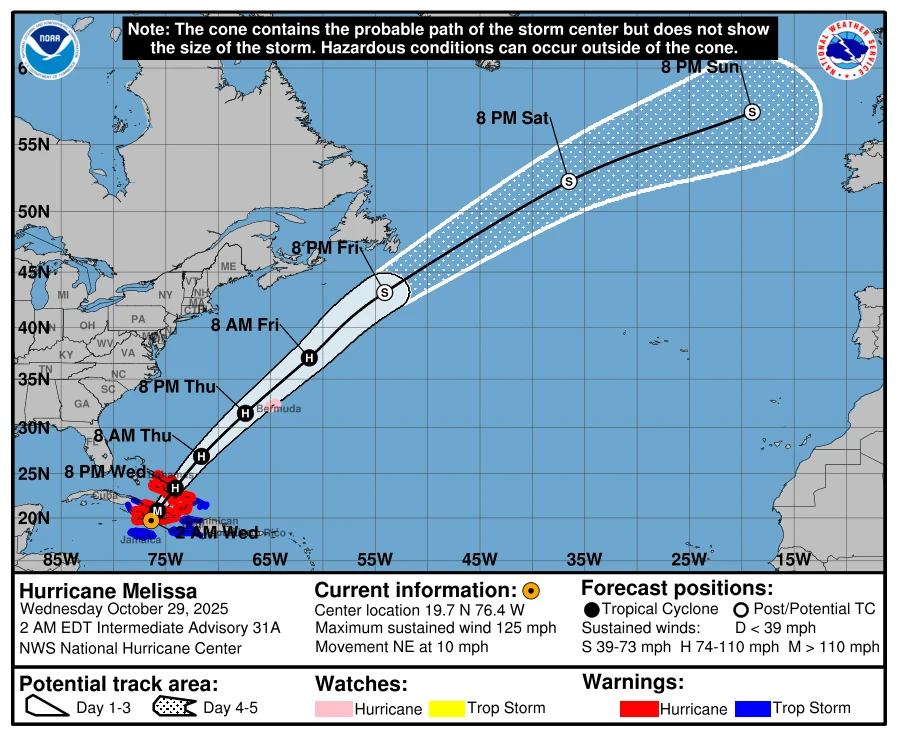
The storm’s core will continue across eastern Cuba through this morning, pass over the southeastern and central Bahamas later today, and approach Bermuda by Thursday night.
Gradual weakening is expected after crossing Cuba due to terrain interaction and increasing vertical wind shear, but Melissa is forecast to remain a powerful hurricane over the Atlantic before transitioning to an extratropical system within about 72 hours.
References:
1 Hurricane Melissa Tropical Cyclone Update – NHC – October 29, 2025

Rishav Kothari is Editor-in-Chief of The Watchers, where he runs the newsroom and covers earthquakes, volcanoes, severe weather and space weather.
Published in the last 24 hours
- In September 1859, a solar storm lit up the night sky so brightly that gold miners in the Rocky Mountains woke up after midnight and started cooking breakfast, convinced the aurora glowing over their camp was the sunrise Epicenter
- A patch of warm Pacific water that could become the strongest El Niño in more than 70 years sits thousands of miles from any American town, yet it is already the main reason NOAA expects a wetter winter across the South and a milder one across the North
- A 19-year-old Nebraska teacher reportedly tied her pupils together with twine and led them to safety through a blizzard in January 1888 Epicenter
- NASA built the Opportunity rover to last 90 days on Mars, and Martian winds helped keep it alive for nearly 15 years by blowing dust off its solar panels, until a planet-wide dust storm in 2018 blocked sunlight and silenced the rover Epicenter
