
Deep and larger-than-average Antarctic ozone hole 2021
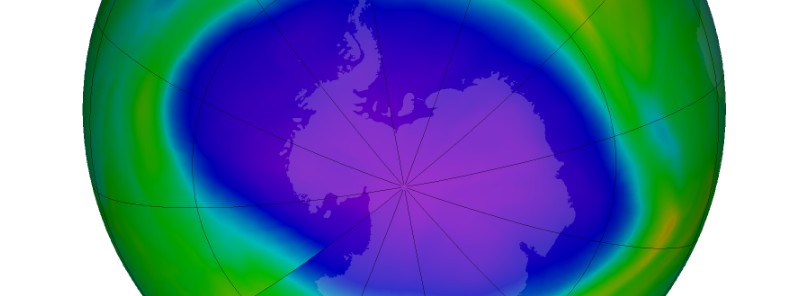
Image credit: NASA/GSFC, OzoneWatch
This year's ozone hole over the southern hemisphere is again deep and larger-than-average due to the colder than usual winter atmosphere over the region. It reached its maximum area on October 7 and ranked as the 13th largest since 1979, according to NASA and NOAA.
NASA satellite observations determined the ozone hole in 2021 reached a maximum of 24.8 million square kilometers (9.6 million square miles), before beginning to shrink in mid-October.1
On October 7, NOAA scientists recorded a total-column ozone concentration of 102 Dobson units, the 8th-lowest level since 1986. Prior to the emergence of the ozone hole in the 1970s, average ozone above the South Pole in September and October ranged from 250 to 350 Dobson units.
At altitudes between 14 and 21 km (8 and 13 miles) ozone was nearly completely absent during the ozone hole’s maximum.

False-color view of total ozone over the Antarctic pole on October 7, 2021. The purple and blue colors are where there is the least ozone, and the yellows and reds are where there is more ozone. Credit: NASA/GSFC, OzoneWatch
Ozone is a gas made up of three oxygen atoms (O3). It occurs naturally in small (trace) amounts in the upper atmosphere (the stratosphere).2
Ozone protects life on Earth from the Sun’s ultraviolet (UV) radiation. In the lower atmosphere (the troposphere) near the Earth’s surface, ozone is created by chemical reactions between air pollutants from vehicle exhaust, gasoline vapors, and other emissions. At ground level, high concentrations of ozone are toxic to people and plants.
References:
1 Substantial Antarctic ozone hole in 2021 – EO
2 NASA Ozone Watch – GSFC

Teo Blašković founded The Watchers in 2011 and edited it until 2026, covering seismic and volcanic activity, extreme weather, space weather and near-Earth objects. Articles on this page are his archive.
Earlier reporting
Nothing on Watchers was published in the last 24 hours. These are older articles.
- On October 22, 2017, a single flash of lightning stretched 515 miles from eastern Texas to near Kansas City, a distance that takes eight hours to drive, and nobody realized how far it had gone until scientists went back through the satellite data years later Epicenter
- CPC posts a slight risk of heavy rain from the Gulf Coast to the Northeast urban corridor November 25-29, and a moderate risk of West Coast wind and Sierra snow on November 25
- Florida's east coast faces a moderate flash flood risk Wednesday through Friday, with 4 to 8 inches of rain forecast and the St. Johns River near Cocoa already in major flood at 17.13 feet
- Cyclone Akvan to make landfall between Nellore and Visakhapatnam around noon on November 20, IMD forecasts 120-130 km/h winds gusting to 145

As above, so below. Science demanding people be faith based with mix and match vaccines, science can now prey to Government/Pharma to solve this. There must be huge grants for testing on and killing helpless animals before testing on and killing helpless humans….
It’s not even a hole, just a thinning……..supposedly …..how would we know?, probably
a hoax like the virus, scare people, make huge money…………..
Like idiot algore, said the ice caps would all be melted by now……….
I would think with the big industrial shut down due to weather and and other problems in China, and the world-wide industry problems from Covid Sars 2 the air pollution would have been a lot lower than recent years.
Also massive back-up and non-movement of cargo between China and US should mean lower pollution one would think.
As usual, they pay no attention to the influence of solar activity and the magnetic behavior of the earth.