
Tropical Storm “Hagibis” to make landfall in southeastern China
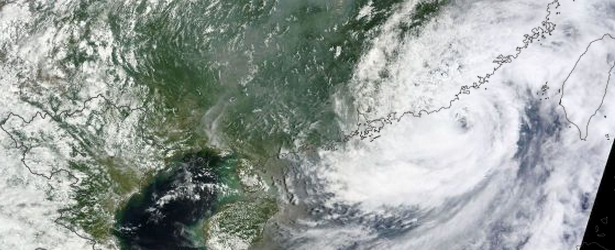
Image credit: NASA - Terra / MODIS on June 15, 2014.
Chinese authorities issued a blue level alert (lowest, 1 out of 4) on Saturday, June 14, as Tropical Storm "Hagibis" approached southeastern China. Hagibis is expected to make landfall late on Sunday, June 15, along the Guangdong Province coast and move near the city of Shantou.
Torrential rains and storms started affecting eastern areas of Guangdong, southern Fujian and southern Taiwan late on Saturday.
According to latest warning issued by Joint Typhoon Warning Center (JTWC) at 09:00 UTC today, Tropical Storm "Hagibis" was located approximately 153 NM (283 km, 176 miles) east-northeast of Hong Kong, and has tracked northward at 07 knots (12.9 km/h, 7 mph) over the past six hours.
Maximum significant wave height at 06:00 UTC today was 16 feet (4.8 meters). Maximum sustained winds were 40 knots (74 km/h, 46 mph), with wind gusts of 50 knots (92 km/h, 57.5 mph).

Tropical Storm "Hagibis" forecast track on June 15, 2014. Image credit: JTWC

Tropical Storm "Hagibis" – multispectral satellite image on June 15, 2014. Image credit: JTWC/SATOPS

Teo Blašković founded The Watchers in 2011 and edited it until 2026, covering seismic and volcanic activity, extreme weather, space weather and near-Earth objects. Articles on this page are his archive.
Earlier reporting
Nothing on Watchers was published in the last 24 hours. These are older articles.
- Cyclone Akvan to make landfall between Nellore and Visakhapatnam around noon on November 20, IMD forecasts 120-130 km/h winds gusting to 145
- Bay of Bengal system to become Cyclone Akvan, landfall forecast between Nellore and Tuni on November 20, India
- Tropical Cyclone Xavier reaches Category 2 over Northern Cook Islands, gale warning for Manihiki and Rakahanga
- On October 22, 2017, a single flash of lightning stretched 515 miles from eastern Texas to near Kansas City, a distance that takes eight hours to drive, and nobody realized how far it had gone until scientists went back through the satellite data years later Epicenter
