
Over 1 000 homes flooded as Tropical Storm Fung-wong brings extreme rainfall to Taiwan
More than 8 300 people were evacuated across 11 counties and cities in Taiwan as Tropical Storm Fung-wong approached landfall on November 12, 2025. The storm brought intense rainfall to the island’s eastern regions, with over 1 000 homes flooded in Yilan County and at least 51 injuries reported.

Satellite image of Tropical Storm Fung-wong near Taiwan at 09:50 UTC on November 12, 2025. Credit: JMA/Himawari-9, RAMMB/CIRA, The Watchers
Taiwan’s disaster-response authorities evacuated more than 8 300 people across 11 counties and cities as Tropical Storm Fung-wong approached landfall on the island on November 12.
Early counts on November 11 listed about 3 000 evacuees; updated figures from the National Fire Agency increased this number to 8 326 people later on November 12.
The largest evacuations occurred in the eastern counties of Hualien and Yilan, where steep terrain and previous flood events have made residents particularly vulnerable. Civil defense teams moved residents from low-lying and landslide-prone zones to temporary shelters established in schools and community centers.
Unofficial reports indicate between 720 and 1 060 mm (28 to 41.7 inches) of rainfall in Yilan. Su’ao recorded 130.5 mm (5.1 inches) in one hour, 334 mm (13.1 inches) in three hours, and 648 mm (25.5 inches) in 24 hours, flooding more than 1 000 homes and submerging streets under chest-high water. Emergency crews conducted several high-water rescues as drainage channels overflowed.
At least 51 people were injured in rain- and flood-related incidents as the storm’s outer bands reached Taiwan, according to the National Fire Agency.
Schools and government offices were closed across much of southern and central Taiwan, including in Kaohsiung, Tainan, Taichung, Pingtung, Chiayi, and Miaoli, while Taipei continued normal operations.
According to the CWA, as of 08:00 UTC on November 12, the storm was located about 80 km (50 miles) west of Eluanbi and moving northeast at 23 km/h (14 mph), expected to accelerate to 43 km/h (27 mph) with a central pressure of 998 hPa.
Maximum sustained winds reached 65 km/h (40 mph) with gusts up to 90 km/h (56 mph). The storm’s 54 km/h (34 mph) wind radius extended 120 km (75 miles).
It was forecast to be 320 km (200 miles) east-northeast of Hualien by 13:00 UTC as it tracked toward the East China Sea.
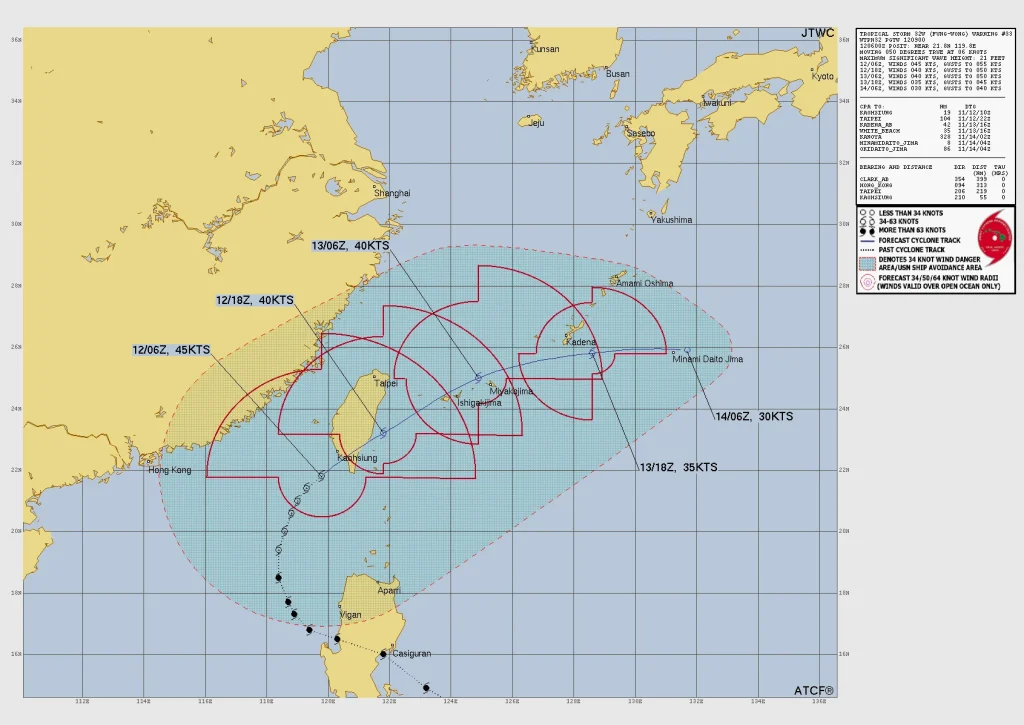
According to the Joint Typhoon Warning Center (JTWC), as of 09:00 UTC on November 12, Fung-wong was located about 80 km (50 miles) west of Eluanbi, Taiwan.
The system was moving northeast at 11 km/h (7 mph) with maximum sustained winds of 83 km/h (52 mph) and gusts up to 102 km/h (63 mph). Central pressure was estimated at 998 hPa, and significant wave heights reached 6.4 m (21 feet).
Fung-wong was forecast to make landfall near Kaohsiung within six hours, skirt Taiwan’s southern coast, and re-emerge over the sea toward the southern Ryukyu Islands before dissipating into a frontal boundary within 48 hours.
Land warnings were issued for Nantou, Chiayi, Pingtung, Tainan, Taitung, Hualien, and Kaohsiung, while sea warnings covered the Bashi Channel, Pratas Islands, Taiwan Strait, and offshore areas of Taiwan. Residents and marine operators were advised to expect strong winds, heavy rainfall, and rough seas.
Heavy rainfall from the storm caused the Matai’an barrier creek to overflow into Mingli Village in Wanrong Township on November 11. The creek had overflowed earlier on September 23, due to the effects of Super Typhoon Ragasa claiming at least 14 lives in Hualien County.
The Central Weather Administration (CWA) forecast that Fung-wong would make landfall or skirt Taiwan’s southern coastline later in the day before moving toward the Pacific.
According to the CWA, heavy rainfall was the main hazard from the storm. A persistent northeasterly monsoon interacting with the storm system intensified precipitation on the island’s eastern side, leading to locally extreme rainfall totals.
Coastal regions could see offshore wave heights reaching 3–5 m (10–16 feet).
Fung-wong has already caused significant damage in the Philippines, where authorities reported 25–27 deaths and widespread flooding before the system moved northward.
The Central Weather Administration maintained heavy rain and strong-wind advisories for 11 counties, urging residents to avoid mountain streams and coastal areas.
Emergency crews remained on alert for post-storm landslides as the system moved offshore, and residual rain bands lingered over the island’s east.

I am an Assistant Editor and Severe Weather & Science Journalist at The Watchers, specializing in real-time severe weather coverage, geophysical event reporting, and research-driven scientific analysis. You can reach me at rishav(at)watchers(.)news.

Commenting rules and guidelines
We value the thoughts and opinions of our readers and welcome healthy discussions on our website. In order to maintain a respectful and positive community, we ask that all commenters follow these rules.